

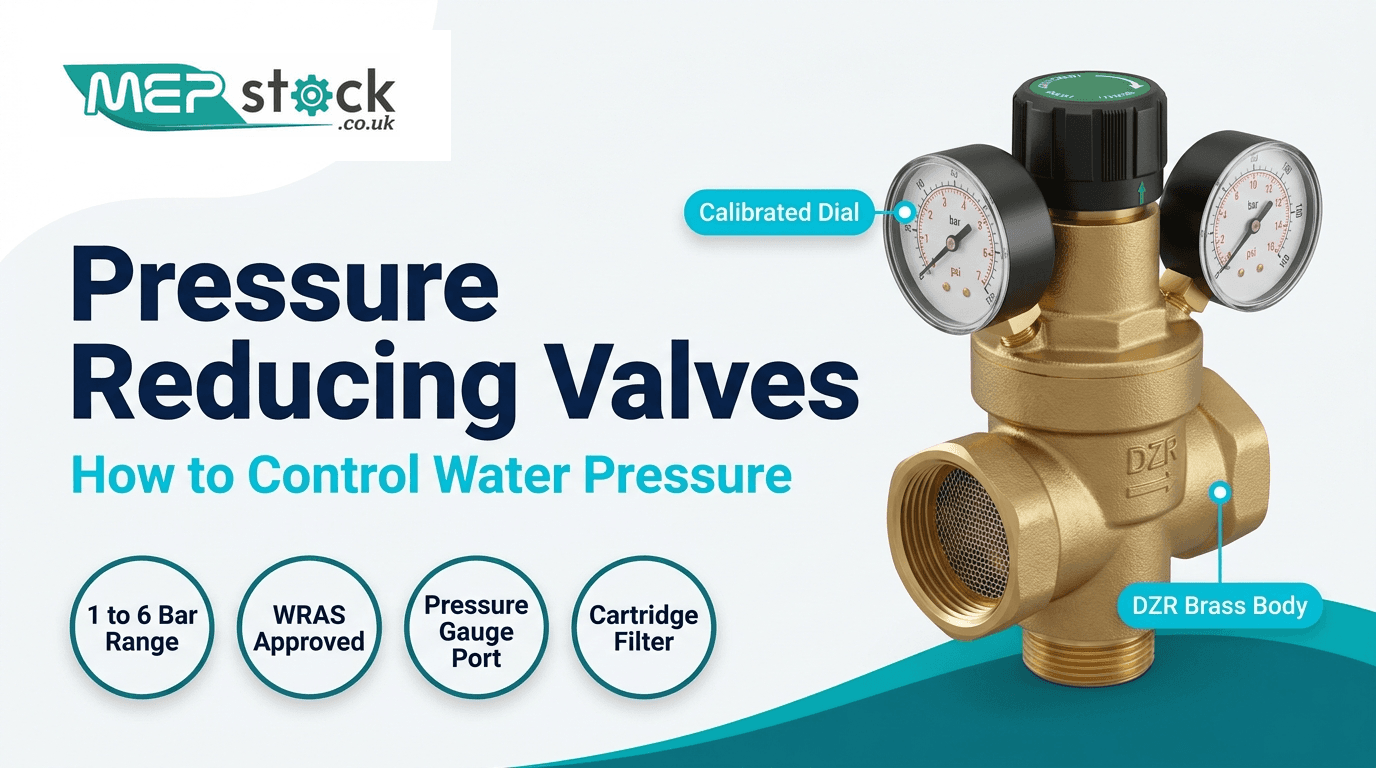
Quick Trade Summary: Pressure Reducing Valve (PRV) Sizing
A Pressure Reducing Valve (PRV) protects domestic pipework, unvented cylinders, and boiler heat exchangers from excessive municipal water mains pressure:
- Standard Setting: UK domestic unvented hot water cylinders and plumbing systems are calibrated to operate at a dynamic pressure of 3.0 to 3.5 bar. Incoming mains exceeding 5.0 bar must be stepped down.
- Sizing: Use 15mm PRVs for standard 1–2 bathroom flats; 22mm PRVs for 3+ bathroom family homes; and 28mm PRVs for light commercial plant rooms.
- Integrated Pressure Gauge: Always install PRVs with an attached 0–10 bar pressure gauge port to enable instant dynamic vs static pressure diagnosis.
Water pressure is an important part of any plumbing system. Too little pressure can affect showers, taps and other outlets, while excessive pressure can put unnecessary stress on pipework, fittings, valves and connected equipment.
A pressure reducing valve (PRV) helps manage this problem by reducing higher incoming water pressure to a controlled downstream pressure. For domestic, commercial and other plumbing installations, choosing a suitable pressure reducing valve can help maintain more consistent pressure and protect compatible components within the system.
One option available from MEP Stock is the Pressure Reducing Valve with Compression – 15mm / 22mm – 1–6 Bar. With an adjustable pressure range and compression connections, it is designed for applications where controlled water pressure is required and the appropriate pipe size and operating conditions match the product specifications.
This guide explains what pressure reducing valves do, how they work, what 1–6 bar means, the difference between 15mm and 22mm connections, and the factors to consider when selecting a PRV for a plumbing installation.
What Is a Pressure Reducing Valve?
A pressure reducing valve is a mechanical valve used to reduce and regulate water pressure within a plumbing system.
Water entering a building or section of a plumbing system can have a higher pressure than the downstream components require. A PRV reduces this pressure to a selected level and helps maintain a more controlled downstream pressure as conditions change.
A typical pressure reducing valve contains a valve mechanism, spring and diaphragm or similar internal components. The valve responds to downstream pressure and adjusts the flow through the valve to help maintain the selected pressure.
The exact construction varies between products, so the manufacturer's technical information should always be checked before installation.
Why is pressure regulation important?
Different plumbing components are designed to operate within particular pressure ranges. If pressure becomes excessive, it can contribute to problems such as:
Increased stress on pipework and fittings
Noisy plumbing systems
Unwanted flow at outlets
Greater strain on certain appliances and components
Water hammer in some installations
Leakage where existing components or joints are unable to cope with the conditions
A PRV provides a way of managing pressure where the incoming supply is higher than the required downstream pressure.
How Does a Pressure Reducing Valve Work?
A pressure reducing valve works by using a sensing mechanism to respond to downstream pressure.
When water flows through the valve, the internal mechanism regulates the opening of the valve. If downstream pressure falls, the valve can open further to allow more water through. When downstream pressure reaches the set level, the valve restricts the flow to help maintain the desired pressure.
The basic process can be understood in three stages:
1. High-pressure water enters the valve
The incoming supply enters the PRV at the upstream pressure.
For example, the incoming pressure could be higher than the pressure required by the plumbing system downstream.
2. The valve regulates the flow
The internal mechanism responds to downstream pressure and adjusts the valve opening.
This reduces the pressure delivered to the downstream side.
3. Controlled pressure leaves the valve
Water leaves the valve at a regulated pressure according to the valve's adjustment and operating conditions.
The result is a more controlled water supply for the connected plumbing system.
It is important to remember that a pressure reducing valve is not simply an on/off valve. Its purpose is to regulate pressure rather than merely stop or allow water flow.
What Does 1–6 Bar Mean on a Pressure Reducing Valve?
The 1–6 bar specification refers to the adjustable pressure range of the MEP Stock product.
A bar is a unit used to measure pressure. In plumbing applications, bar is commonly used to describe water pressure.
The ability to adjust the valve between 1 and 6 bar means the required setting can be selected within that range, subject to the product's specifications and the requirements of the installation.
For example, an installation may require a lower regulated pressure than another system. An adjustable PRV gives the installer the ability to set the downstream pressure rather than using a fixed pressure setting.
Why does the correct pressure setting matter?
The correct pressure setting depends on the plumbing system, connected equipment, manufacturer's requirements and applicable installation guidance.
Setting a PRV unnecessarily high may not provide the intended pressure reduction. Setting it too low could affect the performance of outlets or equipment that require a particular operating pressure.
The valve should therefore be adjusted according to the requirements of the specific installation.
15mm vs 22mm Pressure Reducing Valve Connections
Pipe size is one of the key considerations when selecting a pressure reducing valve.
The MEP Stock product is specified for 15mm / 22mm applications. These sizes are commonly encountered in plumbing installations, but the correct connection must always be confirmed against the existing pipework and the valve's product specifications.
15mm connections
15mm pipework is widely used in domestic plumbing applications, including certain water supply runs and connections to individual fixtures.
A compatible 15mm connection can make the valve suitable for installations where the existing pipework uses this size.
22mm connections
22mm pipework is also common in domestic and commercial plumbing systems, particularly where a larger water flow may be required.
If the existing pipework is 22mm, the appropriate connection configuration should be selected and checked before installation.
Why pipe size matters
The valve connection needs to match the installation correctly.
Before purchasing a pressure reducing valve, check:
Existing pipe diameter
Valve connection type
Required flow rate
Available installation space
Upstream pressure
Required downstream pressure
Manufacturer specifications
Selecting a valve solely because it has the correct nominal pipe size is not enough. The complete operating requirements should be considered.
What Are Compression Fittings?
The MEP Stock pressure reducing valve uses compression connections.
Compression fittings are mechanical pipe connections that use components such as a compression nut and olive to create a sealed connection around compatible pipework.
One advantage of compression connections is that they can provide a practical method of connecting compatible pipework without requiring the same joining process associated with soldered fittings.
For an installation using compression connections, the installer should ensure that the pipe, fitting and valve are compatible and that the manufacturer's installation instructions are followed.
Are compression fittings suitable for every installation?
No.
The suitability of a compression connection depends on factors including:
Pipe material
Pipe dimensions
Valve specifications
Operating pressure
Temperature
Installation environment
Applicable regulations and manufacturer instructions
Always check compatibility before installation.
When Do You Need a Pressure Reducing Valve?
A PRV may be appropriate when the incoming water pressure is higher than the pressure required by the downstream plumbing system or connected equipment.
Some common situations include:
Domestic water systems
A pressure reducing valve can be used where incoming supply pressure needs to be controlled before water reaches parts of a domestic plumbing system.
This can help provide a more suitable pressure for compatible fixtures and components.
Commercial plumbing systems
Commercial buildings can have different pressure requirements depending on the building design, number of outlets and connected equipment.
Pressure regulation can be an important part of designing and maintaining these systems.
Protecting compatible components
Some plumbing components have specified maximum operating pressures.
Where incoming pressure exceeds the appropriate operating conditions, a suitable PRV may be used to reduce the downstream pressure.
The valve must still be correctly selected for the application.
Systems with variable incoming pressure
Where supply conditions vary, an adjustable pressure reducing valve can provide a means of setting the downstream pressure within the valve's specified adjustment range.
What Problems Can High Water Pressure Cause?
High water pressure does not necessarily mean that a plumbing system will immediately fail. Problems can develop over time depending on the system design, component condition and operating conditions.
Potential issues associated with excessive pressure can include:
Stress on pipework and fittings
Higher pressure places greater force on the plumbing system.
Joints, valves, fittings and other components need to be suitable for the operating pressure.
Increased leakage risk
Where joints or components are already worn or compromised, excessive pressure can contribute to leakage.
A PRV may help manage pressure, but it cannot compensate for damaged pipework or defective fittings.
Noise
Excessive flow velocity and pressure can contribute to unwanted noise in some plumbing installations.
The cause of noise should always be investigated rather than assuming pressure is the only issue.
Appliance and equipment pressure requirements
Some appliances and plumbing equipment have specified pressure limits.
The manufacturer's requirements should be checked before connecting equipment to a regulated or unregulated supply.
How to Choose the Right Pressure Reducing Valve
Choosing a PRV involves more than selecting the cheapest or smallest valve available.
Consider the following factors before purchasing.
1. Inlet pressure
Determine the pressure entering the valve.
The PRV must be suitable for the expected upstream pressure.
2. Required outlet pressure
Identify the pressure required downstream.
The selected valve should provide the appropriate adjustment range for the application.
The MEP Stock model offers a 1–6 bar adjustable range, making the specified product suitable for applications that fall within that range, subject to its other technical requirements.
3. Pipe size
Check whether the installation uses compatible 15mm or 22mm pipework.
Do not assume that a nominal pipe size alone confirms compatibility.
4. Connection type
The MEP Stock model uses compression connections.
Check the pipe material and connection requirements before installation.
5. Flow requirements
Pressure and flow are not the same thing.
A valve may regulate pressure while the actual flow available to an outlet depends on several factors, including pipe size, upstream conditions, downstream demand and the valve's flow characteristics.
6. Temperature
Check the operating temperature range of the valve against the intended application.
7. Installation environment
Consider where the valve will be installed and whether the location provides sufficient access for adjustment, inspection and maintenance.
Pressure Reducing Valve vs Pressure Relief Valve
Pressure reducing valves and pressure relief valves perform different functions.
Pressure reducing valve
A pressure reducing valve is designed to reduce and regulate downstream pressure.
It is installed to control pressure supplied to the downstream side of the system.
Pressure relief valve
A pressure relief valve is generally designed to release pressure when it reaches a specified level.
Its purpose and operation are different from those of a PRV.
These two valve types should not be treated as interchangeable.
The correct valve depends on the purpose of the installation and the requirements of the system.
How Should a Pressure Reducing Valve Be Installed?
Installation should be carried out by a suitably qualified person in accordance with the manufacturer's instructions and applicable plumbing requirements.
Before installation, check:
Flow direction
Pipe size
Connection compatibility
Maximum inlet pressure
Required outlet pressure
Operating temperature
Available access
Manufacturer's installation instructions
The valve should be installed in the correct orientation and adjusted to the appropriate pressure for the system.
A pressure gauge may also be useful when setting and checking pressure, depending on the installation.
Why checking the flow direction matters
Many pressure reducing valves have a defined direction of flow.
Installing a valve incorrectly can prevent it from operating as intended.
Look for the flow-direction marking on the valve and follow the manufacturer's installation instructions.
How Do You Adjust a Pressure Reducing Valve?
The adjustment mechanism varies between PRV designs.
For an adjustable valve, the installer normally adjusts the mechanism to increase or decrease the downstream pressure.
The pressure should be measured using a suitable pressure gauge rather than relying solely on the position of the adjustment mechanism.
For the MEP Stock 1–6 bar pressure reducing valve, the required setting should remain within the specified adjustment range and be appropriate for the installation.
After adjustment, the system should be checked to confirm that the desired downstream pressure is being maintained under the relevant operating conditions.
Common Pressure Reducing Valve Problems
Like any mechanical plumbing component, a PRV can experience problems if it is incorrectly installed, contaminated, damaged or used outside its intended operating conditions.
Pressure remains too high
Possible causes can include:
Incorrect adjustment
Valve installed incorrectly
Debris affecting the internal mechanism
Valve unsuitable for the application
Pressure measured incorrectly
The valve and installation should be inspected rather than simply increasing or decreasing the adjustment.
Pressure is too low
Possible causes may include:
Incorrect adjustment
Insufficient upstream pressure
Blockage
Excessive downstream demand
Incorrect valve selection
Again, the complete system should be checked.
Pressure fluctuates
Fluctuating pressure can have several causes.
These may include changes in demand, supply pressure variations, valve condition or other issues elsewhere in the plumbing system.
A pressure gauge can help identify what is happening before adjustments are made.
How Can You Maintain a Pressure Reducing Valve?
Regular inspection can help identify problems before they become more significant.
Depending on the installation, maintenance may include:
Checking for leaks
Inspecting connections
Checking the downstream pressure
Looking for signs of corrosion or damage
Checking for unusual noise
Inspecting the valve after plumbing work
Following the manufacturer's maintenance recommendations
If a valve begins behaving differently from normal, investigate the cause rather than repeatedly changing the pressure setting.
Is a Pressure Reducing Valve Suitable for Domestic Plumbing?
A suitable PRV can be used in domestic plumbing applications where pressure regulation is required, provided the valve is correctly selected for the system.
The important considerations include:
Incoming pressure
Required downstream pressure
Pipe size
Connection type
Flow requirements
Temperature
Manufacturer requirements
Applicable plumbing regulations
The 15mm / 22mm Pressure Reducing Valve with Compression – 1–6 Bar from MEP Stock can be considered where its specifications match the requirements of the installation.
Where Can You Buy a 15mm / 22mm Pressure Reducing Valve?
MEP Stock supplies plumbing and heating products for trade and professional applications.
The Pressure Reducing Valve with Compression – 15mm / 22mm – 1–6 Bar is designed for installations requiring adjustable pressure regulation within its specified range.
You can view the product here:
Pressure Reducing Valve with Compression – 15mm / 22mm – 1–6 Bar
Before ordering, check the product specifications against your installation requirements, including pipe size, pressure range and connection compatibility.
Frequently Asked Questions
What is a pressure reducing valve used for?
A pressure reducing valve is used to reduce and regulate water pressure downstream of the valve. It can help provide a controlled pressure suitable for compatible plumbing systems and components.
What does a 1–6 bar pressure reducing valve mean?
It means the valve has an adjustable pressure range of 1 to 6 bar, subject to the product's operating specifications. The appropriate setting depends on the requirements of the plumbing installation.
What size pressure reducing valve do I need?
The correct size depends on the pipework, required flow, inlet pressure, downstream pressure and the valve's connection specifications. The MEP Stock product is specified for 15mm / 22mm applications.
What is the difference between 15mm and 22mm pipe?
15mm and 22mm refer to different pipe sizes used in plumbing systems. The correct size depends on the existing pipework and the requirements of the installation.
Can a pressure reducing valve be adjusted?
Many pressure reducing valves are adjustable. The MEP Stock model has a specified 1–6 bar adjustment range. Always adjust the valve according to the manufacturer's instructions and the requirements of the system.
Does a pressure reducing valve increase water pressure?
No. A pressure reducing valve is designed to reduce and regulate pressure. If the incoming pressure is already too low, installing a PRV will not increase the available supply pressure.
Is a pressure reducing valve the same as a pressure relief valve?
No. A PRV regulates and reduces downstream pressure, while a pressure relief valve is designed to release pressure when it reaches a specified level. They serve different purposes.
Do pressure reducing valves need maintenance?
They may require inspection and maintenance depending on the installation and manufacturer's recommendations. Checking for leaks, pressure changes, damage and unusual operation can help identify potential problems.
Can I use a pressure reducing valve on 15mm pipe?
A valve specified for compatible 15mm pipework may be suitable, provided all other installation requirements are met. Always check the valve's specifications and connection compatibility.
Can I use a pressure reducing valve on 22mm pipe?
A valve specified for compatible 22mm pipework may be suitable where the rest of the application meets the product requirements. Check the manufacturer's specifications before installation.
Final Thoughts
A pressure reducing valve is an important component when water entering a plumbing system needs to be reduced and controlled to a suitable downstream pressure.
Selecting the right PRV means looking beyond the name of the product. Pipe size, connection type, inlet pressure, required outlet pressure, flow requirements and operating conditions all need to be considered.
The Pressure Reducing Valve with Compression – 15mm / 22mm – 1–6 Bar available from MEP Stock provides an adjustable pressure range and compression connections for compatible plumbing applications.
If you are looking for a 15mm or 22mm pressure reducing valve, review the product specifications and confirm that they match your installation requirements before ordering.
View the Pressure Reducing Valve with Compression – 15mm / 22mm – 1–6 Bar at MEP Stock
Recommended Pressure Reducing Valves & Gauges
15mm Pressure Reducing Valve with Gauge
Adjustable 1 to 6 bar DZR brass PRV with 15mm compression ends and top-mounted pressure gauge.
22mm High-Flow Pressure Reducing Valve
High-capacity pressure regulator designed for unvented hot water cylinders and whole-house incoming mains.