

Quick Installer Summary
Essential trade rules for circulating pump isolation and zero-drain replacement:
- Standard Geometry: Standard UK domestic heating circulators (Grundfos UPS3, UPM3, Wilo Yonos PARA) feature 1½″ BSP male threaded ports and connect to pipework via a pair of dedicated pump isolation valves.
- Pipe Sizing: Use 22mm compression ends for domestic heating circuits and underfloor heating (UFH) blending packs; use 28mm compression ends for modern boiler primary circuits, heat pumps, and high-volume unvented cylinder feeds.
- Valve Selection: Choose quarter-turn ball type pump valves for all new installations and pump replacements. They deliver full-bore flow, never seize from magnetite deposition, and provide immediate, reliable isolation. Reserve multi-turn gate type valves strictly for like-for-like historic matching.
- Port-to-Port Spacing: Standard domestic circulating pumps measure 130mm (UFH manifolds and compact heat packs) or 180mm (traditional boiler airing cupboards). When replacing a 180mm unit with a modern 130mm pump, bridge the 50mm deficit with a 1½″ MxF long pump valve adaptor without re-soldering or altering existing copper pipework.
- Zero-Drain Swaps: Tight shut-off on both pump valves allows a full circulating pump replacement in under 15 minutes, preserving chemically treated system water, avoiding airlock refilling cycles, and preventing inhibitor dilution.
Pump valves are the dedicated pair of mechanical isolation valves installed directly upstream and downstream of a central heating or underfloor heating circulating pump. Each valve features an integrated captive 1½″ BSP union nut designed to mate directly with the pump housing ports, paired with either a 22mm or 28mm compression connection for direct jointing onto copper distribution pipework.
With a functioning pair of pump valves in place, replacing an aged or seized circulating pump requires less than 15 minutes and catches only a cupful of water in a tray. Without working isolation valves, swapping a circulator forces the engineer to execute a full system drain down, re-vent every radiator or manifold loop, clear severe airlocks, and dose fresh chemical inhibitor under BS 7593. Investing in a quality pair of brass pump valves at £4.16 to £6.47 each provides the most cost-effective installation insurance in the airing cupboard.
Quick answer: For modern domestic heating systems and underfloor heating manifolds, install a pair of 22mm ball type pump valves featuring 1½″ BSP captive union nuts. Fit 28mm pump valves on large heat pump or boiler primary circuits. When replacing an older 180mm pump with a modern 130mm circulator, screw a 1½″ male-to-female long pump valve adaptor into one port to bridge the 50mm gap instantly. Always replace the high-temperature EPDM union washers on every pump swap to prevent nuisance leaks.
Gate Type vs Ball Type Pump Valves: Operational Mechanics and Longevity
In domestic hydronic heating installations, pump isolation valves are manufactured in two distinct internal configurations: traditional multi-turn gate valves and modern quarter-turn ball valves. Understanding their mechanical differences is crucial for ensuring system reliability and preventing seized valves during emergency breakdowns:
| Feature | Gate Type Pump Valve | Ball Type Pump Valve |
|---|---|---|
| Operating Mechanism | Multi-turn brass handwheel or knurled wheel head driving a vertical brass wedge (gate). | Quarter-turn screwdriver slotted spindle or low-profile lever driving a chrome-plated brass ball. |
| Sealing Reliability | Prone to passing water over time. Magnetite sludge and limescale settle into the lower body recess, preventing full gate closure. | Positive, bubble-tight mechanical shut-off backed by resilient PTFE valve seats that wipe clean during rotation. |
| Flow Characteristics | Straight-through flow when fully open, but partial internal gate projection creates mild hydraulic turbulence. | Full-bore spherical passage with virtually zero hydraulic resistance or parasitic pressure loss (high Kv coefficient). |
| Seizure Resistance | Poor. Internal brass threads oxidize and scale over 3 to 7 years. Forcing a stuck handwheel frequently snaps the internal stem. | Exceptional. The smooth chrome ball encapsulated in Virgin PTFE resists limescale adherence and turns cleanly even after years of continuous service. |
| Flow Balancing / Throttling | Can be partially closed for coarse manual throttling, though modern modulating ECM pumps render this obsolete. | Strictly on/off service. Partial ball positioning induces seat erosion and cavitation whistling under high velocity. |
| Trade Application | Direct like-for-like replacement in heritage airing cupboards where pipe centres cannot be adjusted. | The industry-standard specification for new heating installations, boiler upgrades, and underfloor heating packs. |
| MEP Stock Price (ex VAT) | 22mm £4.90 • 28mm £6.47 | 22mm £4.16 • 28mm £5.20 |
Both valves are forged from heavy-duty DZR/CW617N brass, WRAS approved, and pressure-rated to PN16 (16 bar static working pressure at up to 110°C). However, for any modern installation or circulator upgrade, ball type pump valves represent the clear engineering choice: they cost less, preserve vital pump head pressure, and ensure that when a replacement pump is needed years down the line, the valves isolate fully without weeping.

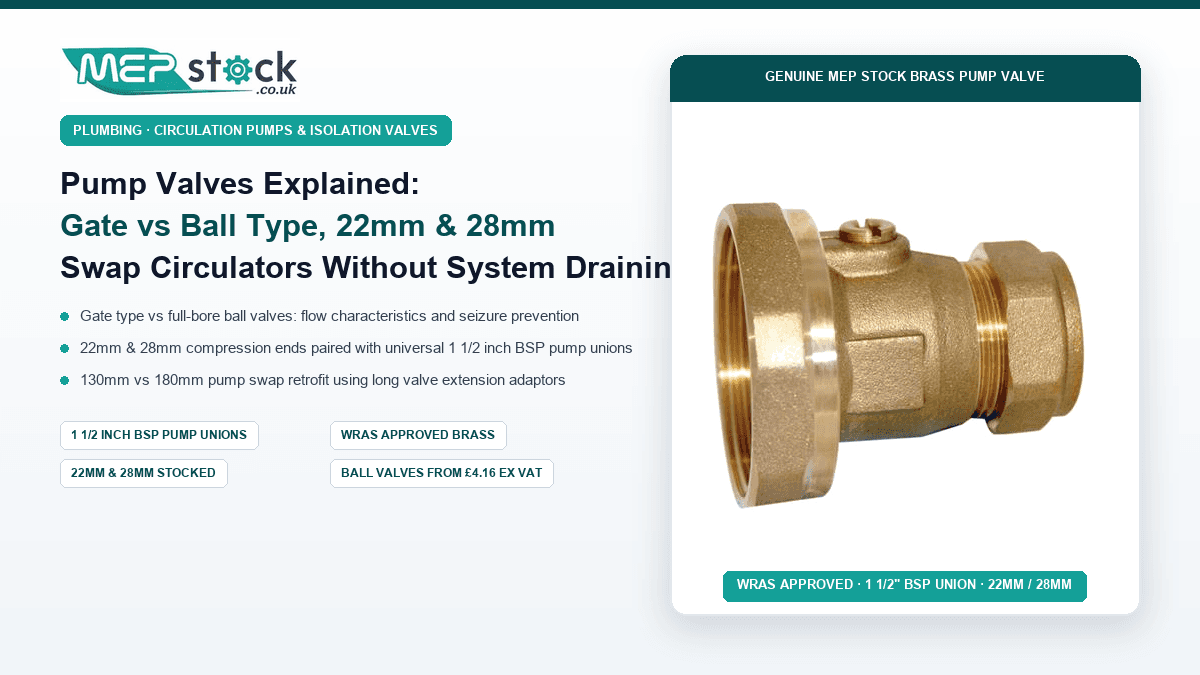
Brass Ball Type Pump Valve (22mm & 28mm)
Full-bore circulating pump isolation valve with captive 1½″ BSP union nut, Virgin PTFE ball seals, and quarter-turn slotted control. Eliminates seized gate stems and delivers 100% leak-tight shut-off. Includes high-temp washer seal.
Sizing Rules: 22mm vs 28mm Compression Ends with Universal 1½″ BSP Unions
A frequent point of confusion among apprentices and DIY renovators is the dual measurement system found on pump valves. Pump valves are specified with two distinct dimensions:
- The Compression End (22mm or 28mm): The male body connection that accepts standard BS EN 1057 copper tube via a compression nut and brass olive.
- The Pump Union Nut (1½″ BSP Parallel Thread): The captive female union nut that spins freely on the valve body and threads onto the male threads cast directly into the cast iron or stainless steel pump housing.
Critically, both 22mm and 28mm pump valves share the exact same 1½″ BSP union nut size. The physical dimensions of the pump volute connection do not change between domestic pipe sizes. The selection between 22mm and 28mm is determined entirely by system flow requirements and hydraulic design:
When to Specify 22mm Pump Valves
Domestic central heating circuits up to 18 kW output typically run on 22mm copper pipework. At typical domestic design temperature differentials (ΔT = 20°C on condensing boilers or ΔT = 11°C on older non-condensing systems), 22mm copper easily handles heating loads with flow velocities maintained under 1.0 m/s to prevent acoustic pipe noise. Underfloor heating blending manifolds also run almost universally on 22mm secondary pipe loops. In these setups, pair a standard 22mm pump valve on the boiler flow and another on the return.
When to Specify 28mm Pump Valves
Modern high-output systems (24 kW to 40+ kW), low-temperature air source heat pumps (ASHPs), and large unvented hot water cylinders require significantly greater volumetric flow rates. Because heat pumps operate at narrow temperature differentials (ΔT = 5°C), circulating water volume must roughly quadruple compared to a ΔT = 20°C boiler circuit to deliver equivalent heat:
Q = ṁ • Cp • ΔT ⇒ ṁ = Q / (Cp • ΔT)
Restricting primary heating flow through a 22mm neck before a high-output circulator introduces excessive hydraulic friction, increases pump energy consumption, and causes premature cavitation. Always specify 28mm pump valves on primary boiler runs and heat pump interfaces to ensure smooth, unchoked hydronic performance.
Bridging Port-to-Port Spacing: 130mm vs 180mm Pump Adaptors
When replacing an older domestic heating circulator, the physical length of the pump body between the union sealing faces is the single most critical dimensional check. In the UK, heating circulators are manufactured in two standard port-to-port lengths:
- 180mm Face-to-Face: The traditional standard dimension found on virtually all standalone domestic heating pumps installed over the past 40 years (including older Grundfos UPS 15-50/60, Myson, and Wilo Gold models).
- 130mm Face-to-Face: The compact modern standard utilized on integrated boiler assemblies, compact heat interface units (HIUs), and underfloor heating manifold blending control packs (such as the Grundfos UPM3 Auto/Flex).
Heating engineers frequently encounter situations where a replacement pump is sourced with a 130mm body length, but the existing pipework and pump valves are locked at a rigid 180mm spacing. Re-plumbing copper pipework in a confined airing cupboard can take hours and risks disturbing existing joints.
The solution is to install a 1½″ Male x Female Long Pump Valve Adaptor (£4.41 ex VAT). This precision-machined brass extension features a 1½″ BSP female union thread on one end that connects directly to the pump valve body, and a 1½″ BSP male thread on the other that seats into the pump union nut. Adding the 50mm extension makes up the exact dimensional difference between 130mm and 180mm without cutting pipe, draining down, or using blowlamps.
High-Efficiency Hydronic Circulators in Stock
Upgrade to ErP-compliant A-rated modulating circulation. From standalone 180mm boiler pumps to compact 130mm Grundfos UPM3 manifold units, MEP Stock supplies verified genuine hydronics with next-day UK dispatch.
Shop Pumps, Packs & Controls →Step-by-Step Trade Guide: How to Change a Circulating Pump Without Draining Down
Follow this trade-verified procedure to exchange a circulating pump swiftly while keeping the primary heating system fully charged:
Stage 1: Electrical Isolation and System Safety
Before touching hydronic components, isolate the heating system at the fused spur. Turn off both the boiler and programmer controls. Remove the 3A fuse or lock off the miniature circuit breaker (MCB). Use an approved two-pole voltage indicator to prove dead at the pump terminal box. Disconnect the electrical wiring (Live, Neutral, Earth, and any PWM speed control cables) noting cable polarities.
Stage 2: Isolate the Flow and Return Pump Valves
Close both pump isolation valves:
- For Ball Type Valves: Use a wide flathead screwdriver or adjustable spanner to rotate the control slot exactly 90 degrees until the slot lies perpendicular to the pipe centerline.
- For Gate Type Valves: Rotate the handwheel clockwise until firmly seated. Do not apply excessive cheater-bar torque to a stiff handwheel, as old brass gate spindles can shear inside the bonnet.
Stage 3: Controlled Depressurization and Union Disconnection
Position a shallow plastic catch tray and absorbent plumber's towels directly beneath the lower pump union. Using an adjustable spanner or water pump pliers (minimum 52mm jaw opening):
- Apply a holding spanner to the octagonal flats of the pump valve body.
- With a second spanner, carefully loosen the top 1½″ captive union nut by turning anti-clockwise. Allow trapped internal pressure and a small volume of water (typically 100 to 200 ml) to weep out.
- If water continues to flow under mains or head pressure without diminishing, one of the isolation valves is passing. Re-tighten the nut immediately. You must execute a partial drain down before continuing.
- If flow ceases, proceed to back off the lower union nut completely, then release the top union nut.
Stage 4: Pump Removal and Gasket Surface Prep
Carefully pull the old pump clear. Scrape away remnants of the degraded rubber or fiber union washers from both valve mating faces using a soft brass wire brush or utility blade. Never leave pitted, hardened gasket material on the sealing face, as surface imperfections guarantee persistent weeping under 2 bar operating pressure.
Stage 5: Installing the New Circulator and Fresh Gaskets
Insert fresh 1½″ pump valve washer seals (£0.18 ex VAT) into each union nut. Place the new pump into position, observing three vital physical orientation rules:
- Flow Direction: Check the cast directional arrow on the pump volute body to ensure it matches the system flow direction (towards radiators/manifold).
- Motor Shaft Orientation: The motor shaft must remain horizontal (parallel to the floor). Operating a wet-rotor pump with a vertical motor shaft traps air in the rotor can, resulting in dry bearing friction and rapid motor burnout.
- Terminal Box Position: Position the electrical terminal enclosure on the upper side or lateral flank of the pump—never facing downwards where condensation or union leaks could enter the electronics.
Tighten the 1½″ union nuts hand-tight. Using two spanners, tighten each nut a further ¼ to ½ turn until the EPDM gasket firmly compresses. Avoid extreme overtightening, which distorts the rubber washer into the water path.
Stage 6: Valve Opening, Hydronic Venting & Commissioning
Slowly reopen the pump valves:
- Open the return valve first to allow system water to push air upwards into the pump head.
- Open the flow valve second to equalize hydraulic pressure across both sides.
- On traditional pumps, loosen the large center chrome bleed screw on the motor face until water emerges, then retighten. On modern automated pumps (e.g. Grundfos UPM3 or Wilo Yonos PARA), activate the automatic de-aeration routine via the control button.
- Inspect both union faces and adjacent compression nuts with a dry tissue. Reconnect electrics, set the required differential pressure or proportional curve, and recheck joints after 15 minutes of thermal cycling.
Recommended Trade Hardware for Pump Swaps & Retrofits

Gate Type Pump Valve
Traditional wheel head brass gate valve with 1½″ captive union nut. Ideal for heritage airing cupboards.

1½″ Long Pump Adaptor
Bridges the 50mm deficit between 130mm modern circulators and 180mm fixed pipe gaps without pipe alteration.

1½″ Pump Valve Gaskets
High-density EPDM high-temperature washer seal. Essential prevention against nuisance post-installation drips.
Fitting Pump Valves for the First Time and System Filtration Protection
If an older heating system was installed without pump isolation valves, or if seized gate valves refuse to budge, you must execute a drain down to below the pump level. Cut out the rigid pipe section with a rotary pipe cutter, deburr the copper cleanly, and install fresh 22mm or 28mm ball type valves. Follow strict compression best practices: hand-tighten the compression nuts plus ½ turn with a spanner while bracing the valve body with a second wrench.
Hydronic System Protection (BS 7593 Compliance): When installing or replacing a circulating pump, always inspect upstream filtration. Circulating pumps rely on system water for wet-rotor bearing lubrication. Circulating black iron oxide (magnetite) sludge rapidly accumulates on the powerful permanent magnetic rotors found in modern ECM pumps, destroying bearings and jamming impellers. To safeguard the pump warranty, fit an inline magnetic filter or high-capacity brass strainer on the heating return immediately before the pump. Consult our comprehensive Y-Strainer and Heating System Filter Guide for sizing and micron mesh standards.
Pump Isolation on Underfloor Heating Manifolds
Underfloor heating installations utilize dedicated mixing shunts where high-temperature boiler or heat pump flow is blended with cooler return water via a thermostatic mixing valve. In pre-assembled manifold pump packs, the pump unions screw directly into the blending body and manifold header.
Where an auxiliary pump is installed remotely to circulate primary water from the plantroom to a distant UFH manifold, it must always be flanked by 22mm ball type pump valves. MEP Stock stocks genuine Grundfos UPM3 130mm Auto & Flex pumps along with fully assembled commercial manifolds in our underfloor heating product range.
Frequently Asked Questions About Pump Valves and Circulators
What is the primary function of a pump valve?
A pump valve is a dual-function plumbing fitting that combines a pipe compression connection on one side with a free-spinning 1½″ BSP captive union nut on the other. Fitted directly upstream and downstream of a heating circulator, pump valves allow the pump to be removed, inspected, or replaced in minutes without draining down the hydronic heating system.
Are pump valves 22mm or 28mm?
Pump valves are manufactured in both 22mm and 28mm compression sizes. 22mm is standard for domestic radiator heating circuits and UFH manifold blending packs. 28mm is specified for high-flow commercial boilers, heat pump interfaces, and primary hot water cylinder circuits. Both 22mm and 28mm versions carry the identical 1½″ BSP union nut to fit standard circulators.
Which is better: gate type or ball type pump valves?
Ball type pump valves are vastly superior for modern heating installations. They feature a full-bore spherical channel that maximizes flow, minimize friction head losses, and utilize Virgin PTFE seats that resist limescale and magnetite buildup. Gate valves tend to seize or weep over several years of service and can snap internally when forced.
Can I change a central heating pump without draining the system?
Yes, provided the pump is fitted with functional, tight-closing pump valves on both the flow and return ports. Simply isolate the electrics, close both valves (quarter-turn on ball valves, fully clockwise on gate valves), crack the union nuts to release residual water into a bowl, swap the pump body, insert new rubber gaskets, and tighten the unions.
How do I fit a 130mm pump into an existing 180mm pipe gap?
Do not alter or re-plumb the copper pipework. Instead, install a 1½″ Male x Female Long Pump Valve Adaptor (50mm extension). Screw the female union thread onto one of the existing pump valves and connect the pump to the adaptor's male thread using a fresh EPDM washer. This bridges the 50mm dimensional difference immediately.
Do pump valves require PTFE tape on the union threads?
No. Never apply PTFE tape or jointing compound to the 1½″ BSP union threads. The pump union joint is a mechanical face seal: the flat face of the valve compresses an EPDM rubber or composite fiber washer against the flat rim of the pump volute. Applying PTFE tape to the parallel threads prevents the nut from fully drawing the sealing faces together, causing water to bypass the gasket.
Order Brass Pump Valves & Hydronics Direct
Stock your van with trade-grade hydronic essentials. Ball type pump valves from £4.16, gate valves from £4.90, adaptors, and high-temp washers available with free UK delivery over £150.
Explore the Full Pump Valves Range →