

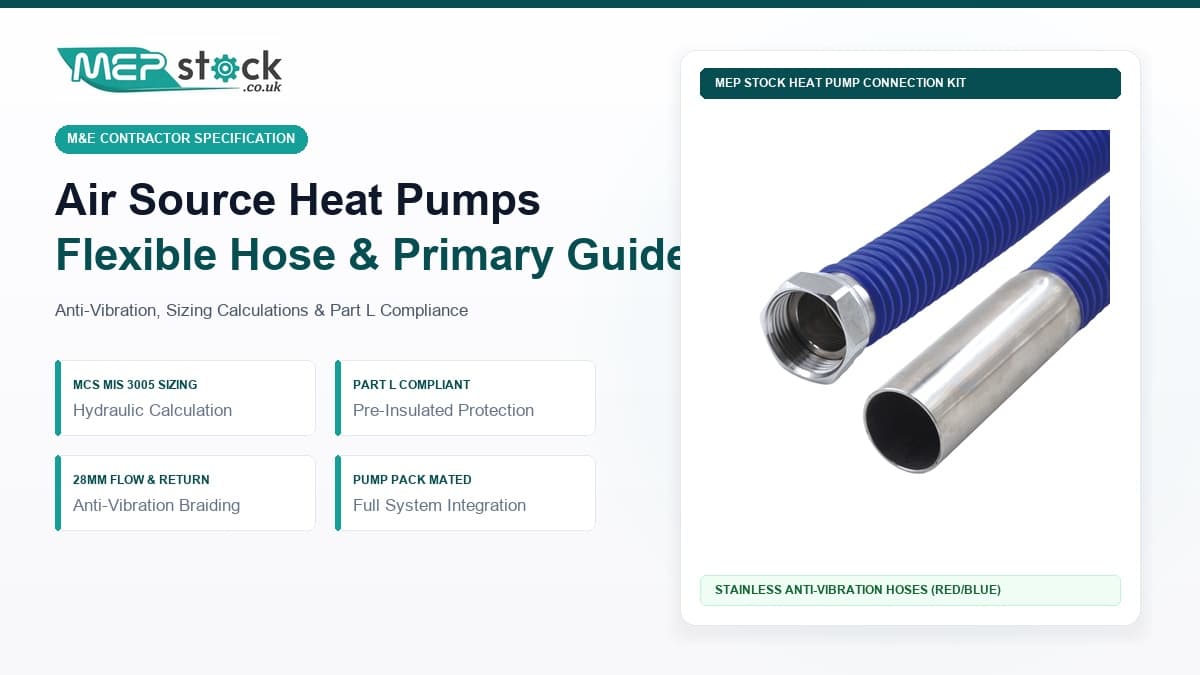
Quick Trade Summary: Heat Pump Primary Connection & Flexible Hose Sizing
For UK renewable heating engineers, MCS contractors, and M&E installers connecting outdoor monobloc Air Source Heat Pumps (ASHPs) to indoor buffer cylinders and manifolds:
- Acoustic & Vibration Decoupling: Monobloc outdoor units generate natural low-frequency vibrations from inverter compressors and axial fans. Rigid copper or plastic pipe connections transmit this mechanical resonance directly into the dwelling's structural fabric. Installing stainless steel braided flexible connection hoses at the outdoor unit flow and return isolates harmonic vibration, preventing structural noise complaints and protecting pipework solder/press joints from cyclic fatigue.
- Hydraulic Sizing (The Delta-T Factor): Because modern heat pumps operate on narrow design temperature drops (ΔT = 5K) compared to fossil boilers (ΔT = 20K), flow rates are nearly 4 times higher for identical kW outputs. Restricting primaries to 22mm causes high friction pressure drops and system lockouts. Standard domestic units (7kW to 14kW) mandate 28mm minimum primary pipework and full-bore 1" or 1¼" flexible hose kits.
- Part L & Weatherproofing Compliance: Under UK Building Regulations Part L, all external primary runs must feature high-efficiency UV-stable, weatherproof thermal insulation with factory vapor barrier seals to eliminate external thermal loss and prevent winter freeze burst risks.
Connecting an air source heat pump outdoor monobloc unit requires full-bore flexible stainless steel hoses (minimum 28mm / 1" BSP) with UV-stabilised external insulation, anti-vibration rubber mounting feet, full-bore isolation ball valves with integrated temperature gauges, an inline magnetic dirt separator, and a pre-assembled hydraulic pump mixing pack for low-temperature underfloor heating distribution.
Hydraulic Physics: Why Heat Pumps Require 4x Higher Flow Rates Than Boilers
The single most common mistake made by engineers transitioning from gas boilers to heat pumps is undersizing the primary flow and return pipework. The fundamental thermal energy transfer equation demonstrates why:
Where Q is thermal output in kW, m is mass flow rate (kg/s), Cp is the specific heat capacity of water (approx. 4.187 kJ/kg·K), and ΔT is the design temperature difference between flow and return.
- Traditional Gas Boiler System (ΔT = 20K): Delivering 12 kW of heat requires a flow rate of only 0.143 kg/s (8.6 litres per minute). A 22mm copper pipe carries this easily at a water velocity of ≈ 0.45 m/s with minimal hydraulic resistance.
- Modern Air Source Heat Pump (ΔT = 5K): Delivering that same 12 kW at the high seasonal efficiency (SCOP > 3.6) demanded by MCS MIS 3005 requires a massive flow rate of 0.573 kg/s (34.4 litres per minute).
Attempting to force 34.4 l/min through a 22mm pipe generates unacceptable fluid velocity (> 1.8 m/s), creating erosive pipe scour, loud hydraulic hiss, and enormous friction head loss (> 45 kPa) that will exceed the residual head capacity of the internal circulating pump, leading to high-pressure drop lockouts (error codes). 28mm or 32mm MLCP primaries are non-negotiable.
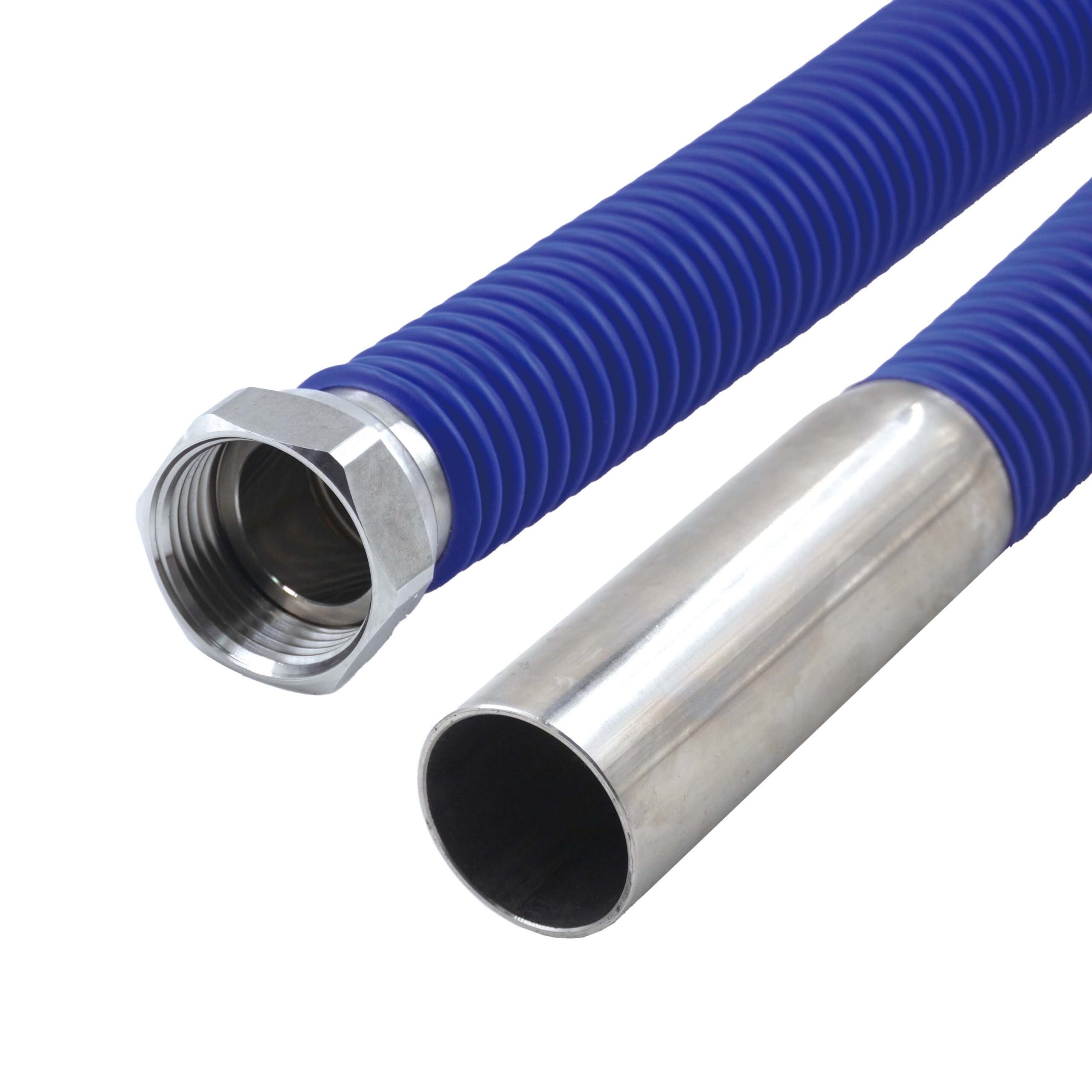
Heat Pump Stainless Steel Pipe Connection Kit - Red and Blue
Engineered specifically for outdoor monobloc heat pump primaries. High-grade AISI 304 stainless steel braided anti-vibration flexible hoses with colour-coded pre-lagged weather-resistant insulation. Protects the property from compressor hum and eliminates thermal loss.
View Heat Pump Connection Kit →Anti-Vibration Mechanics: Preventing Structural Noise Transference
An Air Source Heat Pump is an outdoor mechanical unit containing high-speed variable refrigerant flow (VRF) scroll compressors and high-volume fan blades. While modern inverter outdoor units boast sound power levels under 55 dB(A) in the open air, the physical vibration generated during high-load defrost cycles and sub-zero operation produces structural resonance if pipework is rigidly coupled.
Without flexible anti-vibration connection hoses:
- The rigid pipework acts as an acoustic soundboard, conducting compressor vibration directly through cavity walls and joists into living rooms and bedrooms.
- Ground settlement or thermal expansion stresses of external pipe runs place mechanical bending strain on the outdoor unit's internal brass heat exchanger connections, risking expensive refrigerant leaks.
Stainless steel braided flexible hoses absorb multidirectional vibration while maintaining internal full-bore geometry. When combined with rubber anti-vibration mounting feet, structural transmission is reduced by over 85%.

Ball Valve with Temperature Gauge Set (Red & Blue Pair)
Essential isolation set for heat pump primary circuits and UFH manifolds. Heavyweight DZR brass ball valves with integrated 0–80°C dial thermometers in the handles, allowing instant commissioning verification of design ΔT.
Shop Ball Valve Gauge Pair →System Integration: Blending Valves and Single-Room Pump Sets
When marrying an air source heat pump to underfloor heating, hydraulic separation and temperature modulation must be handled carefully. Under Part L, heat pumps achieve optimum SCOP (> 4.0) when running at 35°C to 40°C pure weather compensation directly into the manifold.
However, in hybrid retrofit installations or home extensions where the primary boiler or heat pump supplies mixed emitter circuits (such as upstairs radiators requiring 50°C and a new extension ground floor requiring 35°C), a local blending valve and pump set is mandatory.

Underfloor Heating Blending Valve & Pump Set (20–55°C)
Pre-assembled thermostatic blending control unit paired with an A-rated high-efficiency variable speed circulation pump. Accurately tempers high primary water to safe radiant floor levels while guaranteeing circuit circulation across multiple manifold loops.
View Blending Valve & Pump Set →
Single Room UFH Pump Pack System
The complete all-in-one heating solution for kitchen extensions, conservatories, and garage conversions up to 40m². Eliminates complex manifolds by connecting directly to existing heating pipework with thermostatic blending and pump control.
Shop Single Room Pump Pack →Best Practices: Installing Heat Pump Flexible Primaries
- Zero Torsional Twist (Dual-Spanner Method): Never allow a flexible braided hose to twist during tightening. Torsional twist stresses the inner EPDM core and leads to premature fatigue blowouts. Always use two spanners: one to brace the fitting body and the second to torque the swivel union nut.
- Adhere to Minimum Bend Radius: Maintain a gentle, natural curve. Never force a tight 90° radius on flexible hoses, as this reduces internal hydraulic bore and creates high-friction turbulence. If an abrupt right angle is required at the outdoor unit casing, install an approved full-bore copper press or brass elbow before connecting the flexible hose.
- Rigid Anchoring Inside the Building Envelope: Anchor the pipework securely to masonry as soon as it penetrates the external wall sleeve. The flexible hoses are designed to isolate outdoor unit vibration; if indoor pipework is left unsupported, it will act as a suspended pendulum.
- Continuous Sealed Insulation: Ensure the thermal insulation sleeves butt tight against the outdoor unit cabinet wall with waterproof vapor-seal tape. Exposed metal pipework outdoors causes severe standing heat loss in sub-zero winter ambient conditions.
Frequently Asked Questions
Why can't I connect rigid copper pipe straight to my heat pump?
Rigid pipework conducts mechanical motor and compressor vibration straight into the building's walls and floor timbers, causing structural droning noises. Furthermore, outdoor thermal expansion and natural ground movement will place cyclic fatigue strain on the unit's internal heat exchanger connections.
What size flexible hose do I need for a 12kW air source heat pump?
A 12kW heat pump operating at ΔT = 5K requires approximately 34 litres per minute. You must install a minimum of 28mm (1" full bore) flexible hoses and 28mm primary pipework. Using 22mm hoses will choke flow rates and trigger system pressure fault alarms.
Do heat pump flexible hoses require anti-freeze protection?
Yes. In monobloc heat pumps, heating water circulates outdoors through the unit and flexible hoses. To comply with BS EN 12831 and manufacturer warranties, the primary circuit must be dosed with approved propylene glycol inhibitor, or protected with mechanical anti-freeze valves (frost protection valves) that automatically dump water if outdoor temperatures drop below 3°C during a power cut.
Equip Your Next Heat Pump Installation with Genuine MEP Stock Parts
Get competitive trade pricing on stainless steel flexible connection kits, full-bore gauge ball valves, UFH pump packs, and pre-insulated pipe runs with reliable UK next-day delivery.
Shop Complete Underfloor Heating & Heat Pump Range →