

Quick Installer Summary
Essential trade rules for leak-free compression joints:
- Joint Mechanics: Tightening the nut compresses the soft brass olive into the fitting's internal cone and onto the pipe surface, creating a permanent metal-to-metal bite.
- Spanner Guidance: Hand-tighten until snug, then turn ½ to ¾ of a turn with a spanner for 15mm (approx. ½ turn for 22mm/28mm). Always brace the fitting body with a second spanner.
- Never Reuse Olives: An olive deforms permanently upon tightening; always install a fresh olive when refitting a joint.
- No PTFE on Olives: PTFE tape belongs on parallel BSP threads only, never over compression olives.
- Concealed Pipework: Compression joints are demountable mechanical joints under Water Regs Schedule 2 and NHBC 8.1; they must remain accessible via an inspection hatch.
A compression fitting joins copper or barrier plastic pipework without requiring an open blowlamp flame or high-tonnage hydraulic press tools. The assembly consists of three components: a forged brass body with machined internal conical seats, a soft brass olive (a compression ring that slides over the pipe), and a threaded compression nut. When tightened, the nut forces the olive into the body taper, crimping it into the outer diameter of the pipe to create a leak-tight mechanical seal.
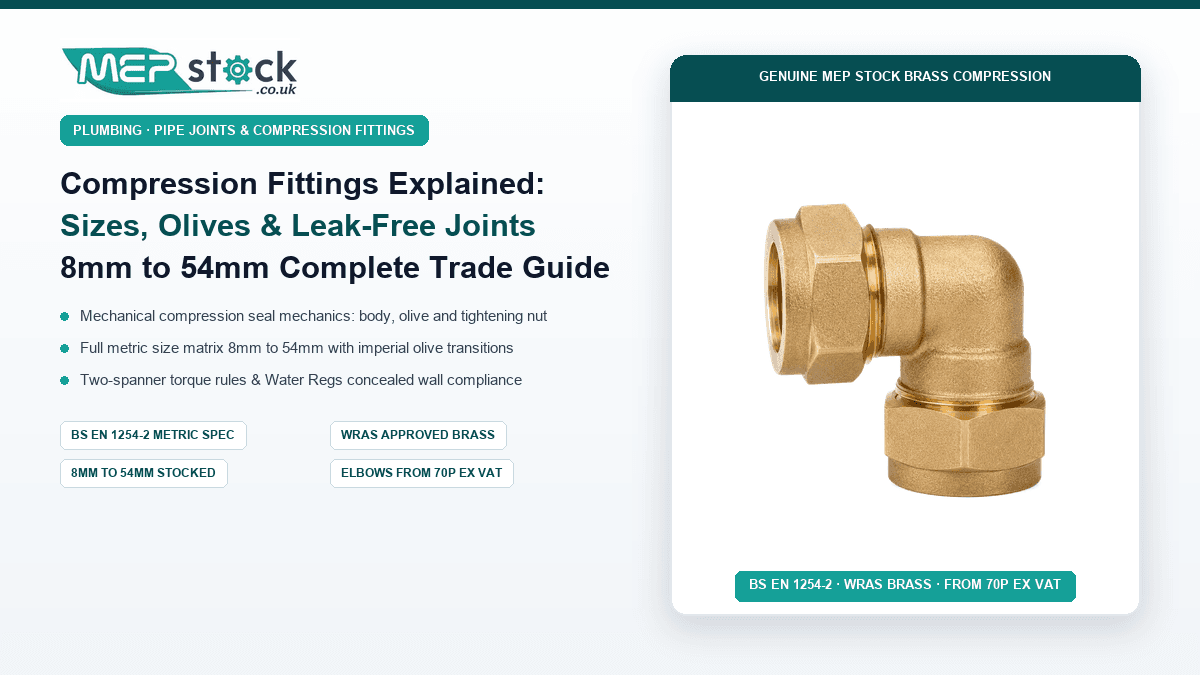
Because compression fittings are demountable and require only two adjustable spanners to install, they remain the preferred fitting for visible domestic pipework, boiler connections, radiator valves, and emergency repair work. MEP Stock's brass compression fittings range starts at 40p ex VAT for stop ends and 70p for 90-degree elbows, with chrome-plated versions available for exposed bathroom work.
Quick answer: Cut the copper pipe square with a rotary pipe slice, deburr internally and externally, slide on the nut followed by the olive, push the pipe fully to the internal body stop, tighten hand-tight, then turn ½ to ¾ turn with a spanner while bracing the body with a second spanner. Do not wrap PTFE around the olive, never reuse a crushed olive, and never seal a compression joint inside a wall or ceiling without an access hatch.
Metric Sizes: 8mm to 54mm and Typical Applications
Metric compression fittings conform to BS EN 1254-2, designed specifically for half-hard and hard copper tube manufactured to BS EN 1057. The following sizing table details common domestic and commercial trade uses:
| Size | Typical Application | Olive Pack of 20 (ex VAT) |
|---|---|---|
| 8mm | Microbore central heating circuits, oil lines | £1.32 |
| 10mm | Microbore heating, radiator tails, hob gas feeds | £1.76 |
| 12mm | Legacy heating systems, specialist plant equipment | £2.42 |
| 15mm | Hot and cold domestic distribution, radiators, sinks | £1.76 |
| 22mm | Mains water feeds, boiler flow & return, bath supplies | £3.08 |
| 28mm | Boiler primaries, unvented cylinder feeds, commercial loops | £4.62 |
| 35mm | Commercial heating primaries, multi-occupancy plant | £10.78 |
| 42mm | Commercial risers and plantroom headers | £15.84 |
| 54mm | Heavy commercial distribution mains and plant headers | £21.56 |
All nine sizes of brass and copper compression olives are stocked for immediate dispatch. When working on older pre-metric UK homes, imperial copper pipework (1/2", 3/4", 1") differs slightly in outside diameter. While 1/2" imperial is close enough to use a 15mm fitting with an imperial olive, 3/4" requires a 22mm fitting paired with a 3/4" olive, and 1" requires a 28mm fitting with a 1" olive. When transitioning between mismatched pipe sizes, our single-piece compression reducing sets provide a clean, compact step-down without compounding fittings.
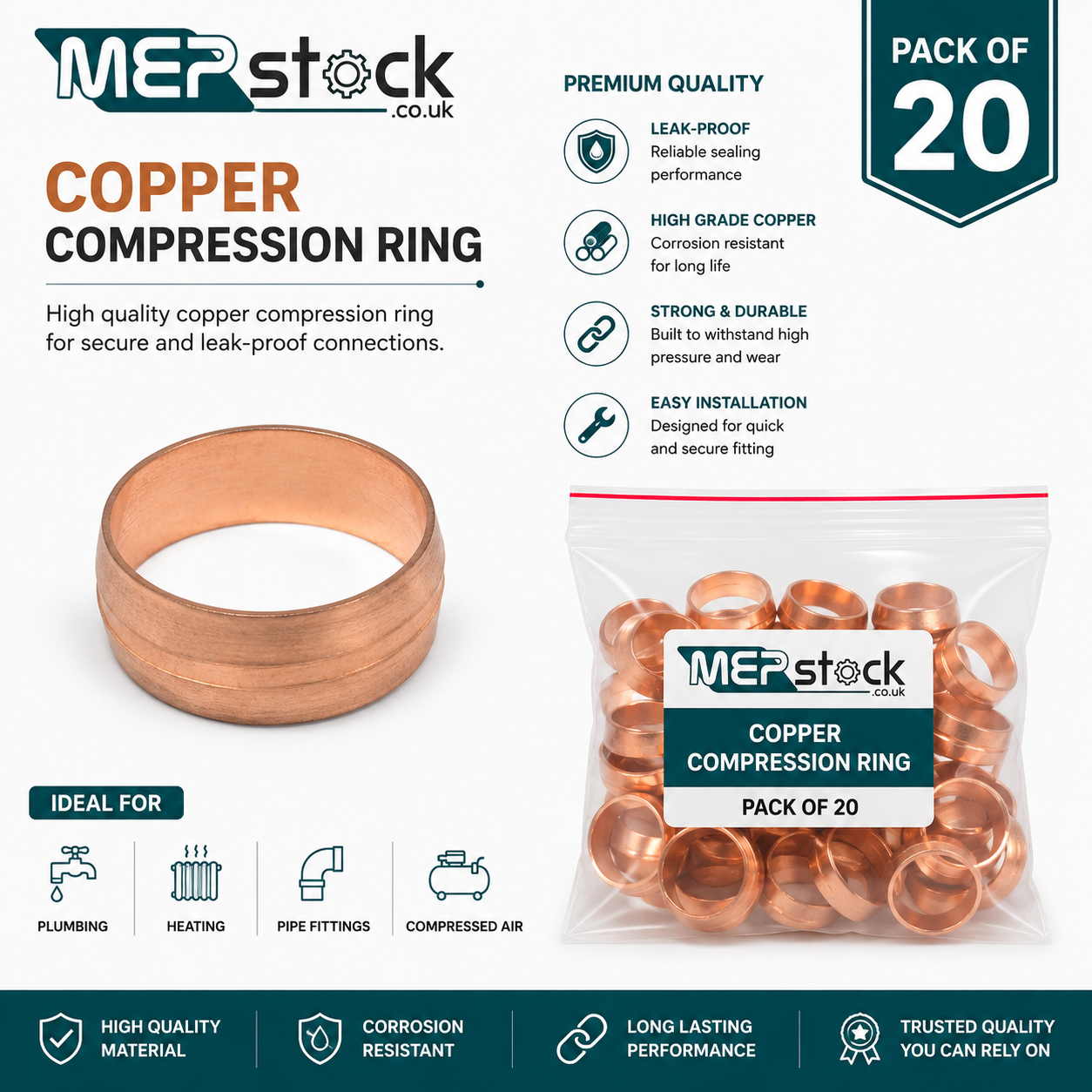
Copper Compression Olives (Pack of 20)
Premium BS EN 1254-2 annealed copper compression olives. Engineered to yield uniformly around copper tube without scoring or distorting pipe geometry. Essential replenishment stock for servicing valves, radiators, and domestic water circuits.
Order Olives Pack of 20 →Anatomy of a Compression Fitting
- Forged Brass Body: Features precision-machined internal tapered cones at each port. Elbows, equal tees, straight couplings, tap connectors, tank connectors, and stop ends share this identical internal cone geometry.
- Soft Brass Olive: A barrel-shaped copper alloy ring engineered to yield under torque. Because the olive compresses permanently around the pipe circumference, it can only form a reliable seal once and must never be reused.
- Compression Nut: Drives the olive down the taper as it threads onto the body. Replacement brass nuts (starting from 30p) allow fitting bodies to be reused indefinitely by replacing only the nut and olive.
Making a Reliable, Leak-Free Joint
- Cut Square: Always cut copper pipe using a rotary wheel tube cutter or pipe slice. Avoid hacksaws, which produce jagged, angled cuts that fail to seat against the internal stop.
- Deburr Internally and Externally: Remove external burrs that could score the olive's seating surface, and ream out internal burrs to eliminate hydraulic turbulence and noise.
- Sequence Nut and Olive: Slide the nut onto the tube first, followed by the olive, positioning it approximately 10mm back from the cut end.
- Push Home to the Internal Stop: Insert the pipe until it bottoms out firmly against the internal shoulder of the brass fitting body. Joints tightened on shallow insertions risk catastrophic blow-off under system pressure.
- Two-Spanner Tightening: Hand-tighten the nut until firm. Engage an adjustable spanner on the nut and apply ½ to ¾ of a turn for 15mm, and approximately ½ turn for 22mm and 28mm. Always brace the fitting body with a second spanner to prevent twisting the pipework or straining nearby joints.
- Avoid Over-Tightening: Crushing an olive by over-torquing distorts the brass ring and causes persistent weeping. If a joint seeps during testing, nip it by an ⅛ turn. If it continues to leak, disassemble, discard the olive, and remake the joint.
- Use Approved Compound, Never PTFE on Olives: PTFE tape belongs on parallel BSP threaded connections. On the olive itself, install clean and dry, or apply a thin smear of WRAS-approved jointing paste for additional seal integrity on potable water.
Application Guidelines: Where to Use and Building Regulations
Recommended Applications: Visible pipework, airing cupboards, plantrooms, under-sink waste connections, cistern float valves, radiator valves, and live system repairs where soldering torches or press tools cannot safely fit.
Concealed Pipework Restrictions: Under the Water Supply (Water Fittings) Regulations and NHBC Standards Section 8.1, compression joints are classified as demountable mechanical fittings that must remain accessible for inspection and maintenance. You must not seal compression fittings inside inaccessible screed floors, tiled partitions, or drylined ceiling voids without an access hatch. As detailed in our guide to press-fit vs push-fit vs compression in concealed walls, permanent M-profile copper press-fit fittings are the modern trade standard for inaccessible runs: no open flame, no demountable olive, and zero maintenance requirements.
Chrome or Brass? For visible decorative pipework in bathrooms and kitchens, chrome compression fittings provide an identical mechanical specification with a mirror-finish exterior. For a complete comparison across all joint types, read our in-depth analysis on press-fit vs solder vs compression fittings.
Working on Inaccessible Walls, Risers, or Under Screed?
Remember: Water Regs Schedule 2 prohibits demountable compression joints in inaccessible ceiling and wall voids without an inspection hatch. For zero-maintenance, flame-free permanent installations, switch to MEP Stock's WRAS-approved M-Profile Copper Press-Fit range—crimped in 5 seconds with 25-bar pressure rating.
Common Faults, Root Causes and Trade Fixes
| Fault | Root Cause | Remedial Fix |
|---|---|---|
| Weep from compression nut after torquing | Olive unseated, pipe not fully home, or scored tube | Nip nut by ⅛ turn. If leak persists, remake with fresh olive. |
| Joint blows off under mains pressure | Pipe not pushed to internal body shoulder stop | Remake joint ensuring full insertion depth and new olive. |
| Nut tight to thread limit but continues leaking | Over-tightened, olive crushed and ovalised | Cut pipe back, fit new olive, torque to correct spanner spec. |
| Leak on barrier plastic pipe | Missing manufacturer internal pipe insert sleeve | Always install pipe inserts; never compress bare plastic tube. |
| Leak at threaded tap connector end | Missing PTFE or damaged rubber/fibre washer on BSP thread | Seal the parallel male/female thread with PTFE or new washer. |
Recommended Trade Compression Fittings & Accessories
Essential trade-tested brass and chrome compression components stocked for immediate UK dispatch:
Copper Compression Olives
8mm to 54mm annealed copper olives for clean sealing without pipe distortion.
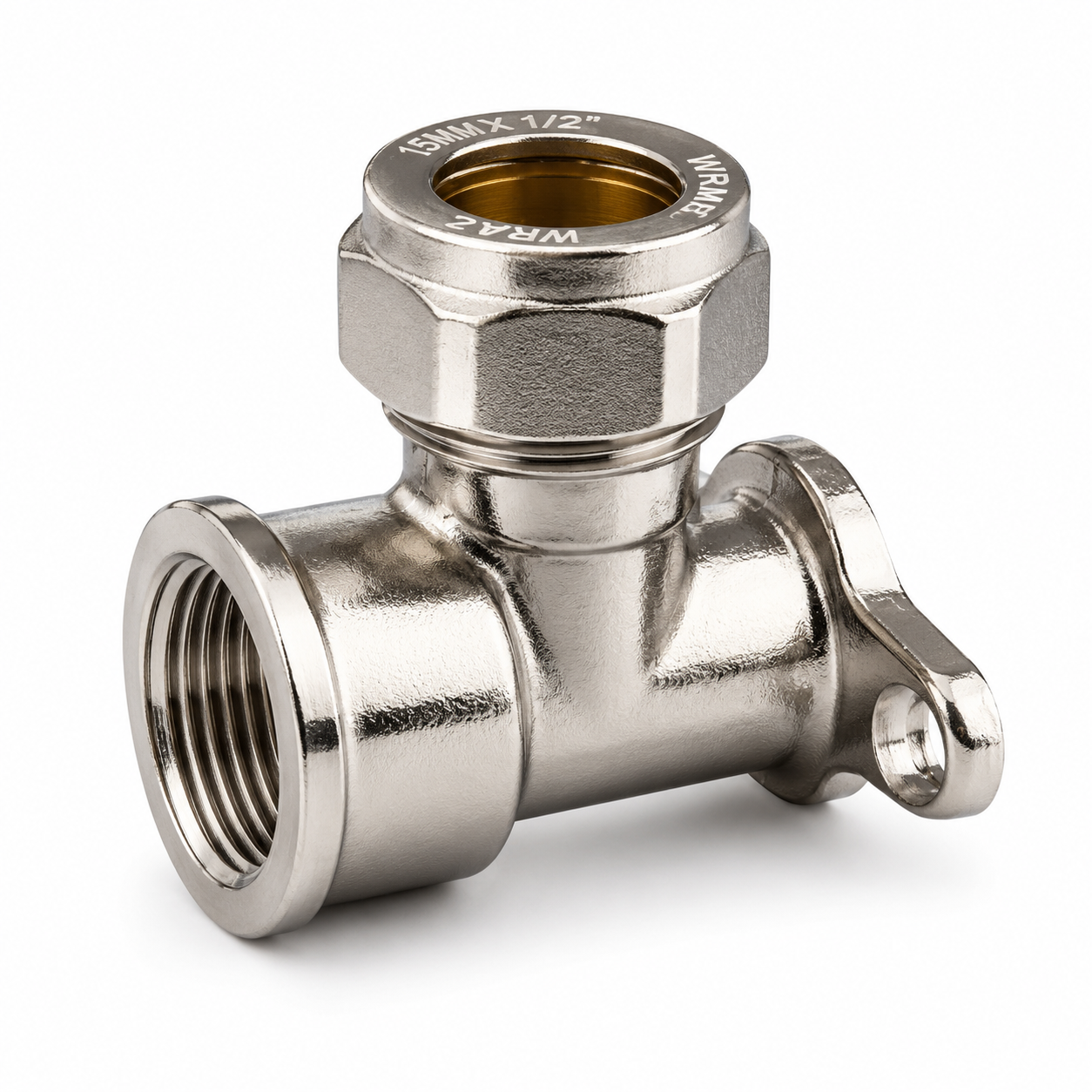
Chrome Wall Plate Elbow
15mm x 1/2" female backplate elbow in high-polish chrome for exposed radiator and shower tails.
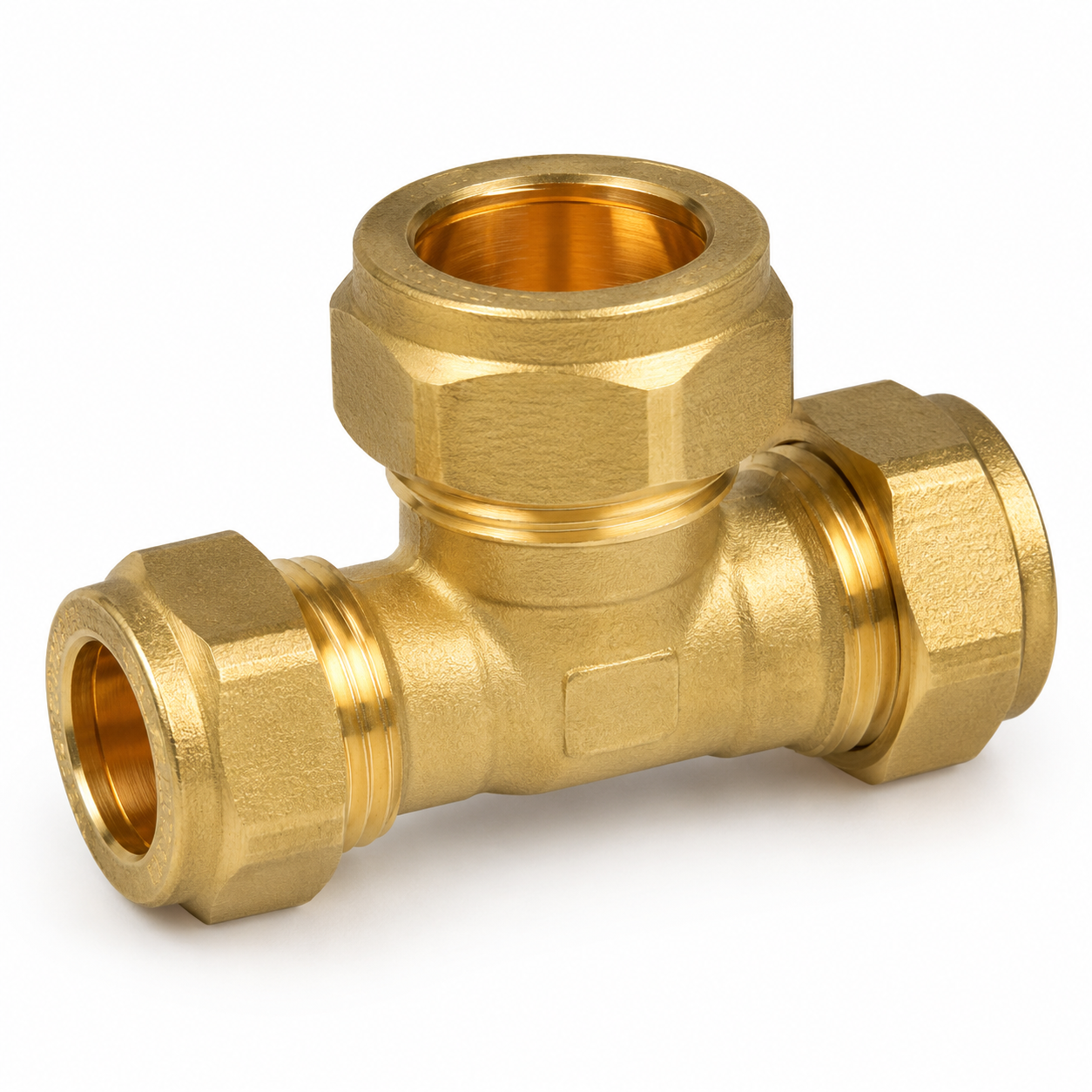
Brass Compression Reducing Tee
22mm x 15mm and 28mm x 22mm reducing tees for domestic branch heating and hot water take-offs.
Frequently Asked Questions
What sizes do compression fittings come in?
Standard metric sizes range from 8mm, 10mm, 12mm, 15mm, 22mm, 28mm, 35mm, 42mm, up to 54mm. Imperial olives in 1/2", 3/4", and 1" sizes are also available for retrofitting older installations.
How tight should a compression fitting be?
Tighten hand-tight until snug, then apply ½ to ¾ of a turn with a spanner on 15mm fittings, and approximately ½ a turn on 22mm and 28mm fittings. Always support the fitting body with a second spanner.
Can you reuse a compression fitting?
The brass body and nut can be reused repeatedly. The brass olive, however, deforms permanently upon compression and must be replaced with a fresh olive whenever the joint is remade.
Do you put PTFE tape on compression fittings?
Never wrap PTFE tape over the olive. PTFE tape is designed exclusively for parallel BSP threads. WRAS-approved jointing compound may be lightly applied to the olive for added security on potable water.
Can compression fittings be used on plastic pipe?
Yes, provided you install the pipe manufacturer's matching internal pipe insert sleeve into the cut end of the tube before tightening the fitting.
Are compression fittings allowed in walls?
Under Water Regulations and NHBC Standards, compression fittings may only be installed in walls if an accessible inspection hatch is provided. For inaccessible concealed runs, use permanent press-fit or soldered joints.
Stock Up on Trade-Priced Compression Fittings & Olives
Elbows from 70p, equal tees from £1.16, couplings, reducing sets, and olives stocked across all sizes from 8mm to 54mm. Next-working-day UK delivery with free shipping over £150.