

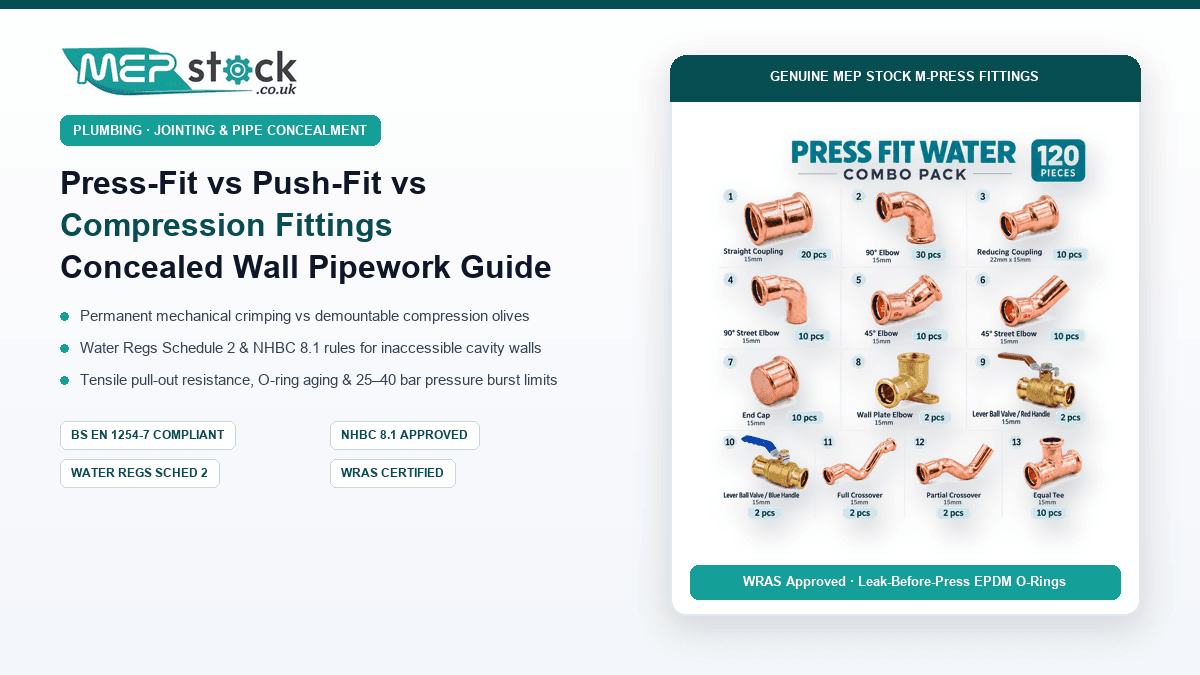
Quick Installer Summary
- Press-Fit (Copper & MLCP under BS EN 1254-7): The gold standard for fully concealed pipework behind drywall, under subfloors, and within service risers. Employs 19kN to 32kN mechanical radial deformation around high-grade EPDM O-rings to create permanent, non-demountable joints with zero flame risk and 100% compliance with Water Regulations Schedule 2.
- Compression Fittings (BS EN 1254-2): Strictly prohibited inside inaccessible walls, floors, and ceiling cavities by NHBC Standards Chapter 8.1 and Water Supply Regulations 1999 unless an access panel or inspection hatch is installed. Thermal expansion cycling causes brass olives to creep, leading to slow concealed leaks.
- Push-Fit Plastic / Metal (BS 7291 / BS EN 1254-4): Permitted in concealed locations only when installed with manufacturer stainless pipe liners and locking collars. However, push-fit joints remain vulnerable to rodent attack on plastic pipe, accidental disassembly during structural vibration, and lateral shear bending.
- Pressure & Tensile Resistance: Press-fit joints withstand operating pressures exceeding 25 to 40 bar and tensile pull-out forces >4,500 N, far exceeding push-fit (16 bar) and compression fittings.
UK Water Regulations & Building Standards for Concealed Pipework
When running domestic hot and cold water supplies (DHWS/DCWS) or central heating circuits behind plasterboard, inside timber stud partitions, or buried under screed, UK plumbers and mechanical contractors are strictly bound by the Water Supply (Water Fittings) Regulations 1999 and NHBC Standards Chapter 8.1 (Services).
Under Schedule 2, Section 7 (Accessibility of Fittings) of the Water Regulations:
"No water fitting shall be embedded in any wall or solid floor, or installed in or under any other building element, in such a position that it is inaccessible for examination, maintenance or replacement, unless the fitting is designed to be permanent and non-demountable."
Because standard compression fittings rely on a mechanical olive compressed by a threaded nut, they are classified as demountable, maintainable joints. Installing a compression elbow inside a sealed drywall bathroom partition without an inspection hatch violates UK Water Regulations and voids structural home warranties under NHBC and Premier Guarantee.
Mechanical Physics: Joint Deformation & Tensile Pull-Out Strength
The fundamental reliability difference between jointing methods lies in how the mechanical seal reacts to radial hoop stress, tensile pull-out force, and thermal fatigue cycling.
Where P = internal hydraulic pressure, d_i = internal pipe diameter, and t = wall thickness.
When water hammer or pump switching occurs, instantaneous surge pressures can spike from 3.0 bar to over 16 bar. The resulting tensile axial load attempting to eject the pipe from the socket is:
For a 28mm copper tube under a 16 bar surge, the axial ejection force exceeds 985 Newtons. Under this dynamic loading:
- Press-Fit (M-Profile / V-Profile): The pressing jaw delivers a calibrated mechanical crimping force of 19kN to 32kN. This permanently plastically deforms both the copper fitting socket and the inserted tube simultaneously (creating a hexagonal lock groove), while compressing the EPDM O-ring by 25% into its toroidal housing. The mechanical interlock provides a tensile pull-out strength >4,500 N—far beyond any hydraulic surge capability.
- Push-Fit: Relies on flexible stainless steel grab teeth. While sufficient under static pressure, axial vibration or lateral pipe bending can cause the teeth to bite deeper into soft plastic or score copper pipe, leading to microscopic weeping.
- Compression: Relies entirely on friction between the brass olive and copper tube. Under repeated thermal expansion cycles (\(\Delta T = 60 ext{K}\)), the copper wall creeps under the olive, reducing radial compression and loosening the seal.
Stock Up on WRAS-Approved Copper Press Fittings at MEP Stock
Explore our full range of M-profile copper press fittings, high-torque battery press tools, and full bore isolation valves engineered for permanent, leak-free installations.
Shop Copper Press Range →Comprehensive Comparison: Press vs Push-Fit vs Compression
| Technical Attribute | Press-Fit (M/V Profile) | Push-Fit (Plastic/Metal) | Compression (Brass) |
|---|---|---|---|
| Joint Classification | Permanent, Non-Demountable (BS EN 1254-7) | Demountable with key / tool (BS 7291) | Demountable mechanical (BS EN 1254-2) |
| Concealed Wall Approval | 100% Approved (No access hatch needed) | Conditional (Must use locking clips/sleeves) | PROHIBITED (Requires access panel) |
| Maximum Pressure Rating | 25 to 40 Bar | 12 to 16 Bar | 16 Bar |
| Installation Speed | Ultra-fast (3–5 seconds per joint) | Fast (push & twist) | Slow (dual spanners, risk of over-tightening) |
| Flame / Hot Works Permit | Zero flame required | Zero flame required | Zero flame required |
| Leak Detection Feature | Leak-Before-Press O-Ring (Drips at 0.1 bar unpressed) | Visual line / depth gauge check only | None |
Thermal Expansion Cycling & Seal Longevity
In central heating and recirculating secondary hot water circuits, pipework expands and contracts continuously under thermal cycling. The linear thermal expansion \(\Delta L\) over a 10-metre run is calculated by:
Where α = linear expansion coefficient (0.0168 mm/m·K for copper, 0.026 mm/m·K for MLCP, 0.14 mm/m·K for Polybutylene/PEX).
When running a 60°C domestic hot water line across 15 metres inside a ceiling or stud wall, the copper tube expands by over 15.1 mm. In a compression fitting, this repeated axial thrust forces the copper pipe to slide back and forth microscopically against the brass olive edge. Over 3 to 5 years, this produces fretting wear, thinning the pipe wall and resulting in slow, catastrophic water damage behind tiled walls.
In contrast, MEP Stock M-profile copper press fittings utilise synthetic EPDM O-rings conforming to BS EN 681-1, with an engineered operating temperature range of -20°C to +110°C. The mechanical crimp locks the tube and fitting together into a single structural unit, accommodating thermal stresses through natural pipe flexure loops without degrading the O-ring seal.
Trade Installation Checklist for Hidden In-Wall Pipework
- Clean Square Cuts & Thorough Deburring: Always cut copper tube with a sharp rotary pipe cutter. Use an internal/external deburring tool to remove all copper burrs. A sharp un-deburred pipe edge will slice through the EPDM O-ring upon insertion, causing hidden leaks.
- Mark Insertion Depth: Measure the fitting socket depth and mark it on the pipe with a permanent marker. Ensure the depth line sits flush with the fitting shoulder after insertion before pulling the press trigger.
- Use Calibrated Press Tooling: Ensure your battery hydraulic press tool (e.g. 18V 25kN MEP Stock press tool kit) has valid calibration and clean, greased M-profile jaw pivot pins.
- Acoustic & Thermal Pipe Insulation: Always lag concealed pipework with Class 0 flexible foam or pre-insulated conduit to eliminate water hammer expansion ticking against plasterboard studs and prevent condensation.
- Two-Stage Hydraulic Pressure Test: Test the concealed network at 1.5× design operating pressure (minimum 6.0 bar) for 1 hour in accordance with BS EN 806-4 before closing and tiling drywall partitions.
Equip Your Van with Professional Press Tool Kits
Upgrade to 18V electric hydraulic press tools compatible with M-profile and U-profile jaws. Fast UK delivery with ex VAT trade pricing guaranteed.
View 18V Hydraulic Press Tool Kit →