

Quick Trade Summary
While individual solder fittings carry a lower unit material price (typically £0.40–£0.80 for end-feed vs £1.80–£2.40 for copper press fit), press fit delivers a net saving of 35% to 50% on total installed project costs. Pressing eliminates the mandatory 1-hour post-hot-works fire watch (Regulatory Reform (Fire Safety) Order 2005), cuts joint assembly time from 3.5 minutes to under 25 seconds (a 70% labour reduction), eliminates annual £800–£1,500 hot works insurance premiums, and reduces drain-down delays on wet pipework. Purchasing bulk trade contractor packs (such as 120-piece and 130-piece combo boxes) closes the unit material price gap while maximising daily billable margin.
Why Plumbing Contractors Are Calculating Total Installed Cost
For decades, plumbing estimators calculated job margins based solely on merchant trade invoices. A 15mm end-feed copper elbow cost £0.45, lead-free solder wire cost pennies per joint, and a canister of MAPP gas lasted several jobs. On paper, soldering appeared unbeatable.
However, modern UK mechanical contracting economics operate under strict labour constraints, soaring public liability insurance premiums, and stringent site safety mandates. Evaluating fittings purely by their shelf price ignores the single largest expense on any plumbing project: skilled billable labour time.
When you evaluate the complete life-cycle equation of a joint—including surface preparation, flux application, heat distribution, cooling time, flushing corrosive acid flux to BS 7593 standards, and mandatory fire watches—flame-free press fit systems certified to BS EN 1254-7 consistently outperform traditional soldering.
The Joint Time Study: 3.5 Minutes vs 25 Seconds
To understand where the true financial break-even occurs, consider the empirical time study conducted across commercial and domestic installations comparing a standard 22mm copper elbow:
Hot Works Permits, Insurance Premiums and Fire Watches
Under UK commercial site regulations and high-density residential developments, the use of open flame blowtorches triggers strict compliance protocols under the Regulatory Reform (Fire Safety) Order 2005:
- Hot Works Permits: Requires pre-approval, isolating smoke and heat detectors (which frequently requires building management call-outs), and clearing all combustible insulation within a 10-metre radius.
- Mandatory Fire Watch: British Standard guidance mandates that an operative remains on site for a minimum of 60 minutes after extinguishing the blowtorch to monitor for smouldering timber studs or joists. On a small 2-hour job, a 1-hour fire watch represents 33% of non-billable dead time.
- Insurance Surcharges: Public liability policies carrying an unrestricted open-flame endorsement typically cost between £1,200 and £2,500 annually for sole traders and small firms. Eliminating open flame can drop annual policy premiums significantly.
Stock Your Van With Master Trade Packs & Save 25%
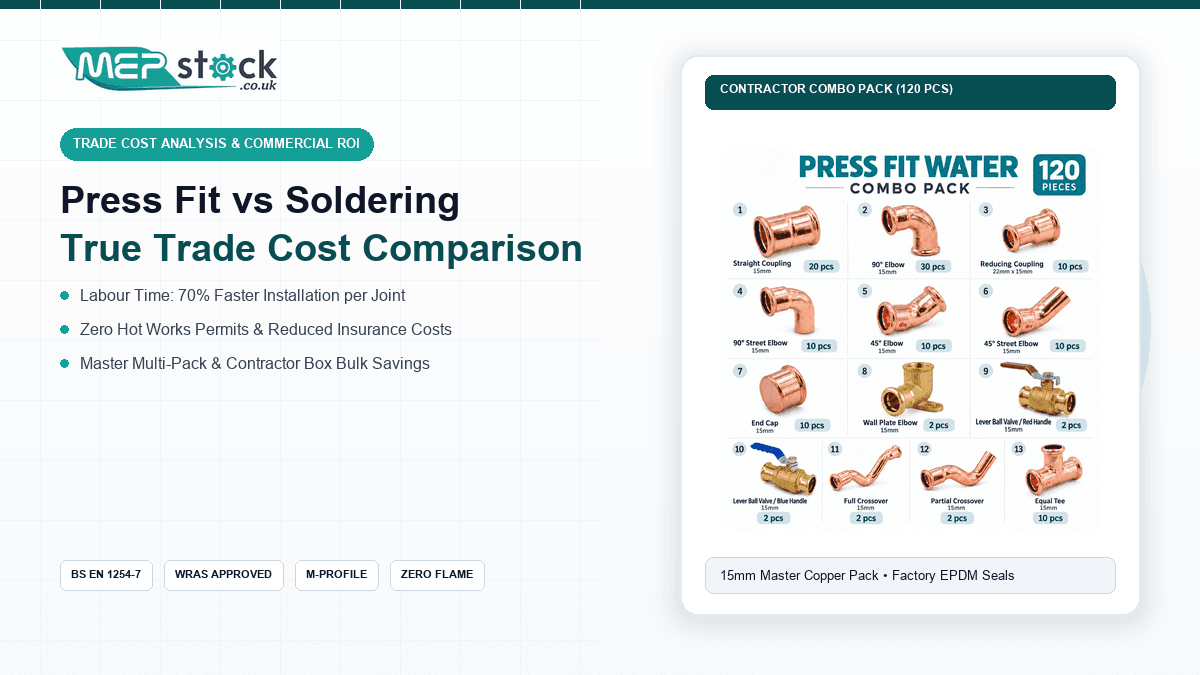
Cut your unit fitting costs while securing the speed of M-profile press fit. Our 120-piece trade box includes 15mm elbows, tees, couplings, full crossovers, and isolation valves with factory-sealed EPDM O-rings.
Shop 15mm Trade Combo Pack (120 Pcs) →Full Installation Financial Model: Domestic Boiler Replacement
Consider a standard domestic combi boiler replacement requiring 40 pipe joints (boiler flow/return, gas supply, hot/cold mains distribution, and heating manifold headers):
Scenario: 40 Copper Joints (22mm & 15mm) at £45.00/Hour Labour Rate
Option A: Soldering (End-Feed / Solder Ring)
• Fittings Material Cost (40 @ £0.65 avg): £26.00
• Solder, Flux, Gas & Abrasive: £14.50
• Joint Labour Time (40 @ 3.2 mins = 2.13 hrs): £95.85
• Mandatory Fire Watch & Flush (1.25 hrs): £56.25
Total Cost: £192.60
Option B: M-Profile Copper Press Fit
• Fittings Material Cost (40 @ £1.85 bulk avg): £74.00
• Consumables (No gas/solder): £0.00
• Joint Labour Time (40 @ 25 secs = 0.28 hrs): £12.60
• Fire Watch / Flush Time: £0.00
Total Cost: £86.60
Working on Wet Pipes: The Hidden Solder Nightmare
Every heating engineer has experienced the frustration of attempting to solder an existing central heating pipe where residual water continues to weep through a passing gate valve. Solder cannot heat past 100°C while water is present inside the pipe; the capillary action is destroyed, and the joint fails.
Plumbers lose hours inserting bread, using freezing kits, or waiting for header tanks to drain completely. With M-profile copper press fittings, residual water inside the pipe does not affect the physical crimp or the seal. As long as the pipe is cut square and deburred, the mechanical 32kN pressing jaw forms an instantaneous, gas-tight mechanical lock and watertight elastomeric seal to BS EN 1254-7.
Equip Commercial Boiler Installs with 22mm Contractor Packs
Our 22mm master contractor box delivers 130 pieces of heavy-duty M-profile elbows, couplings, and equal tees. Rated to 16 Bar operating pressure with WRAS approval for potable water and heating systems.
Shop 22mm Trade Pack (130 Pcs) →The Economics of Bulk Contractor Packs vs Merchant Counter Bags
The traditional hesitation toward press fit stemmed from buying individual fittings from local trade counters at retail prices (£3.50+ for a single 15mm elbow).
Online direct-to-trade packaging changes that equation entirely. By purchasing master boxes such as the 15mm 120-piece combo pack or the 22mm 130-piece contractor pack, the average fitting price drops substantially.
For contractors maintaining two or three vans, keeping a pre-sorted combo box ensures engineers never halt a commercial job due to a missing 45-degree street elbow or reducer.
Technical Verification Checklist for Switching to Press Fit
- Jaw Compatibility: Verify your pressing machine uses M-profile jaws (e.g., Rothenberger, Milwaukee, Novopress, Klauke, REMS) matching CW024A copper tube specifications.
- Calibrated Deburring: Always use a rotational inner/outer deburring tool. Rough copper burrs can nick the internal EPDM O-ring during pipe insertion.
- Depth Marking: Mark the socket insertion depth on the copper tube with a permanent marker to confirm the pipe hasn't slipped prior to crimping.
- Compliance: Ensure all fittings carry WRAS approval and BS EN 1254-7 certification for complete Part G and water undertaker compliance.