

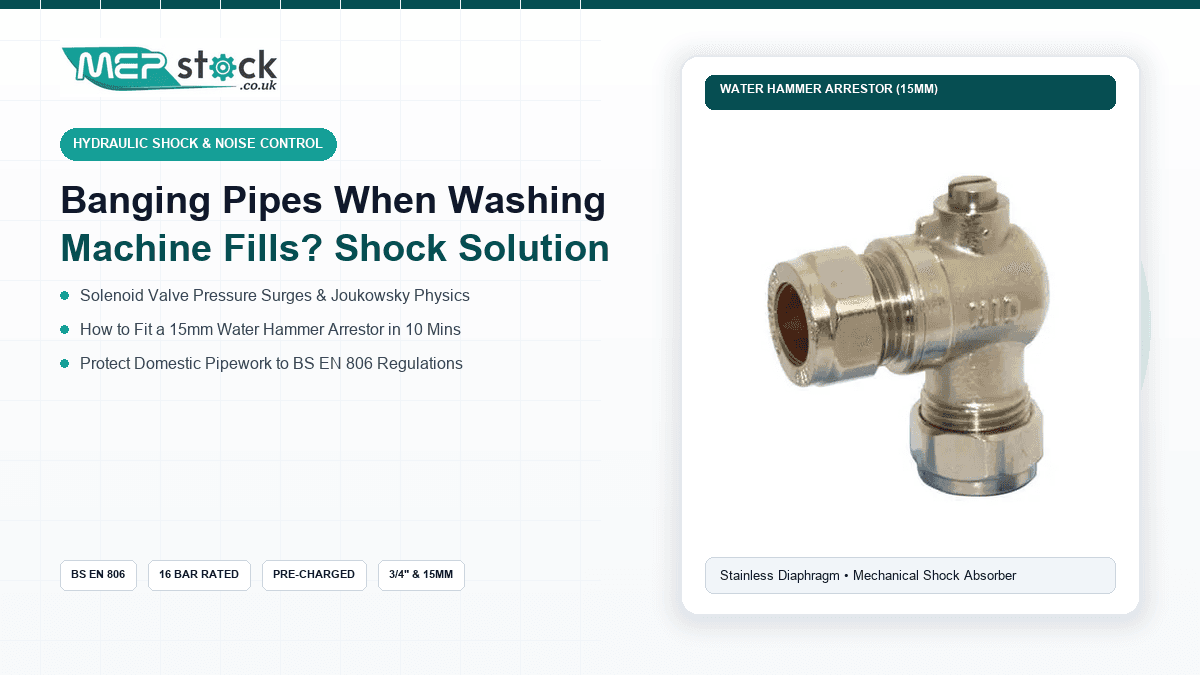
Quick Technical Summary
Loud banging or violent shaking in domestic copper pipework when an appliance fills is caused by hydraulic shock (water hammer). Modern washing machines and dishwashers use high-speed electric solenoid valves that snap shut in approximately 20 to 30 milliseconds. When water travelling at 1.5–2.5 m/s is suddenly halted, its kinetic energy transforms into an acoustic pressure wave governed by the Joukowsky equation (\(\Delta P = ho \cdot c \cdot \Delta v\)), producing transient pressure spikes in excess of 25–35 Bar. Installing a pre-charged mechanical 15mm Water Hammer Shock Arrestor directly onto the cold supply pipe or appliance tee absorbs this hydraulic shock wave, permanently silencing pipe noise and protecting boiler components and solder joints from stress fractures.
Why Do Pipes Bang When the Washing Machine Fills?
If your domestic water pipes shudder, clatter, or bang violently against floor joists every time your washing machine clicks during a rinse cycle, your plumbing system is experiencing hydraulic shock, universally known in the trade as water hammer.
Unlike manual basin taps where a user closes a valve progressively over 1 to 2 seconds, modern domestic appliances rely on electric solenoid valves. These valves pulse water in short, intermittent bursts to control water consumption and detergent dispersion.
Because water is an incompressible fluid, stopping a moving column of water instantaneously creates a violent shock wave that rebounds backward through the pipe network at the speed of sound in water (approximately 1,200 to 1,400 metres per second).
The Physics of Water Hammer: The Joukowsky Equation
In fluid mechanics, the magnitude of the pressure surge generated by a rapidly closing valve is calculated using the famous Joukowsky Equation:
\[ \Delta P = ho \cdot c \cdot \Delta v \]
Where:
- \(\Delta P\) = Pressure surge increase (Pascals / Bar)
- \( ho\) = Density of water (\(1,000 ext{ kg/m}^3\))
- \(c\) = Speed of the acoustic pressure wave in the pipe (~1,200 m/s for copper tube)
- \(\Delta v\) = Sudden change in fluid velocity (m/s)
If water is flowing through a 15mm copper pipe at a velocity of 2.0 m/s (the maximum design velocity permitted under BS EN 806-3) and is abruptly stopped in 25 milliseconds:
\[ \Delta P = 1,000 \cdot 1,200 \cdot 2.0 = 2,400,000 ext{ Pa} = \mathbf{24 ext{ Bar (348 psi)}} \]
When added to a typical domestic static mains pressure of 3.0 Bar, the instantaneous shock wave hits 27 Bar—exceeding the standard proof rating of domestic valves, plastic push-fit fittings, and unvented cylinder expansion vessels.
How a Mechanical Shock Arrestor Solves the Problem
Old plumbing systems historically used "air chambers"—vertical dead legs of copper pipe capped at the top. While initially effective, the trapped air dissolved into the flowing water within a few months (waterlogging), rendering the pipe completely ineffective.
A modern 15mm mechanical water hammer arrestor uses a sealed, maintenance-free design comprising:
- A stainless steel or high-tensile brass pressure vessel rated to 25 Bar.
- An internal gas chamber pre-charged with dry nitrogen (typically 3.5 to 4.0 Bar).
- A flexible synthetic rubber membrane (diaphragm) or sliding piston separating the water from the gas chamber.
When the washing machine solenoid snaps shut, the violent pressure wave rushes into the arrestor. The nitrogen gas compresses smoothly, cushioning the shock wave like a vehicle's shock absorber before dissipating the energy silently.
Stop Banging Pipes Instantly with a 15mm Shock Arrestor
Our commercial-grade 15mm water hammer arrestors feature pre-charged nitrogen chambers with standard compression or appliance tee connections. Rated to 16 Bar operating pressure with WRAS-compliant components.
Shop Shock Arrestors & Compression Fittings →Step-by-Step Installation: Fitting a 15mm Arrestor on a Washing Machine
Installing a water hammer arrestor on a washing machine cold water supply takes under 15 minutes and requires basic plumbing tools:
- Isolate Water Supply: Turn off the blue-handle washing machine valve or isolate the cold water main stopcock. Run a cold tap downstairs to relieve pressure.
- Choose Your Installation Location: Under BS EN 806 guidelines, a shock arrestor must be positioned as close as possible to the quick-closing valve causing the surge—ideally within 0.5 to 1.0 metre of the appliance inlet.
- Inline Tee or Appliance Tee Installation:
- Option 1 (Appliance Tee): Thread an arrestor directly onto a dual-port 3/4" washing machine valve between the isolation valve and the appliance hose.
- Option 2 (Inline Compression): Cut into the 15mm copper pipe directly before the appliance valve using a rotational tube cutter. Insert a 15mm compression equal tee, then fit the shock arrestor vertically into the top branch.
- Tightening Compression Joints: Tighten compression nuts onto the copper olive until hand-tight, then tighten an additional 3/4 turn with an adjustable spanner. (Do not overtighten).
- Orientation & Testing: While mechanical arrestors can be mounted in any orientation (horizontal, vertical, or inverted), installing vertically upward is best practice to avoid debris accumulation. Restore water pressure, check for weeping, and run a washing machine cycle to verify silent operation.
5 Supplementary Checks to Silence Pipe Noise Permanently
- Pipe Clipping Intervals: Verify copper pipes are supported with plastic or rubber-lined pipe clips every 1.2 metres for 15mm pipe and 1.5 metres for 22mm pipe (as required by BS 5422). Loose pipes vibrate violently even under moderate hydraulic shocks.
- Mains Water Pressure Check: If your incoming static mains water pressure exceeds 4.5 Bar, install a Pressure Reducing Valve (PRV) calibrated to 3.0 Bar at your internal stopcock.
- Float Valve Diaphragms: Check toilet cistern float valves. Worn rubber diaphragms oscillate under pressure, causing rhythmic "machine gun" pipe juddering throughout the house.