

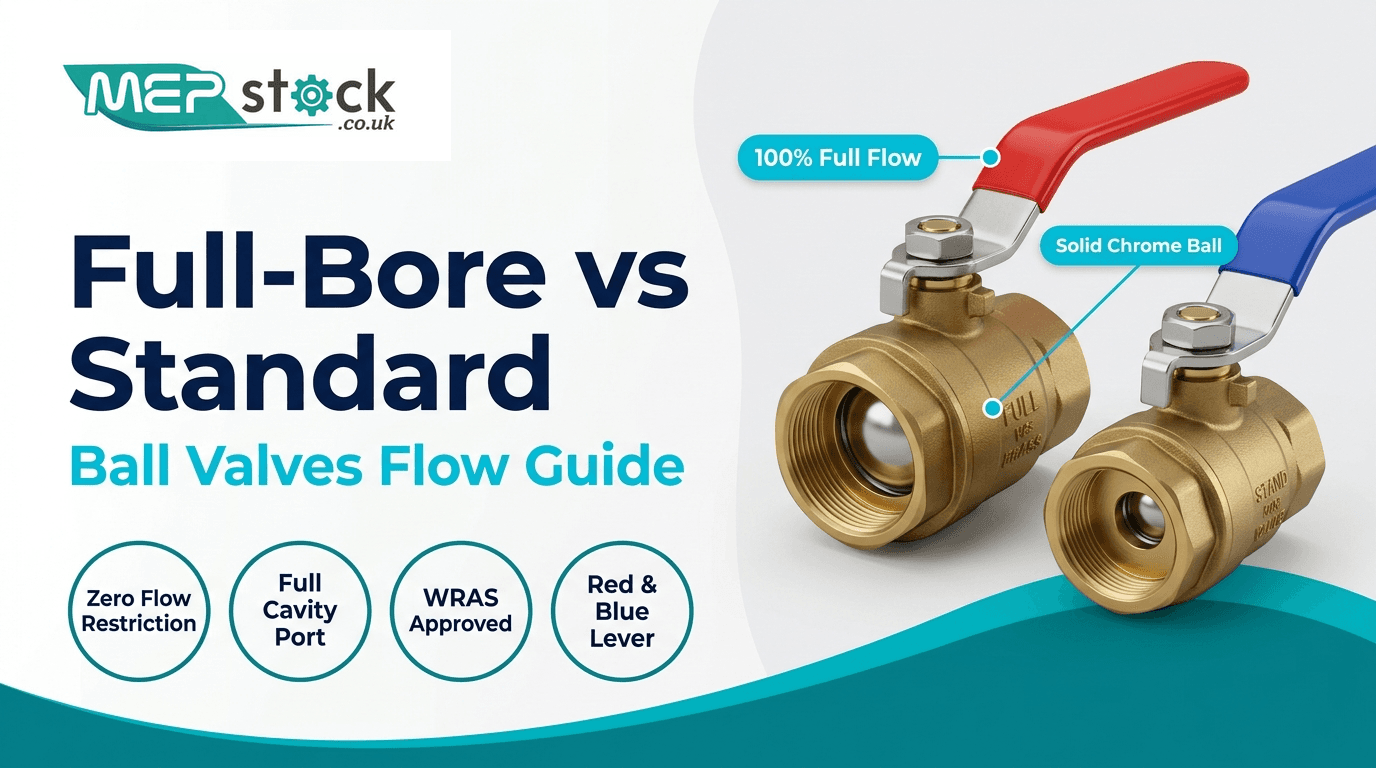
Quick Trade Summary: Full-Bore vs Standard-Bore Ball Valves
Selecting between full-bore and standard-bore (reduced-bore) ball valves directly impacts fluid velocity, pressure loss, pump energy consumption, and compliance in UK plumbing systems:
- Full-Bore Ball Valves (Full Port): The internal ball orifice diameter identically matches the connected pipe's internal diameter. This produces zero flow restriction, near-zero pressure drop (ΔP), and prevents turbulence. Essential for heat pump primary circuits, boiler flow/return headers, unvented cylinder cold mains feeds, and gravity-fed supplies.
- Standard-Bore Ball Valves (Reduced Port): The internal bore is typically one pipe size smaller than the connecting diameter (e.g., a 22mm valve having a 15mm internal opening). This introduces a vena contracta flow constriction, resulting in a 20% to 40% pressure drop across the valve. Suitable only for branch isolation, secondary utility feeds, or low-flow fixtures.
- Handle Colour Coding: Red Handle = Flow / Hot Water Services; Blue Handle = Return / Cold Potable Water; Yellow Handle = Natural Gas & LPG (strictly with yellow HNBR seals to BS EN 331).
- UK Standards: Must comply with BS EN 13828 (Drinking Water Ball Valves), BS EN 331 (Gas Ball Valves), and hold WRAS approval for potable water installations.
Mechanical Anatomy and Engineering Differences
A ball valve is a quarter-turn rotational valve that controls flow using a spherical disc with an aperture (the bore) bored through its centre. When the handle is aligned parallel to the pipe run, the port is open and fluid flows through; rotating the handle 90 degrees positions the solid sphere wall across the flow path, creating a positive mechanical seal against PTFE seats.
The fundamental distinction between full-bore and standard-bore valves lies entirely in the relationship between the ball port aperture diameter ($d_{bore}$) and the nominal pipe internal diameter ($d_{pipe}$).
Core Construction Features:
- Body Material: Forged nickel-plated brass (CW617N) or Dezincification-Resistant (DZR) brass (CW602N) tested to PN16–PN25 pressure ratings.
- Solid Brass Chrome-Plated Ball: Diamond-ground spherical ball finished with mirror-polished hard chrome for minimal friction and extended seat life.
- Virgin PTFE Seats: Polytetrafluoroethylene (Teflon) valve seats providing bubble-tight shut-off across temperatures from -10°C to +110°C.
- Anti-Blowout Stem: Heavy-duty brass stem engineered with an internal shoulder that prevents stem ejection under extreme pressure surges.
- Double O-Ring / PTFE Packing Gland: Adjustable packing nut combined with twin EPDM/FKM O-rings to eliminate external spindle weeping.
Technical Comparison Matrix: Full-Bore vs Standard-Bore
| Technical Parameter | Full-Bore Ball Valve (Full Port) | Standard-Bore Ball Valve (Reduced Port) |
|---|---|---|
| Internal Bore Ratio | 100% of connecting pipe internal diameter. | 70% to 80% of connecting pipe internal diameter. |
| Flow Coefficient ($K_v$) | Maximum possible hydraulic flow capacity. | 25% to 45% lower $K_v$ value than full bore. |
| Pressure Loss (ΔP) | Virtually zero; identical to equivalent straight pipe run. | Moderate to high; creates localized restriction. |
| Turbulence & Noise | Laminar, quiet flow with no vortex generation. | High turbulence at orifice entry/exit; potential whistling at high velocity. |
| Debris / Sludge Accumulation | No internal step or ridge; self-cleaning flow path. | Internal shoulders can trap circulating scale and flux slag. |
| Physical Valve Dimensions | Slightly larger body casting and heavier weight. | More compact body; lighter weight and lower unit cost. |
| Mandatory UK Applications | Heat pump primary loops, boiler headers, unvented cylinder feeds, commercial plantrooms. | Secondary branch isolation, individual basin supplies, non-critical washdown circuits. |
Hydraulic Sizing, Flow Rates ($K_v$) & Head Loss Calculations
In high-flow hydronic systems, an undersized standard-bore valve acts as an uncalibrated throttling orifice. The resulting pressure drop ($\Delta P$) increases pump head requirements, causing higher electrical consumption and potentially triggering low-flow error codes on heat pumps.
| Nominal Size (BSP / mm) | Full-Bore $K_v$ ($m^3/h$) | Standard-Bore $K_v$ ($m^3/h$) | Flow Capacity Difference (%) | Pressure Drop at 2.0 $m^3/h$ |
|---|---|---|---|---|
| 1/2" (15mm) | 14.5 | 8.2 | -43.4% | 0.02 bar vs 0.06 bar |
| 3/4" (22mm) | 29.8 | 18.5 | -37.9% | 0.005 bar vs 0.012 bar |
| 1" (28mm) | 50.2 | 31.0 | -38.2% | 0.002 bar vs 0.004 bar |
| 1-1/4" (35mm) | 85.0 | 52.0 | -38.8% | 0.001 bar vs 0.0015 bar |
| 1-1/2" (42mm) | 150.0 | 95.0 | -36.7% | Negligible |
| 2" (54mm) | 235.0 | 140.0 | -40.4% | Negligible |
Why Heat Pumps and High-Performance Heating Demand Full-Bore Valves
In modern low-temperature heating systems operating at narrow temperature differentials (ΔT of 5°C on heat pumps vs 20°C on gas boilers), the mass flow rate required to deliver the same thermal output is four times greater:
Thermal Output Equation: Q = m × C_p × ΔT
For a 12 kW heat pump at ΔT = 5°C, flow rate $m$ must reach 2,064 Litres/hour (0.57 L/s).
Installing standard-bore valves on a 28mm heat pump primary circuit creates significant hydraulic resistance. The circulating pump must work harder, consuming excess electrical wattage and reducing the seasonal Coefficient of Performance (SCOP). If the flow rate drops below the heat pump’s minimum threshold, the unit will trip with a low-flow fault code.
Trade Handle Colour Coding and Actuation Options
In professional commercial and domestic plantroom installations, valve handle colouring provides immediate visual identification of system medium:
Red Lever Handles
Designates Heating Flow & Domestic Hot Water (DHW) circuits. Provides rapid leverage for quarter-turn emergency isolation on high-temperature pipework.
Blue Lever Handles
Designates Heating Return, Potable Cold Mains, & Chilled Water circuits. Clear visual separation prevents commissioning cross-connections.
Yellow Handles (Gas Safe)
Strictly for Natural Gas and LPG pipework. Certified to BS EN 331 with yellow HNBR high-temperature seals. Never substitute a water valve for gas.
Butterfly (T-Handle) Compact
Engineered for confined installations, underfloor heating manifolds, and tight service risers where long lever handles would foul adjacent walls or pipework.
Trade-Grade Full-Bore Ball Valves & Plantroom Fittings
WRAS approved, PN25 rated, forged brass full-bore lever and butterfly valves in stock for fast UK delivery.
Red Lever Ball Valves (BSP)
Full-bore female BSP threaded valves with insulated red steel lever. 1/2" to 2" sizes. PN25 rated with WRAS approval.
Blue Lever Ball Valves (BSP)
Full-bore female BSP valves with insulated blue handle. Ideal for heating return lines and cold water storage cistern feeds.
Yellow Gas Lever Valves
BS EN 331 certified gas ball valves with high-grade HNBR seals for natural gas and LPG meter and appliance isolation.
Preventing Valve Seizure: The Annual Exercise Protocol
Although PTFE-seated ball valves are significantly more resistant to seizing than traditional gate valves, in hard-water UK regions mineral limescale ($CaCO_3$) and magnetite sludge can adhere to the chrome ball surface if left stationary for extended periods:
- Quarter-Turn Exercising: Rotate every isolation valve fully closed and open at least once per year during routine system inspection to wipe the ball surface clean against the PTFE seats.
- Never Use Wrenches on Levers: If a valve becomes stiff, never apply pipe extensions or cheater bars to the lever, as this can shear the brass stem. Apply penetrating lubricant to the packing nut and gently work the handle back and forth.
- Packing Gland Adjustment: If minor weeping occurs around the stem spindle, gently tighten the hexagonal packing nut beneath the handle clockwise by 1/8th of a turn with a spanner.
Frequently Asked Questions (Trade FAQs)
Can a ball valve be used for flow throttling / balancing?
Standard round-bore ball valves should never be used for throttling flow. When partially open, fluid impinges on a narrow portion of the PTFE seat at high velocity, causing seat erosion, cavitation, and eventual failure to provide a bubble-tight shut-off. Ball valves are strictly designed for on/off isolation. Use dedicated lockshield valves, balancing valves, or V-port control valves for throttling.
Why is full-bore essential on unvented hot water cylinders?
Unvented hot water storage cylinders rely on incoming cold mains pressure to deliver high-flow hot water to multiple showers and outlets simultaneously. Installing a reduced-bore valve on the 22mm or 28mm incoming cold supply introduces dynamic pressure loss, resulting in noticeable shower pressure drop whenever a tap is opened elsewhere in the property.
What is the difference between BSP parallel (BSPP) and BSP taper (BSPT) threads?
BSPP (G thread) has straight parallel threads where sealing occurs via a flat washer, O-ring, or jointing paste against the fitting shoulder. BSPT (R/Rc thread) features tapered threads where the mechanical seal is achieved through thread flank interference as the fitting is tightened, typically requiring PTFE tape or anaerobic thread sealant.