

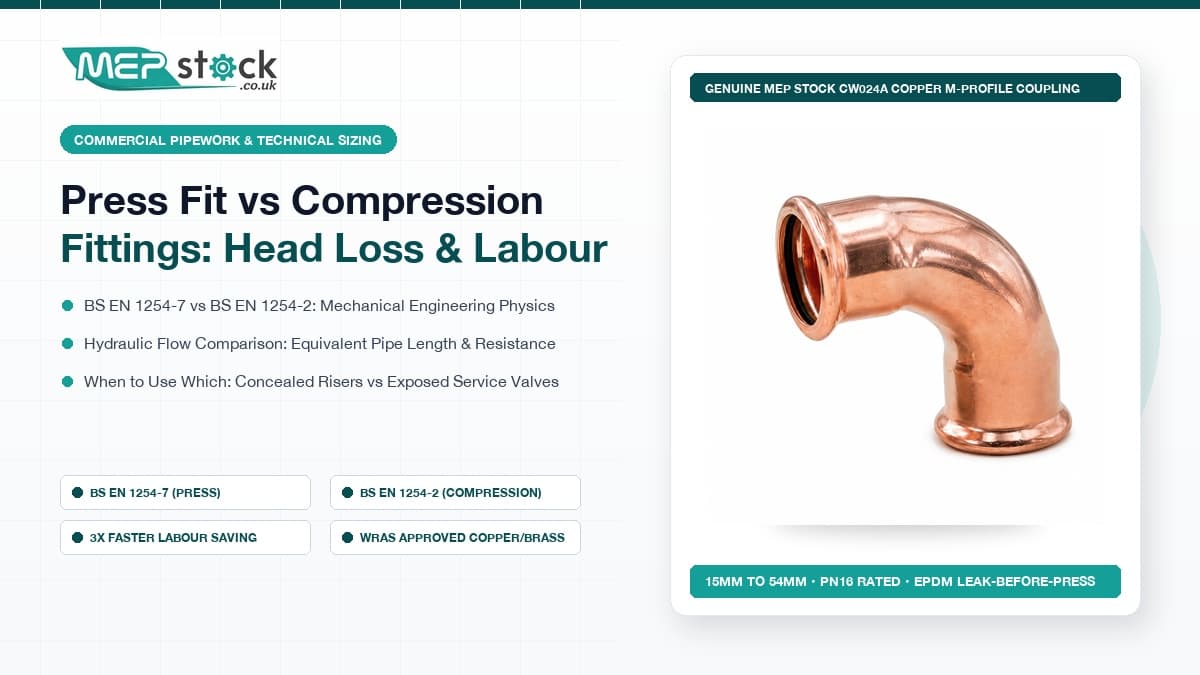
Quick Installer Summary: Joint Selection Protocol
When assembling commercial heating risers, domestic services, and plant room pipework, UK contractors frequently balance speed against serviceability between Copper M-Profile Press Fit Fittings (BS EN 1254-7) and Forged Brass Compression Fittings (BS EN 1254-2). Copper press fit joints assemble up to 3 times faster than compression, require zero spanner swing space, feature factory-lubricated EPDM O-rings rated to 16 bar PN16, and provide permanent mechanical crimps ideal for concealed risers, ceiling voids, and dry-lined stud walls. Conversely, compression fittings require zero expensive pressing machinery, provide 100% mechanical demountability, and excel at appliance service valves, pump unions, and tight retrofits where jaws cannot fit. Both standards have distinct hydraulic head loss profiles and compliance mandates under UK Water Supply Regulations.
Engineering Standards: BS EN 1254-2 vs BS EN 1254-7
In the UK plumbing and mechanical services sector, jointing standards are strictly defined by the British Standards Institution (BSI) under the BS EN 1254 family:
- BS EN 1254-2: Specifies requirements for compression fittings for use with copper tube conforming to BS EN 1057. It covers both Type A (non-manipulative, sealing via surface olive compression) and Type B (manipulative, requiring bell-mouthing or flared tube). The standard requires metal-to-metal sealing capable of withstanding 16 bar at 30°C and 6 bar at 110°C.
- BS EN 1254-7: Specifies requirements for press fittings for use with metallic tubes. It mandates permanent mechanical jointing using radial deformation around elastomeric sealing elements (EPDM for water, HNBR for gas). Fittings must pass rigorous tensile pull-out tests, cyclical thermal shock testing (-20°C to +110°C), and pressure pulsation tests up to 24 bar (1.5x PN16).
Hydraulic Head Loss & Equivalent Pipe Length Comparison
Every fitting introduced into a hydronic heating circuit or potable water riser creates internal turbulence, boundary layer separation, and pressure drop ($\Delta P$). In mechanical calculations, fitting resistance is expressed as Equivalent Length of Straight Pipe ($L_{eq}$):
| Fitting Type (22mm Size) | Internal Geometry | Resistance Coeff ($K$) | Equivalent Length ($L_{eq}$) |
|---|---|---|---|
| Copper Press Straight Coupling | Full tube bore with smooth internal stop | 0.15 | 0.15 m of pipe |
| Brass Compression Coupling | Internal brass tube stop with slight shoulder restriction | 0.25 | 0.25 m of pipe |
| Copper Press 90° Elbow | Smooth sweeping formed radius | 0.55 | 0.65 m of pipe |
| Brass Compression 90° Elbow | Forged angular throat with sharper internal turn | 0.80 | 0.95 m of pipe |
| Copper Press Equal Tee (Branch Flow) | Extruded copper branch contour | 1.10 | 1.25 m of pipe |
Because copper press fittings are formed from deoxidised CW024A copper tube rather than cast or forged blocks, their internal radius transitions are smoother. A typical run of 10 directional bends with press fittings saves up to 3.0 metres of equivalent pipe resistance compared to forged compression elbows, preserving pump flow rates on heat pump and condensing boiler primary loops.
Labour Time & Commercial Installation Economics
Contractors operating on large residential multi-plots or commercial plant rooms find that jointing labour dramatically outweighs fitting unit costs:
Labour Time Comparison per 100 Joints (22mm Pipework):
- Brass Compression Fittings:
- Cut pipe square, deburr inner & outer edges.
- Disassemble nut and olive; slide onto pipe.
- Align pipe in body, apply jointing compound/holding spanner, and swing adjustable spanner 1.5 to 2 turns.
- Average time per joint: 2.5 to 3.5 minutes.
- Total time for 100 joints: ~5.0 hours of physical spanner work.
- Copper M-Profile Press Fit Fittings:
- Cut pipe square, deburr inner & outer edges, mark insertion depth.
- Push fitting onto pipe to witness mark.
- Mount M-profile press jaw and press trigger (4-second automatic electro-hydraulic crimp cycle).
- Average time per joint: 45 to 60 seconds.
- Total time for 100 joints: ~1.5 hours.
- Commercial Labour Saving: Over 70% faster execution, returning 3.5 billable hours back to the contractor per hundred fittings.
Upgrade Your Job Site to Copper M-Profile Press Fit
Save hours on every job with certified WRAS & BS EN 1254-7 copper press couplings, elbows, tees, and valves.
Shop Full Water Press Range →When to Use Which: Practical Site Application Guide
1. Concealed Locations (In-Wall Chases, Screeds & Ceiling Voids): CHOOSE PRESS FIT
Under BS 6700 and UK Water Supply Regulations, non-demountable joints are strictly required for inaccessible pipework. Copper press fittings undergo permanent hexagonal crimping that cannot rattle loose or back off under thermal expansion and water hammer vibration. Compression nuts, if buried behind dry-lining without access panels, violate building codes because their olive joints can weep if subjected to structural building movement.
2. Exposed Bathroom Radiators & Designer Towel Warmers: CHOOSE CHROME COMPRESSION
Where pipework drops down into high-end bathrooms, towel warmers, and designer radiator valves, visual luxury is paramount. Our Chrome Compression Straight Couplings and valves feature electroplated mirror finishes that blend seamlessly with polished chrome tails, offering a clean aesthetic that press tool jaws would scratch.
3. Direct Appliance & Valve Servicing: CHOOSE COMPRESSION
Sanitary fixtures, washing machines, toilet cisterns, and domestic pumps require periodic servicing or component replacement. Installing a 15mm Flat Faced Isolating Service Valve or Brass Compression Isolating Valve allows engineers to simply back off the compression nut with an open-ended spanner, replace the valve body or cartridge, and re-tighten without cutting copper pipe.
4. Retrofit Adaptations & Dropping Pipe Sizes: CHOOSE COMPRESSION REDUCING SETS
When tying a new 15mm feed into an existing 22mm or 28mm pump valve or manifold port, replacing the whole valve is cost-prohibitive. Using a Brass Compression Reducing Set allows you to convert the existing socket in seconds without re-pressing or altering surrounding pipe geometry.
Frequently Asked Questions: Press Fit vs Compression
Can copper press fit fittings be buried in screed?
Yes, provided they are wrapped or protected with corrosion-proof tape or lagging.
BS EN 1254-7 press fittings are classified as permanent non-demountable joints and can be installed in screed. However, they must be wrapped with protective denso tape or impervious lagging to guard against ammoniacal cement corrosion under BS 6700.
Do compression fittings work on plastic pipe (PEX / Polybutylene)?
Yes, but rigid copper or brass pipe inserts are mandatory.
Compression fittings seal perfectly on plastic barrier pipe provided the manufacturer-approved rigid insert is fitted inside the pipe bore. Without an insert, the olive crimp force will collapse the soft plastic wall, leading to joint blowout.
How many times can you reuse a brass compression olive?
Olives are single-use components and must be replaced whenever a joint is broken.
When a compression nut is tightened, the brass olive undergoes irreversible plastic deformation, biting into the copper tube wall. If you disassemble the joint, always cut back the copper or use an olive puller to fit a fresh olive.
What press jaw profile do MEP Stock copper press fittings require?
MEP Stock copper water press fittings strictly require M-Profile press jaws.
They are fully compatible with Rothenberger, Milwaukee, Novopress, Klauke, and REMS press machines fitted with standard M-contour jaws. Never use V-profile or U-profile jaws on M-profile fittings.
Stock Up on Trade Pipework & Fittings at MEP Stock
From copper press combos to brass compression packs and isolating valves, get wholesale contractor prices online.
Browse Full Store Catalog →