

Quick Trade Summary: Sizing & Balancing an Underfloor Heating Manifold
A correctly sized and hydraulically balanced manifold ensures even floor temperatures, silent pump operation, and maximum boiler/heat pump efficiency. Here are the core trade rules:
- Manifold Port Sizing: Allow 1 manifold port per 10m²–15m² of heated floor area. Keep individual 16mm PERT-AL-PERT pipe loops under 100 metres (maximum 110m including tails). For a 100m² home, install an 8-port to 10-port Stainless Steel UFH Manifold.
- Hydraulic Balancing Rule of Thumb: Calculate flow rates based on a 5°C design temperature differential (ΔT). Standard residential loops run between 1.5 and 2.5 litres per minute (l/min). Shorter hallway loops must be throttled down to ~1.0 l/min to prevent short-circuiting longer room loops.
- Temperature Blending Control: High-temperature boiler feeds (65°C–75°C) must be tempered down to 35°C–45°C using an A-rated Manifold Mixing Pump Pack before entering screed loops.
What Does an Underfloor Heating Manifold Do?
The manifold is the central distribution and control hub of any hydronic (wet) underfloor heating system. It receives primary hot water from the heat source (heat pump or boiler), blends it to the required underfloor temperature, and distributes it evenly across multiple dedicated pipe loops embedded throughout the building.
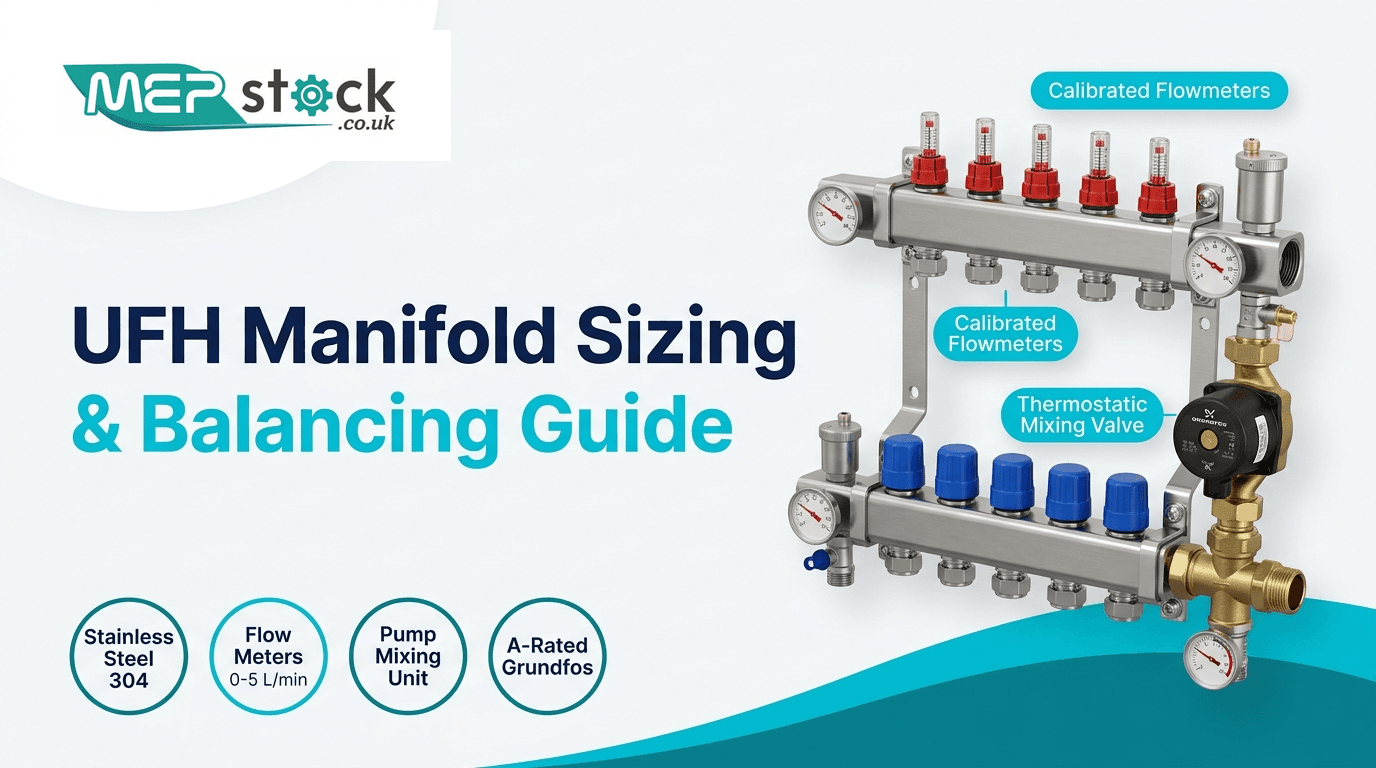
Modern commercial and residential systems utilise premium grade 304/316 stainless steel manifolds equipped with precision flow meters, electrothermic actuator valve ports, isolation ball valves, automatic air vents, and integrated drain/purge points.
Anatomy of a Modern Stainless Steel Manifold
A standard high-efficiency distribution manifold consists of two distinct horizontal rails:
- Top Flow Rail (Supply Header): Features individual transparent sight flow meters (0.5 to 5.0 l/min). Installers rotate the red or black collar on each glass cylinder to calibrate precise flow rates in litres per minute, compensating for differences in loop length and room heat demand.
- Bottom Return Rail (Return Header): Fitted with manual blue balancing caps or M30 x 1.5mm threaded ports designed to accept 230V electrothermic actuators. When a room digital thermostat calls for heat, the actuator pin opens the corresponding port.
- End Sets & Purge Assemblies: Combined automatic air vents (AAVs) to eliminate airlocks, pressure gauges (0–10 bar) for monitoring, and 3/4" drain/fill hose connection cocks.
- Circulation & Blending Unit: Compact mixing pump sets (such as Wilo or Grundfos A-rated variable speed pumps) paired with a thermostatic mixing valve (TMV) adjustable between 20°C and 60°C.
How to Size a Manifold for Your Heating Project
Sizing an underfloor heating manifold requires determining the total floor area, floor finishes, heat loss calculations, and room zoning requirements:
1. Loop Length & Port Count Calculations
For standard 16mm MLCP installed at 200mm pipe spacing, you will use approximately 5 linear metres of pipe per square metre of floor area:
- A room of 15m² requires: 15 × 5 = 75 metres of pipe → 1 Manifold Port.
- A large open-plan living area of 35m² requires: 35 × 5 = 175 metres of pipe. Because 175m exceeds the 100m single loop limit, this room must be split into two equal loops of 87.5m → 2 Manifold Ports.
2. Manifold Port Sizing Reference Table
| Manifold Size | Typical Heated Floor Area | Recommended Heat Source | Primary Connection Size |
|---|---|---|---|
| 2–3 Port Manifold | 20m² – 35m² (Single room / Extension) | Boiler sub-circuit or ASHP branch | 22mm Copper / 20mm MLCP |
| 4–6 Port Manifold | 40m² – 70m² (Apartment / Ground Floor) | Air Source Heat Pump or System Boiler | 22mm Copper / 25mm MLCP |
| 7–9 Port Manifold | 75m² – 110m² (Medium Detached Home) | System Boiler / High-Output ASHP | 28mm Copper / 25mm MLCP |
| 10–12 Port Manifold | 115m² – 160m² (Large Residential / Commercial) | Dedicated Plant Room / Buffer Tank | 28mm–35mm Copper / 32mm MLCP |
How to Calculate and Balance Flow Rates
Hydraulic balancing prevents water taking the path of least resistance (rushing through short loops while leaving long loops cold). Water flow rate is determined by the heat requirement of each room:
Flow Rate Calculation Formula:
Flow Rate (l/min) = Room Heat Requirement (Watts) ÷ (Specific Heat Capacity [4.186] × ΔT [5°C] × 60)
Rule of Thumb: For a standard 5°C design temperature drop, 1,000 Watts of heating requires approximately 2.8 litres per minute of flow.
Quick Balancing Reference Guide
- Long Loops (80m–100m - Large Living Areas): Set flow meter indicator to 2.5 to 3.0 l/min.
- Medium Loops (50m–75m - Bedrooms & Kitchens): Set flow meter indicator to 1.5 to 2.0 l/min.
- Short Loops (20m–40m - Hallways & En-suites): Throttle flow meter down to 0.8 to 1.2 l/min.
Step-by-Step Commissioning & Purging Protocol
Commissioning an underfloor heating manifold must follow BS EN 1264 standards to ensure air-free operation:
1. Individual Loop Flushing
Never open all manifold loops at once during filling—mains water pressure is insufficient to purge air from multiple loops simultaneously. Connect a mains pressure hose to the top flow rail fill cock and attach a drain hose to the bottom return drain cock leading to an outdoor drain.
Close all flow meters except Loop 1. Open the fill and drain valves until water flows completely clear with zero sputtering air bubbles. Close Loop 1 and repeat sequentially for Loop 2, Loop 3, and so on.
2. Hydraulic Pressure Testing
Once all loops are purged, close the drain valves and use a hydraulic pressure test pump to pressurise the system to 6 bar. Maintain pressure for 24 hours. The manifold pressure gauge should remain constant.
3. Setting the Mixing Valve & Actuators
Set the thermostatic mixing head between 35°C and 45°C for concrete screed (or 45°C–50°C for timber overlay systems). Screw your 230V electrothermic actuators onto the return rail and wire them into your central wiring centre paired with individual room thermostats.
Recommended Manifolds, Pumps & Heating Controls
Stainless Steel UFH Manifolds
2 to 12 port premium stainless manifolds complete with flow meters, isolation valves, and automatic air bleeders.
Manifold Pump & Mixing Packs
High-efficiency Wilo & Grundfos blending units with thermostatic mixing valves for precise water temperature control.
PERT-AL-PERT Pipe Coils
16mm 5-layer composite pipe in 100m, 200m, and 500m coils with 100% DIN 4726 oxygen barrier.
Thermostats & Wiring Centres
Programmable digital touch thermostats, wireless multi-zone controllers, and 230V electrothermic actuators.
Frequently Asked Questions
What is the maximum number of loops recommended on a single manifold?
While 12-port manifolds are readily available, best practice for large properties is to install two separate smaller manifolds (e.g. two 6-port units) placed centrally on different floors or wings. This reduces pipe run congestion in hallways and prevents excessive pressure drops on primary supply feeds.
Why are some underfloor heating loops warm while others stay cold?
This is almost always caused by an unbalance in flow rates or trapped air. Ensure the manifold was purged loop-by-loop with mains water, check that the return pin valve beneath the actuator is not stuck down, and adjust the flow meter on the cold loop to increase its litres per minute.
Do I need a pump pack if connecting to a heat pump?
If your heat pump is operating at low weather-compensated flow temperatures (35°C–40°C) and the internal heat pump circulation pump has sufficient head to overcome system resistance, a separate mixing valve may not be required. However, for systems paired with boilers or multi-temperature zones, a dedicated mixing pump pack is essential.
What size primary pipework should feed the manifold?
Manifolds up to 6 ports should be fed with minimum 22mm copper or 25mm MLCP. Manifolds with 7 to 12 ports require minimum 28mm copper or 32mm MLCP to provide the required volume of water without excessive velocity noise.
Buy Stainless Steel UFH Manifolds with Next-Day Delivery
Get competitive ex-VAT trade pricing on 2 to 12 port stainless steel manifolds, A-rated pump mixing packs, pipe coils, and smart room controls.
Shop Underfloor Heating Manifolds →