

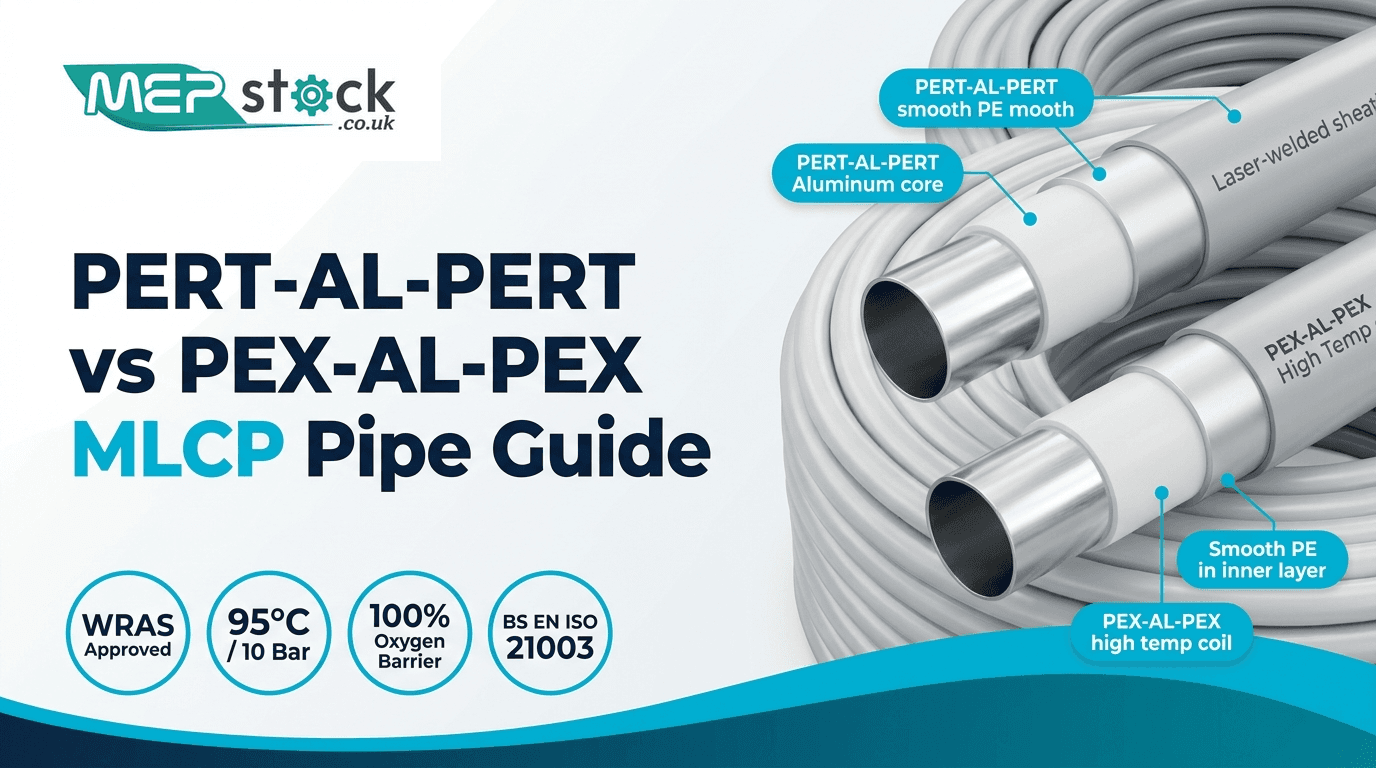
Quick Installer Summary: Which Pipe Should You Choose?
If you are deciding between multi-layer composite pipes for your next heating installation, here is the industry standard recommendation:
- Standard Underfloor Heating (35°C–45°C flow temps): Install PERT-AL-PERT Pipe Coils. PERT-II polymer offers superior flexibility, zero spring-back memory, 100% oxygen tightness (DIN 4726), and provides the most economical cost-per-metre for screeded and low-profile overlay systems.
- High-Temperature Heating & Radiator Feeds (up to 95°C): Install PEX-AL-PEX Pipe Coils. Cross-linked polymer chains deliver the thermal safety margins and pressure resilience required for boiler primaries, commercial plant rooms, and unvented hot water circuits.
- Primary Heat Pump & Manifold Distribution Runs: Always specify Pre-Insulated MLCP Pipe (Red & Blue) to eliminate parasitic heat loss between manifold zones and comply with UK Building Regulations Part L.
Why UK Heating Installers Are Switching to Multi-Layer Pipe
Over the last decade, UK heating engineers and plumbers have transitioned away from traditional copper and single-layer polybutylene (PB) or unlined PEX towards Multi-Layer Composite Pipe (MLCP). Modern low-temperature heating systems—particularly Air Source Heat Pumps (ASHPs) and condensing boilers—require pipework that combines the thermal stability and rigidity of metal with the corrosion resistance and smooth hydraulics of advanced polymers.
Within the MLCP category, two main composite constructions dominate UK specifications: PERT-AL-PERT and PEX-AL-PEX. While both incorporate an internal aluminium core providing 100% oxygen diffusion impermeability, fundamental differences in their polymer chemistry determine where each performs best.
What Is Multi-Layer Composite Pipe (MLCP)?
Unlike single-layer barrier pipes that rely on an external coating susceptible to jobsite scuffing, genuine MLCP is a co-extruded 5-layer composite engineered to BS EN ISO 21003 standards:
- Internal Polymer Layer (PERT or PEX): Mirror-smooth surface finish (roughness factor k = 0.007 mm) preventing limescale sedimentation, reducing friction, and eliminating biofilm adhesion.
- Adhesive Tie Layers: High-strength polymeric bonding agents maintaining structural cohesion across thermal cycling from -20°C to +110°C.
- Aluminium Core (100% Oxygen & Vapour Barrier): A longitudinal butt-welded aluminium cylinder that guarantees zero oxygen ingress (DIN 4726) to stop boiler corrosion, while delivering complete form stability (zero memory spring-back) so loops stay pinned in place.
- External Polymer Layer: Impact-resistant outer polymer shell shielding the aluminium core against site abrasion, concrete/screed alkalinity, and accidental gouging.
PERT vs PEX: Polymer Chemistry & Thermal Differences
Understanding PERT (Polyethylene of Raised Temperature Resistance)
PERT (specifically PERT Type II used in modern heating coils) is a high-density polyethylene polymer whose molecular chains are synthesised with targeted alpha-olefin comonomer branches. These polymer chains interlock naturally into crystalline structures that resist long-term hydrostatic pressure and elevated temperatures without requiring chemical cross-linking.
Because PERT is a thermoplastic, it remains supple and naturally elastic. When unrolling a 200m or 500m coil in cold UK winter site conditions (0°C to 5°C), PERT bends smoothly around tight 150mm UFH loop centres without pinching, buckling, or causing installer fatigue.
Understanding PEX (Cross-Linked Polyethylene)
PEX is a thermoset polymer where polyethylene molecular chains are chemically or physically cross-linked into a 3D lattice (via peroxide PEX-a, silane PEX-b, or electron beam PEX-c methods).
This cross-linking elevates the polymer's upper temperature ceiling, allowing continuous operation at 95°C and emergency excursions up to 110°C. However, this structure makes PEX noticeably stiffer than PERT, requiring mechanical pipe benders or internal bending springs on tighter radii.
Technical Comparison: PERT-AL-PERT vs PEX-AL-PEX
| Specification | PERT-AL-PERT (16mm x 2.0mm) | PEX-AL-PEX (16mm x 2.0mm) |
|---|---|---|
| Polymer Classification | Thermoplastic PERT Type II | Thermoset Cross-Linked Polyethylene |
| Standard Continuous Working Temp | 70°C (Class 4 UFH / Low-Temp Heating) | 95°C (Class 5 High-Temp Heating) |
| Maximum Peak / Malfunction Temp | 95°C (Short duration excursion) | 110°C (Malfunction limit) |
| Max Operating Pressure at 70°C | 10 Bar | 10 Bar |
| Thermal Conductivity (k) | 0.43 W/m·K | 0.43 W/m·K |
| Coefficient of Thermal Expansion | 0.026 mm/m·K (Matches copper) | 0.026 mm/m·K |
| Minimum Bend Radius (Hand / Spring) | 5 x D (80mm) / 3 x D (48mm) | 5 x D (80mm) / 4 x D (64mm) |
| Oxygen Diffusion Barrier | 100% Diffusion-Tight (DIN 4726) | 100% Diffusion-Tight (DIN 4726) |
| Expected Design Lifespan | 50+ Years (BS EN ISO 21003) | 50+ Years |
| Cost per Metre Comparison | Most Cost-Effective | ~15%–25% Premium |
Underfloor Heating Pipe Sizing & Hydraulic Calculations
When laying 16mm MLCP underfloor heating loops, adhering to proper hydraulic limits prevents system cavitation, pump overload, and uneven heat distribution across the floor:
Maximum Continuous Loop Lengths
- 16mm x 2.0mm MLCP: Maximum recommended continuous single loop length is 100 to 110 metres (including flow and return tails back to the manifold). Exceeding 110m creates excessive pressure drop (> 25 kPa), reducing circulation efficiency.
- 12mm MLCP (Low Profile Overlay): Maximum loop length is 60 to 70 metres.
- 20mm MLCP (Commercial / High Output): Maximum loop length is 120 to 140 metres.
Pipe Spacing vs Heat Output
- 150mm Pipe Centres (6.7 m of pipe per m²): High heat loss rooms (conservatories, bathrooms, older uninsulated properties, or low-temp ASHP systems operating at 35°C flow). Delivers approx. 70–100 W/m².
- 200mm Pipe Centres (5.0 m of pipe per m²): Standard modern new-builds with Part L insulation levels. Delivers approx. 50–70 W/m².
- 250mm–300mm Pipe Centres (3.5–4.0 m per m²): Super-insulated passive buildings or secondary storage areas.
Installation Guide: Best Practices & Common Mistakes
1. Professional Uncoiling
Never pull MLCP off the side of a coil horizontally—this twists the aluminium core and creates kinks. Mount your 200m or 500m coil onto a rotating Premier Pipe Uncoiler or Foldable Pipe Uncoiler. Feed the pipe through an MLCP Pipe Straightener to ensure arrow-straight presentation on castellated panels or tacker insulation.
2. Cutting and Precision Reaming
Always cut MLCP using sharp rotary pipe shears to avoid ovalising the pipe. After cutting, you must chamfer and ream the inner pipe wall using a calibrated deburring tool.
3. Jointing via M-Press or Euroconus
For manifold connections, slide the 3/4" Euroconus nut, split compression ring, and barbed insert onto the pipe and tighten securely with a spanner. For in-line fittings, tees, and elbows, use approved press fittings crimped with a Manual M-Press Fitting Tool Kit or battery press tool fitted with compatible jaws.
4. Hydraulic Pressure Testing Prior to Screed Pouring
Under BS EN 1264-4, the entire underfloor heating pipe network must be hydraulically pressure-tested with water before any screed or timber floor covering is laid:
- Purge each loop individually with clean water through the manifold drain valve until all air bubbles are expelled.
- Pressurise the system to 6 bar (or twice the working pressure).
- Maintain pressure for at least 24 hours. The pipework must remain under operating pressure during the entire screed pour to prevent pipe compression.
Recommended UFH Pipes, Tools & Manifolds
PERT-AL-PERT UFH Coils
Premium 5-layer 16mm pipe for wet UFH systems. Available in 100m, 200m, and 500m lengths with 100% oxygen barrier.
PEX-AL-PEX Heavy-Duty Coils
High-temperature cross-linked composite pipe for boiler primaries, radiator tails, and industrial heating circuits up to 95°C.
Pre-Insulated MLCP Coils
Factory pre-lagged with protective blue or red thermal insulation for hot/cold potable water and Part L heat pump primary runs.
UFH Manifolds & Pump Packs
Stainless steel 2–12 port distribution manifolds with integrated flowmeters, automatic air vents, and high-efficiency pump mixing units.
Frequently Asked Questions
Can I connect PERT-AL-PERT directly to an unvented cylinder or gas boiler flow?
No. Building regulations and boiler manufacturer guidelines state that the first 1.0 to 1.5 metres of pipework connected directly to a boiler or hot water cylinder primary flow must be rigid copper or stainless steel to withstand potential overheat cycles. Beyond that distance, PEX-AL-PEX or insulated MLCP can be safely used.
Can I repair a damaged MLCP loop inside a concrete screed?
While approved MLCP press couplers wrapped in anti-corrosion tape are technically rated for embedded screed use, best practice is to install continuous, uninterrupted loops from the manifold back to the manifold. If a loop is pierced during construction, use an M-profile or TH-profile press coupling and pressure test to 6 bar before patching screed.
What jaw profile should I use for MLCP press fittings?
Always check the fitting manufacturer's specification. Most UK MLCP press fittings utilise TH or U jaw profiles, while copper press systems use M or V profiles. Multi-profile tools like our Manual M-Press Fitting Tool Kit provide interchangeable jaws for different fitting standards.
Why does MLCP have less thermal expansion than standard plastic pipe?
Standard PEX or PB expands significantly when heated (0.15–0.20 mm/m·K), causing pipework to snake and strain fittings. Because MLCP features a solid aluminium core bonded to the polymer, the aluminium restricts linear thermal expansion to just 0.026 mm/m·K—virtually identical to copper.
Equip Your Next Heating Project with MEP Stock
Get competitive ex-VAT trade pricing on PERT-AL-PERT coils, PEX-AL-PEX, Pre-Insulated pipe, manifolds, and professional uncoiling tools with reliable UK next-day delivery.
Shop Complete Underfloor Heating Catalog →