

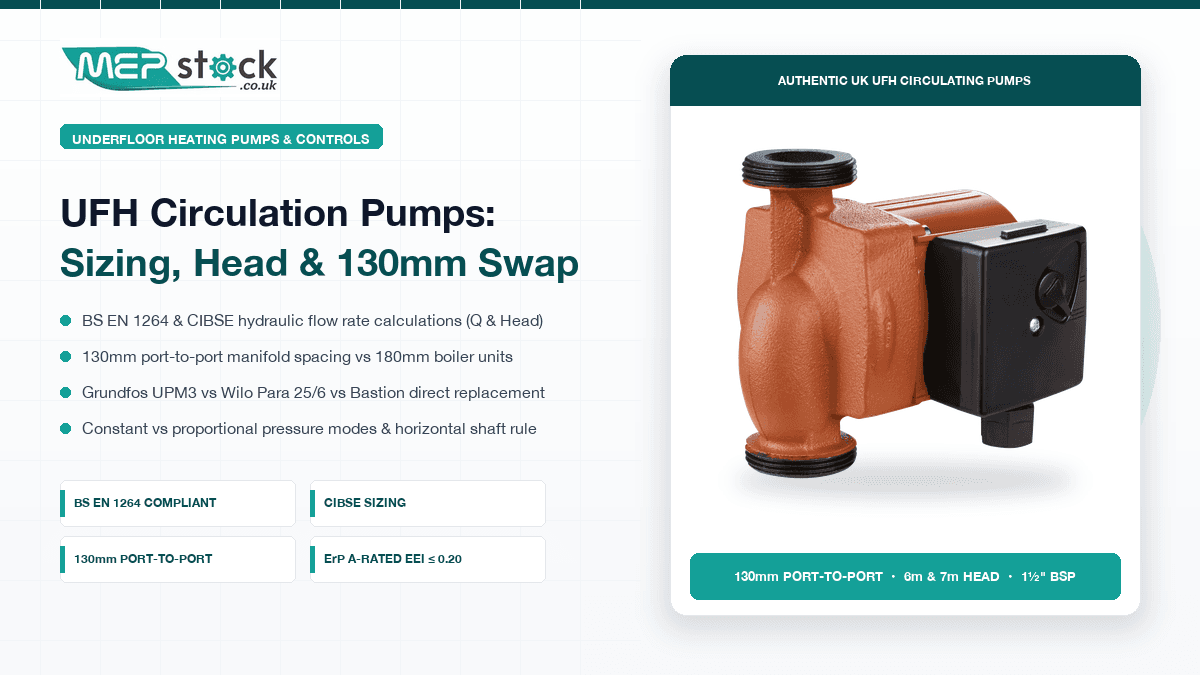
Quick Installer Summary: Underfloor Heating Pump Selection & Sizing
Direct Answer: Sizing an underfloor heating circulation pump requires matching the circuit's total flow rate ($) and friction head pressure ($). Most domestic underfloor heating manifolds (2 to 12 ports serving 30m² to 160m²) operate at a design temperature differential (ΔT) of 5°C with a total flow requirement between 0.5 and 1.8 m³/h (8 to 30 L/min) and a hydraulic head loss between 2.0m and 3.5m across the index loop.
- Port Length Standard: Manifold pump stations use compact 130mm port-to-port circulators with 1½" BSP union threads (do not confuse with standard 180mm domestic boiler circulators).
- Control Mode: Always select Proportional Pressure (Δp-v) or Constant Pressure (Δp-c) on modulating pumps like Grundfos UPM3, Wilo Para, or Bastion 6m to prevent water hammer and noise when manifold electrothermic zone actuators shut.
- Shaft Alignment Rule: The pump motor shaft must ALWAYS lie perfectly horizontal. Running a wet-rotor pump with a vertical motor shaft results in air accumulation around the bearings, cavitation, and premature motor burnout within 6 to 18 months.
Recommended 130mm Replacement Pumps (In Stock for Next-Day Delivery)
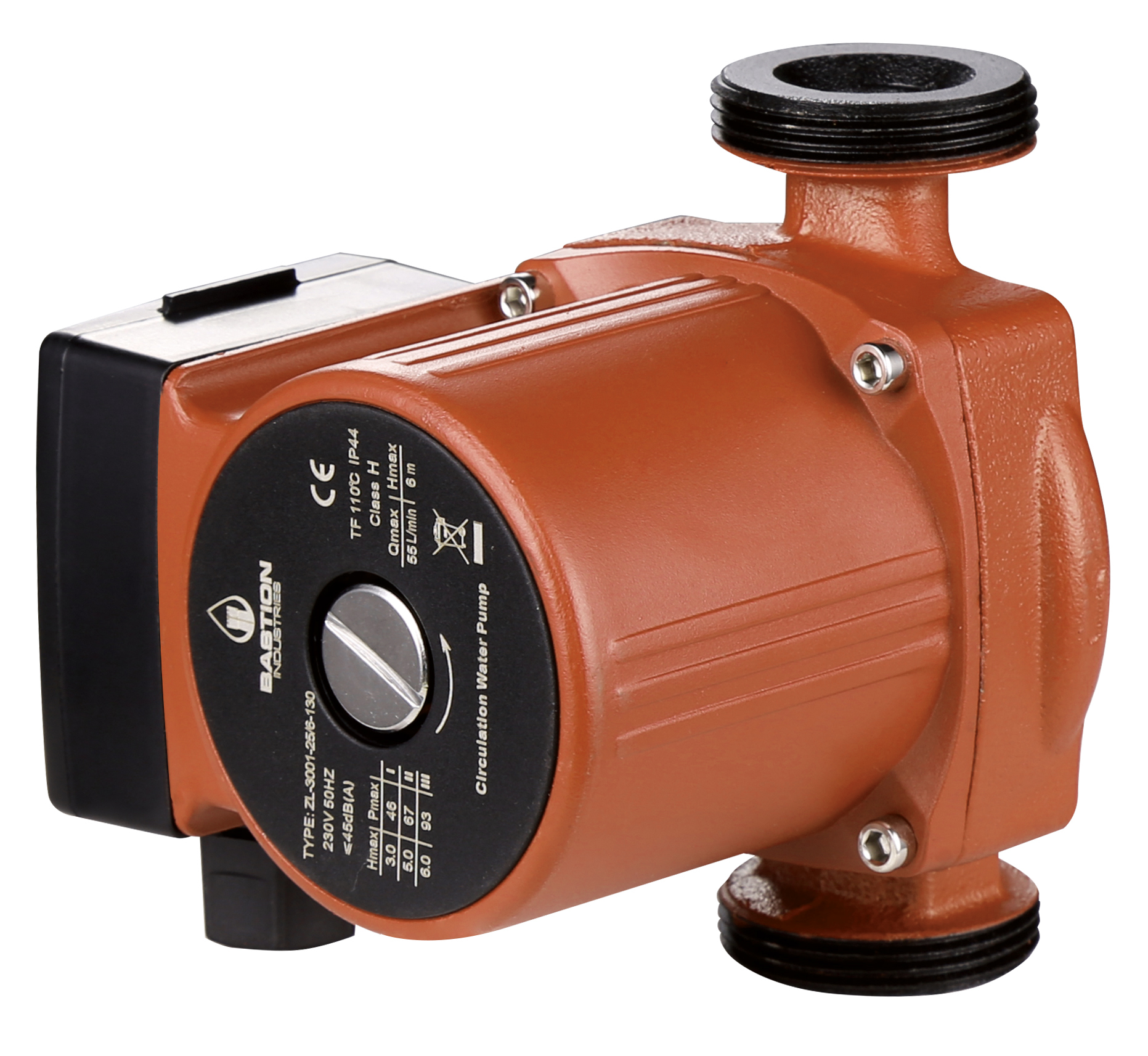 BEST VALUE
Bastion 130mm Central Heating Circulating Pump (6m Head)
- 130mm port-to-port manifold direct fit
- 6 Metre maximum head / 1½" BSP unions
- ErP A-rated energy efficiency
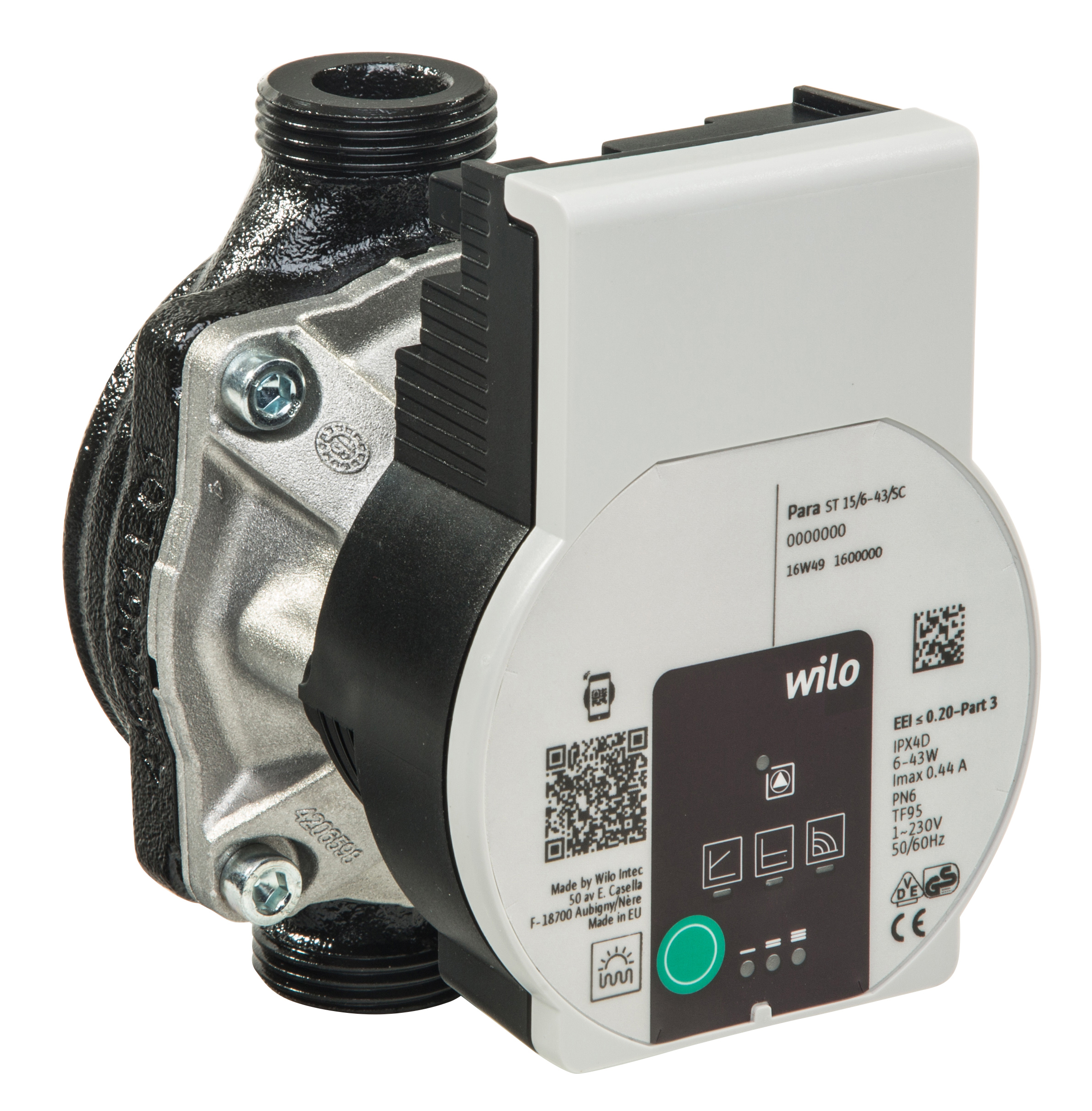 OEM STANDARD
Wilo A-Rated 6m Circulating Pump with Cable
- Factory-fitted molex power wiring harness
- Direct swap for Wilo Para, Yonos & OEM manifold packs
- Δp-v, Δp-c and 3-speed manual presets
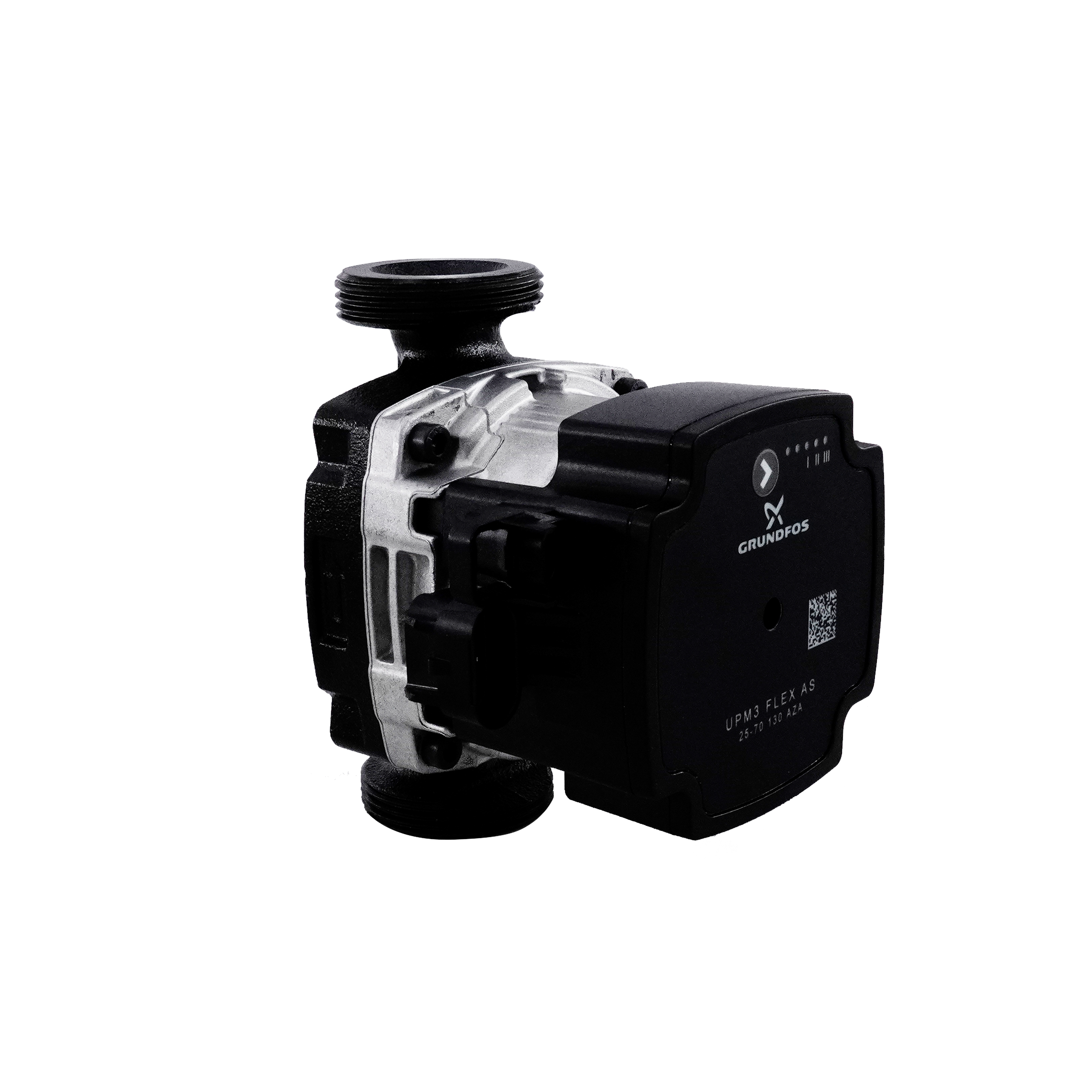 HIGH-HEAD (7M)
Grundfos UPM3 Circulating Pump - Flex & AUTO (7m Head)
- Up to 7 Metres head for multi-port 8–12 port loops
- Auto-modulating proportional pressure algorithm
- Universal replacement for Grundfos UPM2 / UPS2
Hydraulic Sizing Fundamentals: The CIBSE & BS EN 1264 Equation
Underfloor heating operates at significantly lower flow temperatures (32°C to 45°C) than high-temperature copper radiator circuits (65°C to 75°C). Because radiant heat transfer depends on surface floor emission, the design temperature differential between manifold flow and return is tight—typically ΔT = 5°C (or 7°C for heat pump systems).
To deliver sufficient heat across all loops, the circulating pump must move substantially higher water volumes than a radiator circuit of equivalent kilowatt rating.
Calculating Required Flow Rate ($)
The total system mass flow rate is governed by the thermodynamic heat load formula:
Q = Φ / (c · ρ · ΔT)
Where:
- Φ (Heat Output): Design heat loss of all heated rooms combined (Watts, W). Typical UK domestic rooms require 50W/m² to 75W/m².
- c (Specific Heat Capacity of Water): 4,186 J/(kg·K).
- ρ (Water Density): ~1,000 kg/m³.
- ΔT (Temperature Difference): Flow temperature minus return temperature (typically 5°C).
Practical Installer Rule of Thumb: For standard 16mm x 2mm pipe spaced at 200mm centres, each square metre of heated floor requires approximately 0.12 to 0.16 litres per minute (L/min). A 100m² underfloor heating zone therefore demands:
100 m² × 0.14 L/min = 14.0 L/min (0.84 m³/hour)
Calculating Index Loop Head Loss ($)
In a closed hydronic circuit, the pump does not lift water against gravity (geodetic height is zero). The pump solely overcomes viscous fluid friction against the inner walls of the composite pipe, manifold valves, and blending units.
Critical Calculation Rule: Never sum the lengths of all loops together. You must calculate the friction loss of the single longest loop (the index circuit) plus the distribution manifold and blending unit pressure drop:
H_total = Δp_pipe + Δp_manifold + Δp_blending + Δp_valves
- Pipe Friction: 100 metres of 16mm MLCP/PERT pipe operating at 2.0 L/min generates ~15 to 20 kPa of friction head (approx. 1.5m to 2.0m head).
- Manifold & Mixing Block: The thermostatic mixing valve, pump isolation valves, and flow meters add approximately 10 to 12 kPa (1.0m to 1.2m head).
- Total Duty Head Required: 2.5m to 3.2m hydraulic head.
Comparing Leading 130mm Underfloor Heating Circulators
When replacing an existing manifold pump or building a new distribution board, installers must evaluate motor efficiency, electronics reliability, warranty, and plug-and-play wiring connectors.
1. Grundfos UPM3 Auto (130mm, 1½" BSP)
The benchmark OEM pump specified by leading manifold manufacturers across Europe. Features an electronically commutated motor (ECM) with permanent magnet rotor and frequency converter.
- Maximum Head: 7.0 metres.
- Energy Efficiency Index (EEI): ≤ 0.20 (compliant with EU/UK Ecodesign directives).
- Control Modes: Proportional pressure, constant pressure, constant curve, and PWM digital signal control.
- Diagnostic Indication: Front face bi-colour LED display indicates operating mode, flow status, and blocked rotor error codes.
2. Wilo Para 25/6 (130mm, 1½" BSP)
Renowned for rugged cast iron volute build quality and user-friendly wiring. The tool-free Wilo-Connector clip allows connection without opening the terminal electrical box.
- Maximum Head: 6.2 metres.
- Air Bleeding Mode: Dedicated de-aeration routine cleans air bubbles from the wet-rotor chamber automatically upon commissioning.
- Self-Protection: High starting torque with automatic unblocking software pulses the rotor if limescale accumulates during summer downtime.
3. Bastion A-Rated 6m Circulator (130mm, 1½" BSP)
The trade favourite for cost-effective retrofit replacement and new domestic installations. Combines full ErP A-rated energy efficiency with robust cast bronze/iron construction at trade prices.
- Maximum Head: 6.0 metres.
- Complete Pack: Supplied with 1.0m pre-wired silicone cable and heavy-duty 1½" rubber sealing washers.
- Affordability: Up to 35% lower cost than OEM branded replacements with matching flange dimensions and hydraulic duty curves.
Upgrade Your UFH Manifold Pump Today
Shop authentic 130mm A-rated underfloor heating circulation pumps from Grundfos, Wilo, and Bastion. In stock with next-day UK trade delivery ex VAT.
Shop Pumps & Mixer Packs →Step-by-Step 130mm Manifold Pump Replacement Protocol
Swapping an underfloor heating circulation pump takes less than 25 minutes when executed according to standard CIBSE commissioning protocol. Follow these steps:
Step 1: Electrical & Hydraulic Isolation
- Isolate the main 230V electrical supply to the underfloor heating wiring centre or boiler spur. Verify dead with a calibrated multimeter or voltage tester.
- Close the dedicated 1½" pump isolation ball valves located immediately above and below the pump body. Turn the butterfly handle 90 degrees until perpendicular to the pipe.
- If the pump valves do not shut off completely, turn off the primary boiler flow and return isolation valves to avoid draining the main central heating circuit.
Step 2: Uncoupling & Removal
- Disconnect the power lead (unclip the Wilo-Connector or unscrew the terminal face plug).
- Place a shallow catch-tray and absorbent plumbers' towels underneath the pump station.
- Hold the pump body firmly with wide-jaw water pump pliers or a footprint wrench. Use an adjustable spanner to loosen the upper 1½" union nut clockwise, then loosen the bottom nut.
- Carefully slide the old 130mm pump body away from the brass manifold unions.
- Discard the old perished rubber washers. Wire-brush the brass union seating faces to remove dried scale, flux, and magnetite deposits.
Step 3: Installation & Horizontal Shaft Verification
- Verify the directional flow arrow stamped on the cast iron pump volute. On underfloor heating mixing manifolds, water must flow downward from the mixing valve into the bottom flow manifold rail (or upward depending on your specific manifold design).
- Insert brand-new high-temperature EPDM rubber sealing washers into the union nuts.
- Position the new 130mm pump squarely between the unions. CRITICAL: Ensure the motor electrical terminal box is accessible and the motor shaft is completely horizontal. Never mount the pump pointing vertically up or down.
- Hand-tighten both union nuts to prevent cross-threading, then tighten an additional ⅓ to ½ turn with a spanner. Avoid overtightening into brass flanges.
Step 4: De-aeration & Commissioning
- Slowly open the lower pump isolation valve first, allowing water to fill the pump chamber. Then open the upper isolation valve.
- Inspect for weepage around both union washer joints.
- Re-connect the 230V power supply lead to the wiring centre terminal (Live, Neutral, Earth).
- Power up the system and run the pump's automatic de-aeration cycle (on Wilo models) or manually open the manifold's top automatic air vent (AAV) screw to expel microbubbles.
- Set the pump controller to Proportional Pressure Mode II or Constant Pressure Mode II. Observe the glass flow meters on the upper manifold rail to ensure uniform flow distribution across all zones.
Frequently Asked Questions About Underfloor Heating Pumps
What is the difference between a 130mm and 180mm circulation pump?
A 130mm pump has a compact port-to-port dimension of 130 millimetres, specifically engineered to fit the tight vertical spacing of underfloor heating manifold blending packs. Standard domestic central heating and boiler circulators measure 180mm port-to-port. Attempting to fit a 180mm pump onto an underfloor heating manifold will not physically align with the brass union centres.
Why should an underfloor heating pump run on Proportional Pressure mode?
In an underfloor heating system, electrothermic actuators open and close individual circuits as room thermostats reach temperature. In fixed-speed mode, closing 6 out of 8 loops causes the pump's pressure to spike across the remaining 2 open loops, resulting in whistling valve noise, water hammer, and excessive power draw. In Proportional Pressure mode (Δp-v), the pump's variable speed inverter automatically throttles down motor RPM as zone valves close, maintaining ideal flow velocity and cutting electricity consumption by up to 80%.
Can I replace a Grundfos UPM3 with a Bastion or Wilo pump?
Yes. Provided the replacement pump has identical 130mm port-to-port length and 1½" BSP union connection threads with equal or greater head pressure (6m or 7m), the pumps are 100% hydraulically interchangeable. Bastion and Wilo models drop directly onto existing Grundfos manifold union valves without modifying pipework.
How do I know if my underfloor heating pump has failed?
Common symptoms of pump failure include: the boiler firing but all manifold flow meter floats staying pinned at 0 L/min; the pump body feeling boiling hot while the manifold pipes stay lukewarm (indicating a jammed rotor); strange grinding or rattling noises (bearing wear or cavitation); or electrical tripping at the consumer unit.