

Quick Trade Summary: Electric vs Wet Underfloor Heating
Deciding between Electric (Dry) and Hydronic (Wet / Water) underfloor heating is governed by floor area, build-up depth, heat source, and lifetime operating expenditure:
- Hydronic (Wet) UFH (Best for Whole-House, Extensions & New Builds): Circulates warm water (35°C to 45°C) through embedded 16mm MLCP (PERT-AL-PERT) pipe connected to a boiler or heat pump via a stainless steel manifold. Delivers 3.5x to 4x lower running costs (~3.5p–5p / kWh with an Air Source Heat Pump) and high thermal inertia. Floor build-up ranges from 15mm (low-profile dry panels) to 65mm–75mm (screeded).
- Electric (Dry) UFH (Best for Small Single-Room Bathrooms & En-Suites): Uses thin resistance heating cable mats (150W/m²–200W/m²) laid directly in the tile adhesive layer (3mm–5mm build-up). Low upfront capital cost and zero structural floor disruption, but incurs significantly higher operating costs (~24p–28p / kWh).
- UK Building Regulations (Part L 2025): Mandates that all newly installed wet heating systems operate at design flow temperatures of 55°C or below. Hydronic UFH satisfies this requirement inherently, maximizing heat pump efficiency (SCOP > 3.8).
System Anatomy and Mechanical Principles: How Both Systems Operate
Both electric and hydronic underfloor heating operate as low-temperature radiant emitters. Rather than heating air convection currents that rise directly to the ceiling (as conventional steel panel radiators do), radiant floor heating turns the entire floor slab into a thermal emitter, warming people and solid objects directly from floor level.
Hydronic (Wet / Water) System Anatomy
- Continuous 16mm MLCP Pipe: High-density PERT-AL-PERT multilayer pipe with an integrated 100% oxygen barrier, laid in continuous loops (max 100m per circuit) with zero sub-floor joints.
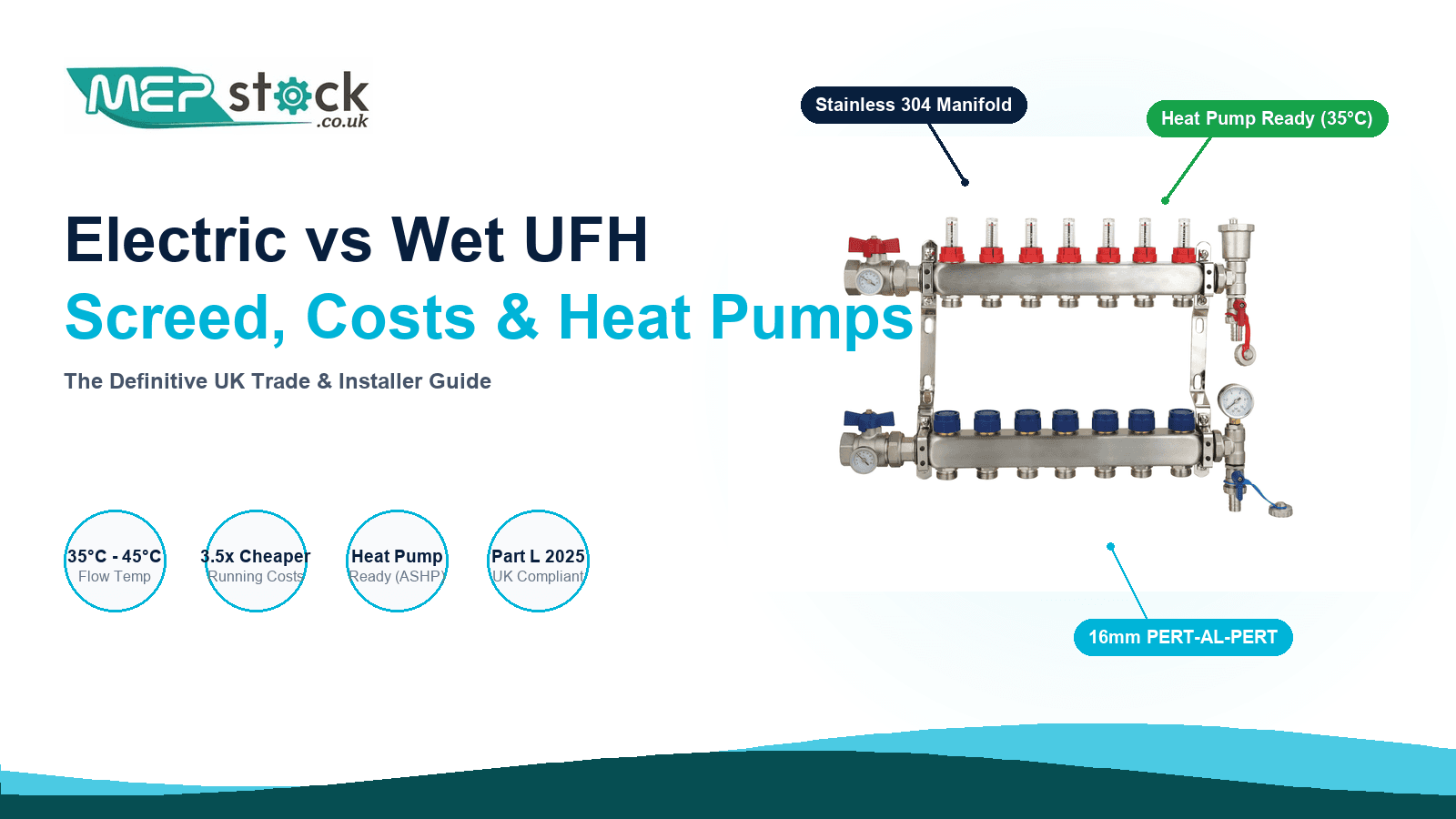
- Grade 304 Stainless Steel Manifold: Heavy-duty distribution header with top-mounted flow meters (0–5 L/min), return balancing valves, and electro-thermal actuators.
- Pump & Blending Unit: Thermostatic mixing valve paired with an A-rated circulating pump (e.g. Grundfos UPM3) to blend high boiler water down to 35°C–45°C.
- Subfloor Insulation: Minimum 50mm–100mm PIR insulation board (e.g. Celotex/Kingspan) to prevent downward thermal loss.
Electric (Dry / Wire) System Anatomy
- Dual-Core Resistance Heating Mat: Thin fluoropolymer-coated resistance heating wire pre-spaced on self-adhesive fibreglass mesh (150W/m² or 200W/m² output).
- Cold Tail Feed Cable: 3m–4m insulated non-heating power cable connecting the floor mat to the wall thermostat / RCD supply.
- Embedded Floor Temperature Probe: NTC thermistor sensor installed in flexible conduit between heating wire runs to cap floor surface temperature at 27°C.
- Insulation Backer Board: 6mm–10mm coated extruded polystyrene tile backer boards to direct heat upwards into tiles.
Technical Comparison Matrix: Electric vs Wet Underfloor Heating
| Criteria / Metric | Hydronic (Wet / Water) UFH | Electric (Dry / Wire) UFH |
|---|---|---|
| Running Cost per Unit Energy | ~3.5p – 6.0p / kWh (ASHP with SCOP 3.5+ or Gas Condensing Boiler) | ~24.0p – 28.0p / kWh (Standard UK Electricity Tariff) |
| Initial Capital / Installation Cost | £70 – £120 / m² (Including pipe, manifold, pump pack & screed) | £25 – £50 / m² (Low upfront equipment cost) |
| Floor Build-Up Height | 15mm–20mm (Low-profile overlay) to 65mm–75mm (Screeded) | 3mm – 5mm (Lays directly within flexible tile adhesive) |
| Heat-Up Response Time | 2 to 4 hours (Screed thermal mass absorbs and radiates heat) | 20 to 35 minutes (Direct rapid warmth underfoot) |
| Thermal Retention After Shutdown | 6 to 10 hours of residual thermal storage | 15 to 30 minutes (Cools rapidly once power is disconnected) |
| Best Application Scope | Whole house new builds, extensions, open-plan kitchens (> 20m²) | Single bathrooms, en-suites, small cloakrooms (< 10m²) |
| Lifespan of Core Element | 50+ years (BS EN ISO 21003 PERT-AL-PERT multilayer pipe) | 15 to 25 years (Subject to floor substrate movement) |
Screed Sizing, Depths and Floor Build-Up Guide
When installing hydronic underfloor heating, selecting the correct screed type determines the floor’s thermal inertia, drying time, and overall structural height:
| Screed / Substrate Type | Minimum Thickness | Cover Above Pipe | Thermal Conductivity (λ) | Curing Time Before Commissioning |
|---|---|---|---|---|
| Traditional Sand & Cement (1:4) | 65 mm – 75 mm | 45 mm – 50 mm | 1.2 W/mK | 21 to 28 days |
| Liquid Anhydrite (Flowing Screed) | 45 mm – 50 mm | 25 mm – 30 mm | 2.0 W/mK (+60% Heat Transfer) | 7 to 14 days |
| Low-Profile Overlay Panels (Dry) | 15 mm – 18 mm | Foil / Gypsum flush | Foil diffusion layer | 0 Days (Instant dry laying) |
| Electric Mat in Tile Adhesive | 3 mm – 5 mm | Adhesive level | Direct tile contact | 7 days (Adhesive cure) |
Heat Pump Integration & UK Building Regulations Part L
Under the Future Homes Standard & Building Regulations Approved Document L, all new space heating systems in England and Wales must be designed for maximum water flow temperatures not exceeding 55°C:
Heat Pump Efficiency Ratio: COP = Heat Output (kW) / Electrical Input (kW)
When supplying water at 35°C to a hydronic UFH manifold, an Air Source Heat Pump operates at peak efficiency (COP 4.2 to 4.8). If forced to heat water to 65°C for conventional radiators, COP falls to 2.2, doubling running costs.
Trade-Grade Underfloor Heating Manifolds, MLCP Pipe & Controls
Grade 304 stainless steel manifolds, WRAS approved PERT-AL-PERT pipe coils, and Grundfos blending units.
Stainless Steel UFH Manifolds
2 to 12 port stainless steel manifolds complete with flow meters (0–5 L/min), automatic air vents, and fill/drain valves.
16mm PERT-AL-PERT MLCP Pipe
100m, 200m, and 500m coils of 5-layer 100% oxygen diffusion tight multilayer pipe. 50-year warranty.
Full-Bore Lever Ball Valves
1" female BSP red and blue lever ball valves for manifold primary isolation with zero flow restriction.
Frequently Asked Questions (People Also Ask)
Is wet underfloor heating cheaper to run than electric underfloor heating?
Yes, significantly cheaper. Hydronic underfloor heating powered by a modern gas condensing boiler costs around 6p to 7p per kWh, and when powered by an Air Source Heat Pump (ASHP) with a COP of 4.0, running costs drop to approximately 4p to 5p per kWh of delivered heat. In contrast, electric resistance heating mats draw power directly from the grid at standard electricity rates of 24p to 28p per kWh, making wet systems 3.5x to 4x cheaper to run.
Can you install wet underfloor heating upstairs on timber joists?
Yes. Upstairs timber joist floors cannot take heavy sand and cement screed due to weight restrictions. Instead, installers use aluminium heat spreader plates fitted between the floor joists (with insulation batts below) or low-profile 18mm high-density gypsum overlay panels laid directly across the existing floorboards.
Can wet underfloor heating run from a combi boiler without a hot water cylinder?
Yes. Combi boilers can easily power a wet underfloor heating manifold via a blending pump unit. The pump set mixes hot boiler flow water (typically 65°C) with cooler return water from the floor loops to deliver a safe, regulated 35°C to 45°C flow temperature into the PERT-AL-PERT pipework.
What is the maximum floor temperature allowed for wooden and vinyl floors?
Under BS EN 1264, the maximum permissible floor surface temperature for timber, engineered wood, laminate, and Luxury Vinyl Tiles (LVT / Karndean / Amtico) is 27°C. Operating above 27°C causes adhesive softening, plank warping, or wood shrinkage. Floor temperature limit probes connected to digital thermostats ensure this threshold is never exceeded.
How long does a wet underfloor heating system take to heat up?
A standard 65mm–75mm screeded wet system takes 2 to 4 hours to reach full operating temperature because it heats the entire screed thermal mass. However, once up to temperature, it retains and radiates heat for 6 to 10 hours after the boiler turns off. Low-profile overlay panels heat up in 30 to 45 minutes.