

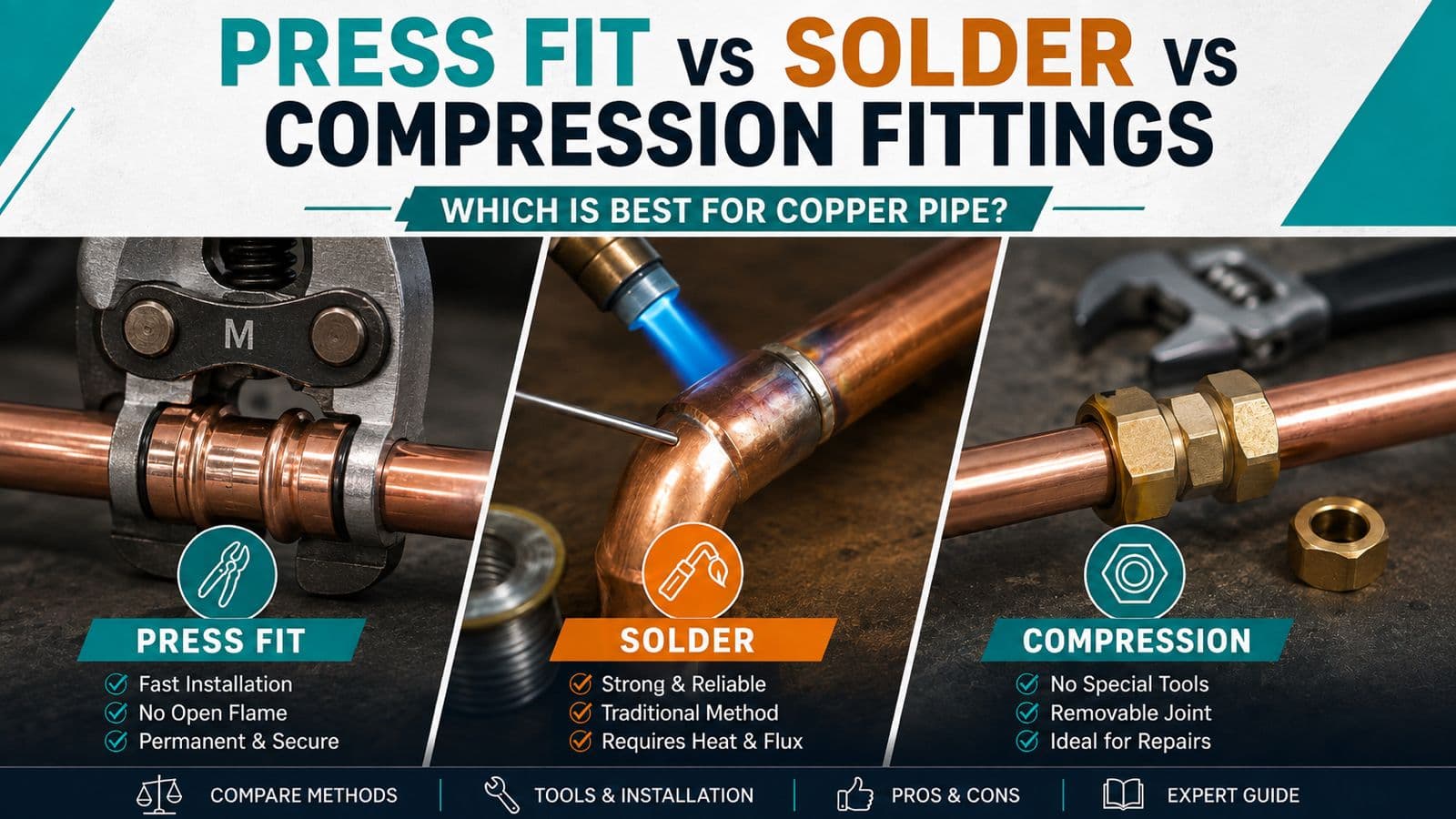
Press fit is fastest and flame-free but needs a press tool; soldering is cheapest per joint and strongest once mastered; compression is the easiest for repairs and DIY. For most trade installs today, press fit wins on labour time.
The main difference is how the fitting creates and maintains the joint around the copper pipe.
A press fitting is mechanically compressed around the pipe using a powered pressing tool.
A solder fitting is joined to the copper pipe by heating the joint and allowing solder to form the connection between the prepared surfaces.
A compression fitting mechanically grips and seals the pipe by tightening a nut against a compression ring or olive.
All three methods can create effective copper pipe connections when the correct products are selected and installed correctly.
However, the tools, installation process and practical advantages are very different.
What Is a Copper Press-Fit Connection?
A copper press-fit connection uses a specially designed fitting that is pressed onto compatible copper tube.
The fitting normally contains a factory-installed sealing element. Once the pipe has been correctly prepared and inserted to the required depth, a compatible press jaw or ring is positioned around the fitting.
The press tool then completes a controlled pressing cycle.
This permanently forms the fitting around the pipe and its sealing element.
For the MEP Stock Press Fit Water range, the relevant fittings use an M Profile pressing system, so the correct M Profile jaw and compatible pressing equipment must be used.
A typical press-fit installation involves:
- Cutting the copper pipe square.
- Deburring the inside and outside edges.
- Checking and cleaning the pipe.
- Inspecting the fitting and sealing element.
- Marking the correct insertion depth.
- Inserting the pipe fully.
- Positioning the correct press jaw.
- Completing the full press cycle.
- Inspecting the joint.
- Testing the completed system.
Because no soldering flame is required, press fitting is often described as a flame-free copper pipe jointing method.
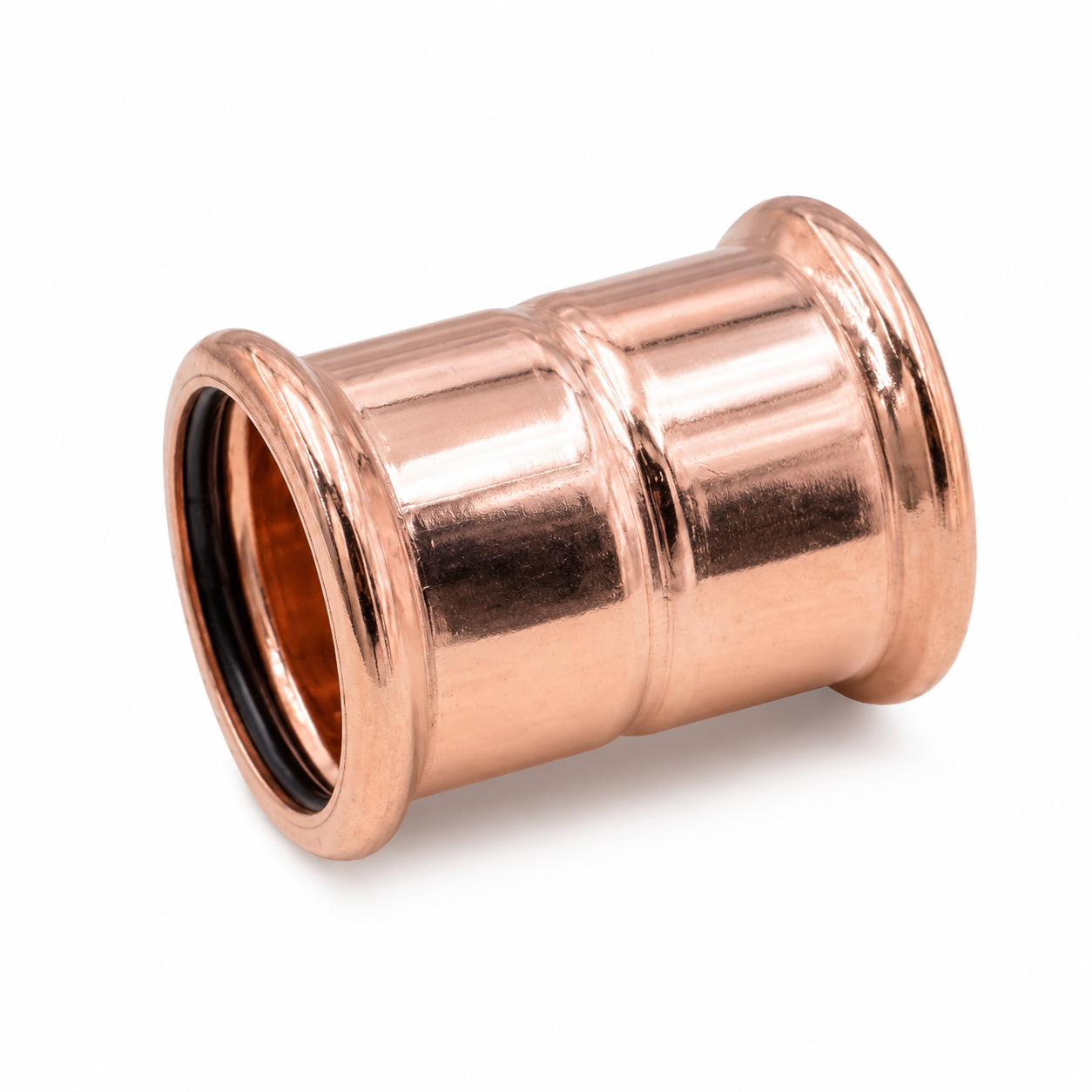 WRAS APPROVED • M PROFILE
Copper M Profile Press Fit Water Straight Coupling
WRAS-approved permanent copper press-fit coupling with factory-fitted EPDM seals. Engineered for rapid flame-free jointing on commercial and domestic water installations.
Shop Press Coupling →
What Is a Soldered Copper Connection?
Copper M Profile Press Fit Water Straight Coupling
WRAS-approved permanent copper press-fit coupling with factory-fitted EPDM seals. Engineered for rapid flame-free jointing on commercial and domestic water installations.
Shop Press Coupling →A soldered copper joint uses heat to draw solder into the small gap between compatible copper pipe and a fitting.
The installer normally:
- Cuts and prepares the copper tube.
- Cleans the pipe and fitting surfaces.
- Applies the appropriate flux where required.
- Assembles the connection.
- Heats the fitting.
- Applies solder.
- Allows the joint to cool.
- Cleans and inspects the finished connection.
When performed correctly, soldering produces a compact permanent joint and has been widely used in copper plumbing systems for many years.
However, it depends heavily on correct preparation.
Contaminated surfaces, remaining water in the pipe, insufficient heat, excessive heat or poor solder distribution can all affect the finished joint.
Soldering also introduces an open flame or high-temperature heat source into the installation area.
That makes the working environment an important part of the decision.
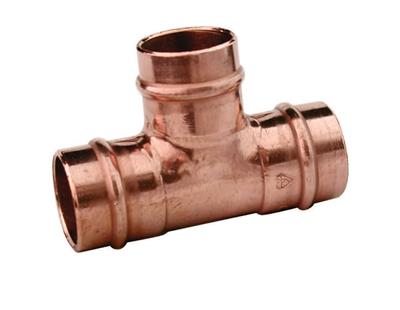 BS EN 1254-1 • PRE-LOADED SOLDER
Solder Ring Equal Tee Copper Plumbing Pipe Fitting
High-purity UK manufactured copper fitting with pre-loaded lead-free solder ring. Delivers capillary flow and proven high-integrity joints across hot and cold services.
Shop Solder Equal Tee →
What Is a Compression Fitting?
Solder Ring Equal Tee Copper Plumbing Pipe Fitting
High-purity UK manufactured copper fitting with pre-loaded lead-free solder ring. Delivers capillary flow and proven high-integrity joints across hot and cold services.
Shop Solder Equal Tee →A compression fitting connects copper pipe mechanically.
Instead of solder or a press tool, the fitting normally uses:
- A compression nut
- A compression ring or olive
- A fitting body
As the nut is tightened, the olive compresses around the pipe and creates the mechanical seal.
Compression fittings are commonly found around:
- Isolation valves
- Taps
- Appliances
- Heating components
- Repair work
- Connections that may need future access
They are particularly useful when an installer wants a flame-free connection without purchasing or carrying a press machine.
However, using large numbers of compression fittings across an entire installation may take more time and create bulkier joints than a purpose-designed press-fit system.
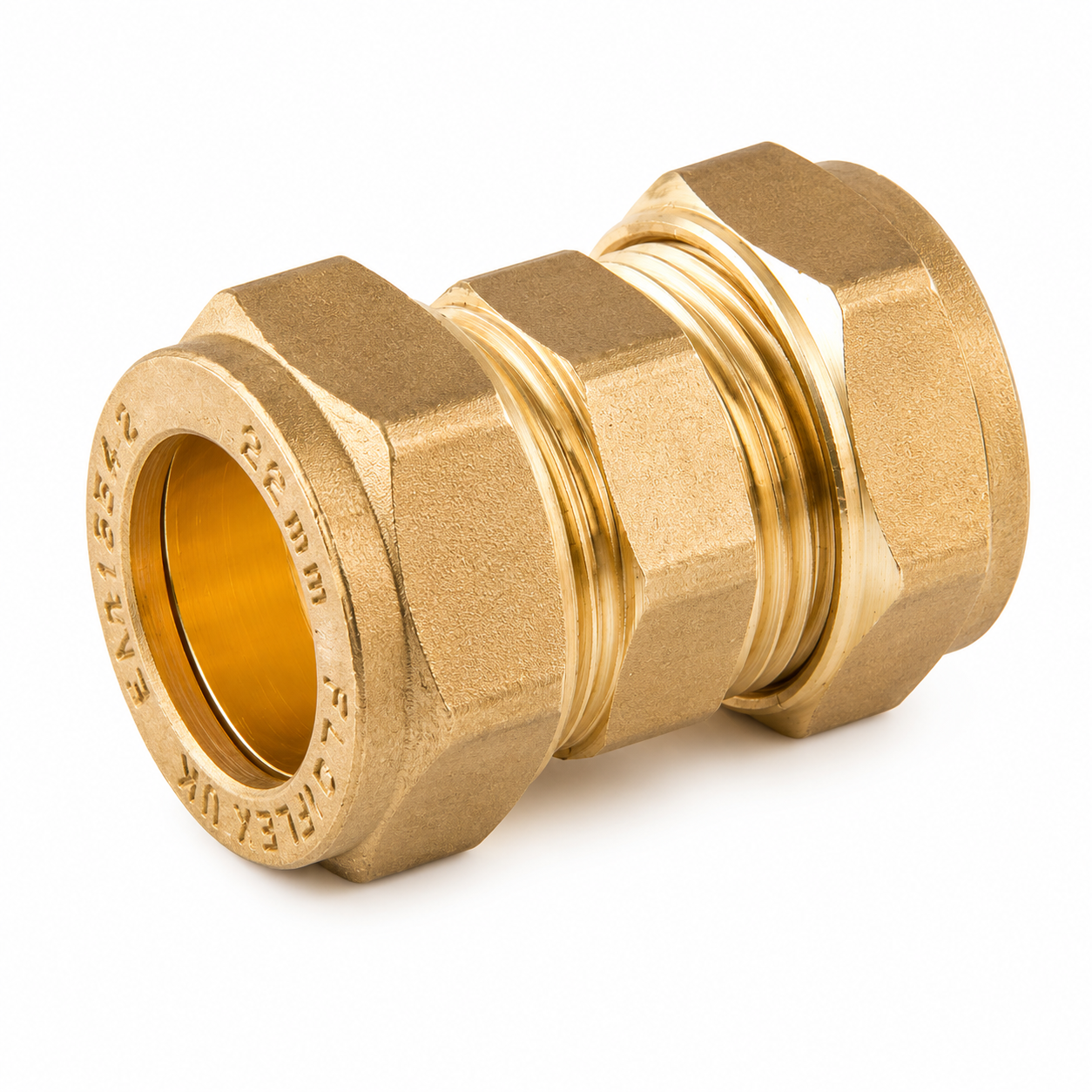 BS EN 1254-2 • FLAME-FREE DEMOUNTABLE
Brass Compression Straight Coupling
Heavyweight dezincification resistant (DZR) brass compression coupler with precision copper olive. Ideal for service valves, demountable joints, and flame-free repairs.
Shop Compression Coupler →
Press Fit vs Solder: What Is the Main Difference?
Brass Compression Straight Coupling
Heavyweight dezincification resistant (DZR) brass compression coupler with precision copper olive. Ideal for service valves, demountable joints, and flame-free repairs.
Shop Compression Coupler →The biggest practical difference is that press fitting creates the joint mechanically, while soldering creates the joint using heat and solder.
This affects almost every part of the installation.
Press fit does not require an open flame
A press fitting is mechanically pressed using a compatible tool.
Soldering requires heat.
This difference can matter when working near:
- Timber
- Insulation
- Existing decoration
- Confined plant areas
- Occupied buildings
- Sensitive equipment
- Areas where hot-work controls apply
A flame-free method does not mean that the overall installation is automatically risk-free. Normal electrical, mechanical, pressure and site-safety procedures still apply.
But removing the soldering flame can simplify some installation environments.
Which Is Faster: Press Fit or Solder?
For repeated pipe connections, press fit will usually allow joints to be completed considerably faster than traditional soldering.
Once the pipe has been properly prepared:
- Insert the pipe.
- Position the jaw.
- Complete the press cycle.
There is no need to heat the fitting, apply solder and wait for the joint to cool.
This speed advantage becomes more significant when an installer is completing dozens or hundreds of fittings.
For example, consider an installation requiring:
- 40 elbows
- 25 couplings
- 15 tees
- 10 reducers
That is 90 individual fitting connections.
Saving time on every joint can produce a meaningful reduction in total installation time.
This is one reason press fitting is attractive for larger domestic, commercial and mechanical-services installations.
Does That Mean Press Fit Is Always Better Than Solder?
No.
A faster installation method is not automatically the best method for every project.
Solder may remain practical where:
- The installer already has the correct equipment.
- Only a small number of joints are required.
- Press-tool access is difficult.
- The project has been designed around soldered fittings.
- The installer is highly experienced with soldering.
- Initial tool investment is a major consideration.
Press fit becomes increasingly attractive when installation speed, repeatability and flame-free working are important.
Press Fit vs Compression Fittings
Press fitting and compression fitting share one important characteristic:
Neither method normally requires soldering the joint.
However, they create the connection in very different ways.
A press fitting is permanently formed around the pipe using a powered tool.
A compression fitting is tightened mechanically using a nut and olive.
Press fit is better suited to repeated permanent connections
For a large copper pipe installation, using a press tool can make repeated joints fast and consistent.
Typical examples include:
- Couplings
- Elbows
- Tees
- Reducers
- Crossovers
- End caps
- Press valves
Once the installation workflow is established, the installer can move systematically through the pipework.
Compression fittings are useful where future access is important
Compression fittings can be particularly convenient around equipment or components that may need to be disconnected later. You can explore our extensive selection of standard Compression Fittings as well as specialist MLCP Compression Fittings designed for modern composite pipe networks.
Examples might include certain:
- Valves
- Taps
- Appliances
- Service connections
- Maintenance points
The exact connection type should always be chosen according to the component manufacturer’s instructions and system design.
Which Is Faster: Press Fit or Compression?
For a small number of fittings, the difference may not be important.
For a larger installation, press fit usually becomes much more efficient.
A compression connection requires the installer to:
- Position the nut.
- Position the olive.
- Insert the pipe.
- Hold the fitting correctly.
- Tighten the connection to the appropriate level.
A press connection still requires careful pipe preparation, but the final joint is completed by the press machine.
When the same operation is repeated across a large system, press fitting can significantly streamline the workflow.
Which Method Requires the Most Tools?
Press fit
Press installation normally requires:
- Pipe cutter
- Deburring/calibrating equipment as specified
- Marker or insertion-depth gauge
- Compatible press machine
- Correct profile press jaw or ring
- Suitable inspection/testing equipment
The important additional investment is the press machine and jaws. For professional contractors seeking high installation speed and reliability, an 18V Electric Hydraulic Press Tool Kit (25kN) with interchangeable M-profile jaws provides the ideal battery-powered solution.
Solder
Soldering normally requires:
- Pipe cutter
- Cleaning tools
- Flux where applicable
- Solder
- Heat source
- Heat protection
- Suitable fire-safety equipment
- Joint cleaning equipment
The initial tooling cost can be lower than purchasing a professional pressing machine.
Compression
Compression fitting normally needs comparatively simple hand tools:
- Pipe cutter
- Deburring tool
- Suitable spanners or wrenches
- Other preparation tools specified for the installation
For occasional connections, compression can therefore have the lowest equipment barrier.
Which Is Best in Confined Spaces?
There is no universal winner because tool access determines whether the connection can actually be completed.
Press fit
Press fitting is useful in many confined locations because there is no need to position a flame around the fitting.
However, sufficient room is still needed for:
- The press jaw
- The press machine
- Correct jaw positioning
- The machine to complete its cycle
Large fittings may require rings or slings rather than standard jaws.
Solder
Soldering may be physically possible in tight spaces, but the installer also needs to consider the heat around the fitting and nearby surfaces.
Compression
Compression can work well where spanners can reach the nut.
However, extremely tight spaces can make it difficult to hold the fitting and achieve proper tightening.
So the correct question is not simply:
Which method works in tight spaces?
It is:
Which installation tool can be correctly and safely positioned around this particular connection?
Press Fit vs Solder vs Compression: Full Comparison
| Feature | Press Fit | Solder | Compression |
|---|---|---|---|
| Connection method | Mechanically pressed | Heat and solder | Nut and olive |
| Open flame | No | Yes | No |
| Powered tool required | Yes | No | No |
| Specialist jaw required | Yes | No | No |
| Installation speed at scale | Excellent | Moderate | Moderate |
| Permanent joint | Yes | Yes | Typically mechanically demountable |
| Initial tool cost | Higher | Lower | Low |
| Repeated installation | Excellent | Good | Fair |
| Joint size | Compact | Very compact | Usually larger |
| Confined-space suitability | Good when jaw fits | Depends on safe heat access | Good where spanner access exists |
| Hot-work considerations | Reduced | Required | None from jointing method |
| Skill required | Correct preparation and tooling | Strong soldering technique | Correct assembly and tightening |
| Useful for maintenance connections | Sometimes | Less convenient | Often |
| Large installation efficiency | Excellent | Good | Usually less efficient |
Which Connection Looks Neatest?
All three systems can produce professional-looking pipework when installed correctly.
However, their physical appearance differs.
Solder fittings
Soldered fittings can produce a very compact traditional copper installation.
Press fittings
Press fittings have visible formed ends and are slightly more substantial around the joint, but a carefully planned press installation can still look extremely clean and professional.
Compression fittings
Compression fittings have nuts around the connection, making them physically larger and more visually noticeable.
This is one reason compression fittings are often used selectively instead of for every connection in exposed pipework.
Which Method Is Best When Water Is Still in the Pipe?
This is an important practical distinction.
Soldering generally requires the joint area to be dry enough to heat correctly. Remaining water can absorb heat and make achieving the necessary joint temperature difficult.
Press fitting does not depend on heating the joint.
That can make it useful during certain repair or refurbishment situations where completely drying nearby pipework is difficult.
However, this does not mean every press fitting can simply be installed onto a wet, dirty or poorly prepared pipe.
The pipe surface, fitting and sealing area must still meet the manufacturer's installation requirements.
Which Method Is Best for New Installations?
For a professional installation involving a large number of copper connections, press fitting can offer a strong combination of speed, repeatability and flame-free installation.
This is particularly relevant to projects involving repeated:
- Straight couplings
- Elbows
- Tees
- Reducing fittings
- Threaded adaptors
- Valves
But system design comes first.
The installer should confirm:
- Pipe specification
- Fitting compatibility
- Application
- Operating conditions
- Required approvals
- Tool compatibility
- Project specification
The joining method should follow those requirements rather than being selected only because one fitting is quicker to install.
Which Method Is Best for Repairs?
It depends on the repair.
Press fit can be useful when:
- A permanent repair is required.
- A flame-free connection is preferred.
- The correct press machine and fitting are available.
- Tool access is sufficient.
A slip coupling, for example, may be useful in certain press-fit repair situations.
Compression can be useful when:
- The connection must remain accessible.
- Only one or two joints are required.
- A press machine is unavailable.
- Future disassembly may be desirable.
Solder may be useful when:
- The existing installation is already soldered.
- The installer has suitable access.
- The pipe can be properly prepared and dried.
- Hot work can be carried out safely.
There is no responsible answer that says one system wins every repair scenario.
What About the Cost?
This is where many comparisons become misleading.
Looking only at the fitting price does not tell you the total installation cost.
A proper comparison should consider:
Total installation cost = material + tools + labour + preparation + access + site controls + testing
Press fit
The fitting itself may cost more than a basic soldered fitting, and the pressing equipment represents an additional investment.
But labour savings can become important across a large installation.
Solder
Individual fittings and basic equipment may be inexpensive, but more installation time may be required.
Hot-work requirements can also add practical costs on certain sites.
Compression
Compression fittings require little specialist equipment but are not necessarily the most economical solution for hundreds of permanent joints.
For a professional contractor, the cheapest fitting is therefore not always the cheapest installed connection.
Is Press Fit More Reliable Than Solder?
This question needs careful wording.
A high-quality correctly installed press joint can be highly reliable.
A correctly soldered joint can also be highly reliable.
A correctly installed compression fitting can also provide reliable service within its intended application.
Problems normally arise when one or more requirements are ignored.
For press fittings, common installation errors can include:
- Incorrect jaw profile
- Incorrect jaw size
- Damaged sealing element
- Poorly prepared pipe
- Insufficient insertion
- Misaligned fitting
- Incomplete press cycle
- Using an incompatible pipe or fitting
For solder fittings, problems may include:
- Poor surface preparation
- Water remaining in the joint
- Incorrect heating
- Poor solder penetration
- Contamination
- Excessive heat
For compression fittings, problems may include:
- Incorrectly positioned olive
- Damaged pipe
- Misalignment
- Insufficient tightening
- Excessive tightening
- Reusing unsuitable components
Therefore the better question is:
Which system can be installed correctly and consistently for this particular application?
When Should You Choose Press Fit?
Press fitting can be an excellent choice when:
- Many copper joints are required.
- Installation speed matters.
- Flame-free working is desirable.
- You already have compatible pressing equipment.
- The correct jaw profile and size are available.
- The system specification permits press fittings.
- Consistent repeated installation is important.
For customers choosing M Profile water fittings, MEP Stock offers product types including:
- Straight couplings
- Slip couplings
- Reducers
- 45° elbows
- 90° elbows
- Street elbows
- Equal tees
- Reducing tees
- BSP adaptors
- Crossovers
- End caps
- Press-fit valves
When Should You Choose Solder?
Soldering may make sense when:
- Only a small number of copper joints are required.
- The installer already has suitable soldering equipment.
- The surrounding environment is appropriate for hot work.
- The existing pipework uses soldered fittings.
- A compact traditional copper joint is preferred.
- The project specification requires or permits soldering.
The presence of newer press systems does not automatically make soldering obsolete.
It remains an established method when used correctly.
When Should You Choose Compression?
Compression fittings may be suitable when:
- A connection needs to remain accessible.
- Future removal may be necessary.
- Only a limited number of joints are required.
- A press machine is not available.
- Open-flame jointing is undesirable.
- The component itself uses compression connections.
They are commonly useful around serviceable components rather than being selected simply as a replacement for every press or solder connection in an installation.
Press Fit vs Solder vs Compression: Which One Should You Choose?
If the priority is fast, repeatable installation across many copper connections, press fit is often the strongest option.
If the priority is a traditional compact permanent copper joint with minimal specialist tool investment, soldering may remain suitable.
If the priority is a straightforward mechanical connection that can remain accessible, compression may be the practical choice.
The decision should ultimately be based on:
- The system specification.
- Pipe compatibility.
- Intended application.
- Working pressure and temperature.
- Required approvals.
- Installation environment.
- Tool access.
- Number of connections.
- Future maintenance requirements.
- Manufacturer instructions.
There should never be a decision based only on which fitting happens to be cheapest.
Frequently Asked Questions
What is a press fitting?
A press fitting is a mechanical pipe joint that uses an internal EPDM O-ring seal compressed onto copper pipe using a specialised pressing tool. It provides a permanent, leak-free connection in seconds without heat, solder, or flux.
Are compression fittings as good as solder?
Compression fittings are highly reliable for accessible, serviceable joints and repairs where heat cannot be used. However, soldered joints are more compact, permanent, and generally preferred inside concealed walls or floors where mechanical joints are discouraged.
Which is faster, press fit or solder?
Press fit is substantially faster, taking roughly 5 to 10 seconds per joint with zero cooling, cleaning flux residue, or hot-works cooldown time. On commercial or whole-house installations, press fit cuts pipework labour time by up to 50% compared to soldering.
Is press fit better than soldering?
Press fit can be faster and does not require an open flame, making it attractive for many professional installations. Soldering remains a proven connection method and may be more economical where only a small number of joints are required. The best choice depends on the system, site conditions, tooling and project requirements.
Is press fit stronger than compression?
The two connections work differently and should not be compared only by perceived strength. A press joint is intended as a permanent mechanically pressed connection, while a compression fitting relies on a nut and olive. Both must be used within their approved applications.
Do press fittings need solder?
No. A press fitting is mechanically formed around compatible pipe using a press machine and the correct jaw or ring.
Do compression fittings need solder?
No. Compression fittings create the connection mechanically using a compression nut and olive.
Can press fittings be used instead of solder fittings?
They can be used where the selected press-fitting system is approved for the pipework, application and operating conditions. The installation must follow the fitting and tool manufacturer's requirements.
Do I need a special tool for copper press fittings?
Yes. Press fittings require a compatible press machine and the correct jaw or ring for the fitting profile and size.
What does M Profile mean?
M Profile describes the pressing contour required by a compatible press-fitting system. An M Profile fitting needs the appropriate M Profile pressing jaw or ring in the correct size.
Are press fittings reusable?
A fitting that has been fully pressed should be treated as a permanent connection and should not be removed and reused as a new fitting.
Are compression fittings reusable?
Some components may be removable, but that does not mean every olive, nut or fitting should automatically be reused. Follow the product manufacturer's instructions and inspect all components before reassembly.
Choosing Copper Fittings for Your Next Project
Press fit, solder and compression are not competing answers to exactly the same problem.
Each is a different method of connecting copper pipe, with its own advantages.
For larger installations where speed, repeatability and flame-free jointing are important, M Profile press fitting is particularly attractive.
The key is to treat the fitting as part of a complete system:
pipe + fitting + seal + tool + application + installation method.
Never select a fitting based only on diameter or appearance.
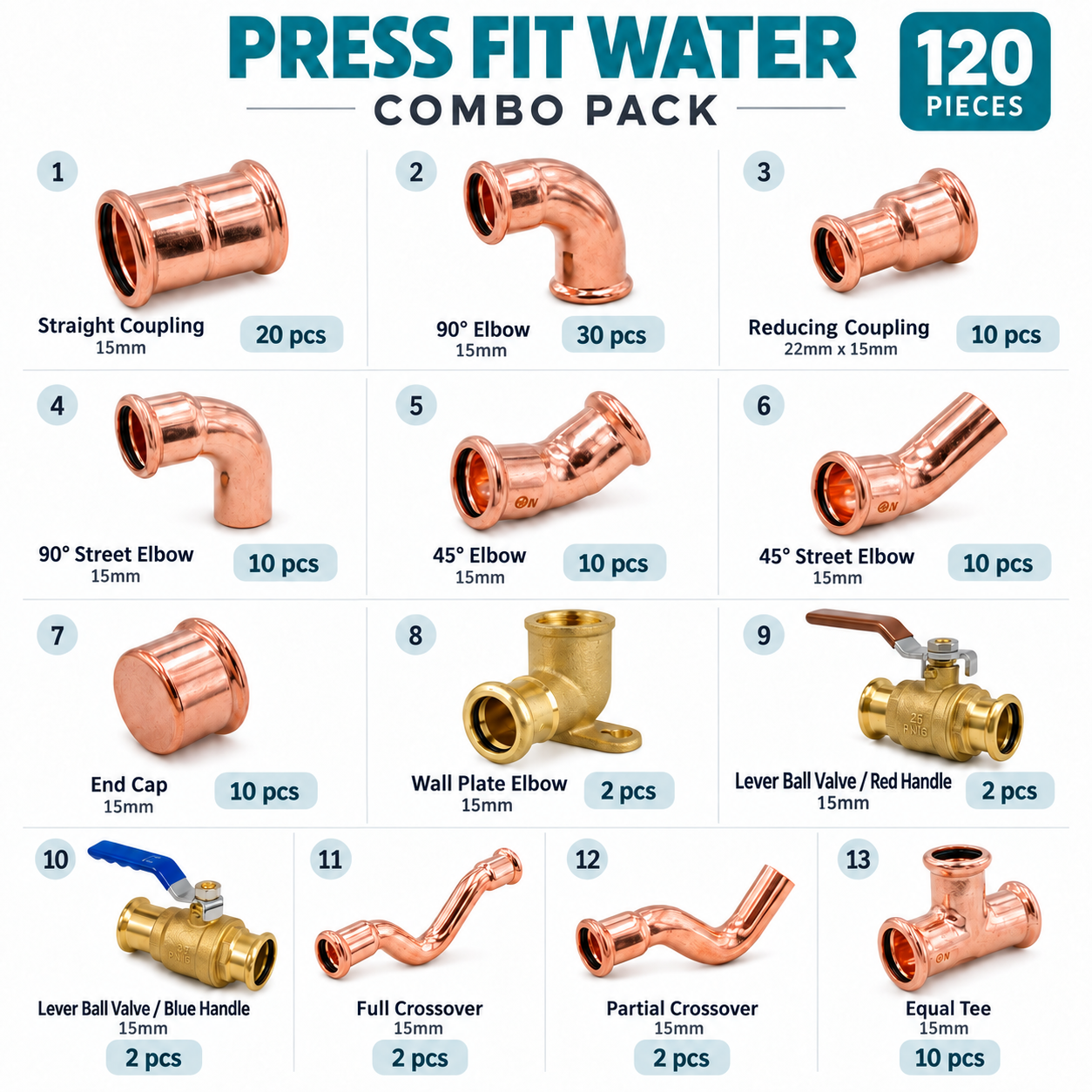 CONTRACTOR PACK • 120 PIECES
15mm Press Fit Water Fittings Combo Pack (120 Pieces)
Essential trade contractor bundle containing elbows, tees, couplings, reducers, and stop ends in a sturdy organiser case. Maximum convenience and ex-VAT savings.
View Contractor Combo Pack →
Shop M Profile Copper Press Fittings for Water
15mm Press Fit Water Fittings Combo Pack (120 Pieces)
Essential trade contractor bundle containing elbows, tees, couplings, reducers, and stop ends in a sturdy organiser case. Maximum convenience and ex-VAT savings.
View Contractor Combo Pack →Explore the MEP Stock Press Fit Water range for M Profile copper:
- Couplings
- Elbows
- Tees
- Reducers
- Threaded adaptors
- Crossovers
- End caps
- Valves