

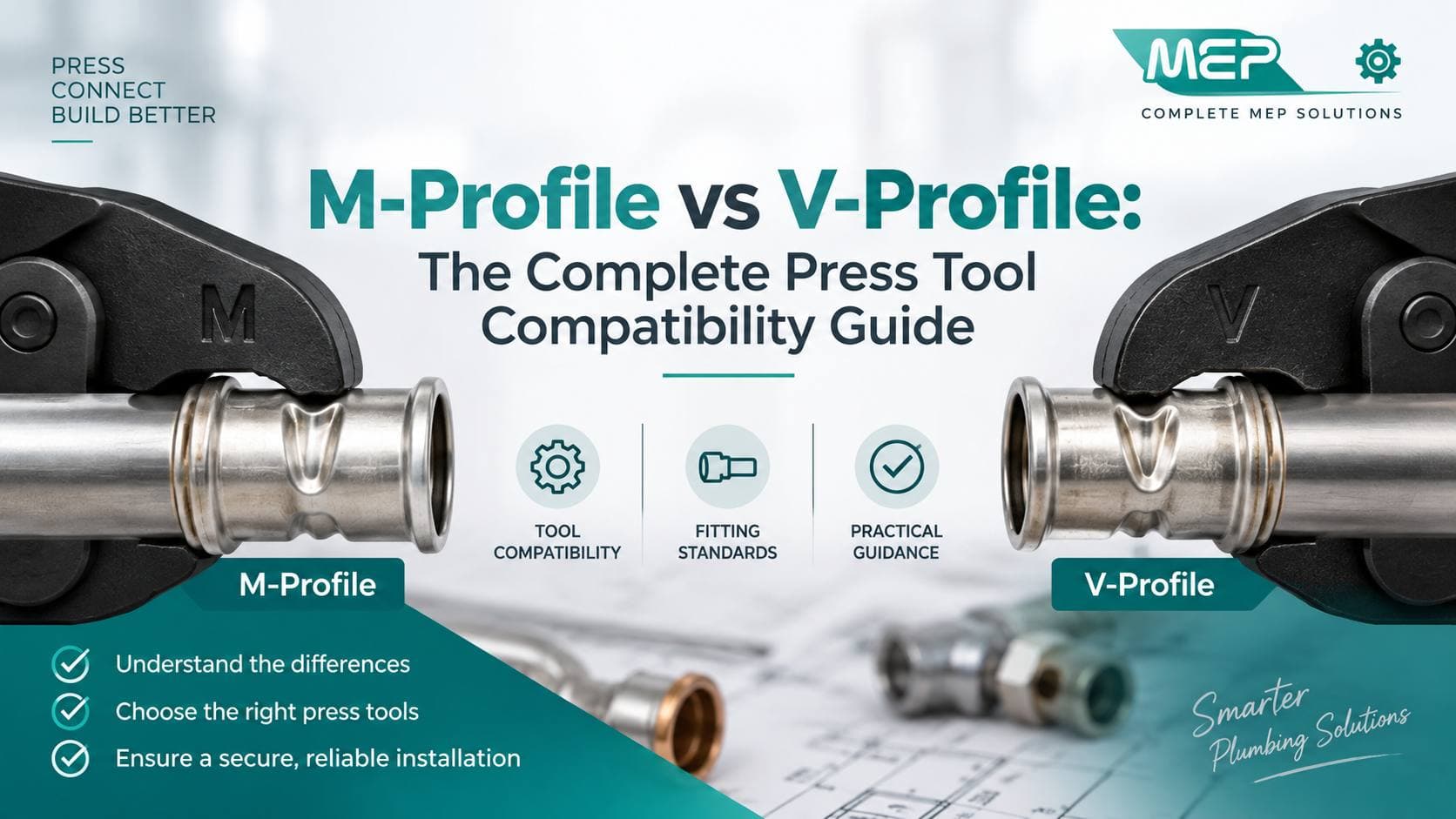
Press-fit plumbing has become an increasingly popular alternative to traditional soldered connections in the UK. For installers, the attraction is clear: press systems can significantly speed up installation, eliminate open-flame work and provide consistent mechanical connections when the correct pipe, fitting and tooling system is used.
But there is one part of press-fit installation that should never be treated as a guess: press profile compatibility.
M-Profile and V-Profile are two of the press contours installers are most likely to encounter. Although the differences may look small, the jaw or pressing ring must be compatible with the fitting system being installed. Using a profile that has not been approved for the fitting can result in an incorrectly formed connection, potentially leading to leakage or other system problems.
This is particularly important when working with different manufacturers' fittings, press tools and jaws. A press machine being physically capable of accepting a particular jaw does not automatically mean that the resulting combination is approved for every fitting.
In this guide, we explain the difference between M-Profile and V-Profile, how press profiles work, how to check compatibility and what installers should consider before making a press connection.
Quick rule: Always follow the fitting manufacturer's installation instructions and compatibility chart. Match the jaw or pressing ring to the fitting system—not simply to the brand of press machine.
What Is a Press Profile?
A press profile is the specific shape or contour formed by the pressing jaw, ring or sling around a press fitting during installation.
When the press tool is activated, the jaw applies a controlled force to the fitting. The fitting sleeve is deformed according to the specified contour, creating the mechanical connection between the fitting and the pipe while the internal sealing element forms the required seal.
The exact pressing geometry varies between systems. This is why an M-Profile jaw should not automatically be substituted with a V-Profile jaw simply because both are designed for press fittings.
For example, Geberit states that its Mapress fittings use an M-contour and are not compatible with V-contour tools.
Similarly, manufacturers publish specific tool compatibility information for their fitting systems. Conex Bänninger, for example, directs installers to its tool compatibility information and states that its >B< Press fittings in sizes 12–54 mm can be installed using B or V profile jaws.
Why Does the Profile Matter?
The pressing contour determines where and how force is applied to the fitting.
The fitting, pipe and sealing element are designed as a system. The correct jaw profile applies the required deformation in the intended location, helping the completed connection achieve the performance specified by the manufacturer.
Using an incorrect or unapproved profile can therefore mean that the fitting is not pressed as designed.
This is why installers should avoid choosing a jaw based purely on appearance or assuming that a similar-looking profile will work.
How Do You Identify the Profile?
Before pressing, check:
- The marking on the fitting
- The profile marking on the jaw or pressing ring
- The fitting manufacturer's installation instructions
- The manufacturer's press-tool compatibility chart
- The pipe diameter and fitting size
- Any requirements relating to the specific press machine or tool
Some manufacturers also provide markings on the completed pressed joint. Geberit's technical documentation, for example, explains how markings on pressed joints can identify the pressing attachment used.
The safest approach is simple: check the manufacturer's documentation before pressing rather than relying on a generic M/V compatibility assumption.
What Is M-Profile?
M-Profile, sometimes referred to as an M-contour, is a press profile widely used across metal press-fitting systems.
One of the best-known examples is Geberit Mapress, whose fittings use an M-contour. Geberit specifically states that Mapress fittings are not compatible with V-contour tools.
M-Profile systems are used across a range of plumbing, heating and other building-services applications, depending on the particular fitting material, seal and manufacturer approval.
How Does M-Profile Work?
The M-profile jaw is shaped to produce the pressing contour specified by the fitting manufacturer.
During pressing, the fitting sleeve is formed around the pipe and sealing area. The resulting mechanical deformation provides the connection's holding force, while the sealing element provides the required seal.
The important point for installers is that the M shape is not simply a visual preference. It forms part of the engineered connection system.
Where Is M-Profile Used?
M-profile systems can be found in applications including:
- Domestic plumbing
- Commercial plumbing
- Heating installations
- Water distribution
- Industrial applications
- Gas applications where the specific fitting and seal are approved for gas
The actual application depends on the individual fitting system. For example, Geberit offers different sealing materials and system configurations for different media and operating conditions.
M-Profile Fittings at MEP Stock
For installers looking for M-profile copper press fittings, MEP Stock also has a dedicated range covering common fitting types and sizes.
Browse M-Profile Copper Press Fittings at MEP Stock
When selecting a fitting, check the fitting profile, tube compatibility, diameter and intended application before choosing the corresponding jaw.
What Is V-Profile?
V-Profile is another established press contour used by a number of press-fitting systems.
It is important, however, not to describe V-Profile as simply the "British standard" or assume that every UK press fitting uses V jaws. Compatibility is manufacturer- and system-specific.
For example, Conex Bänninger states that its >B< Press fittings can be installed using B or V profile jaws, subject to its compatibility requirements.
V-profile systems are commonly encountered by UK plumbing and heating installers, particularly in domestic and building-services applications.
How Does V-Profile Work?
Like other approved press contours, the V-profile jaw applies a controlled deformation to the fitting at the locations specified by the fitting manufacturer.
The finished joint depends on the complete system working together:
Pipe + fitting + sealing element + correct jaw/profile + compatible press tool
Changing one part of that combination without checking compatibility can affect the finished connection.
For this reason, installers should always check the technical documentation for the exact fitting being installed.
Important Installer Note
M-Profile is not automatically "better" than V-Profile, and V-Profile is not automatically "better" than M-Profile.
The correct profile is the one specified and approved for the particular fitting system.
That distinction is going to be one of the most important SEO/value points of this article because it prevents us from giving installers an oversimplified M-vs-V answer.
The Golden Rule of Press Compatibility
When working with press-fit plumbing, there is one rule that should always take priority:
Never choose a press jaw based only on the brand of your press machine. Check that the jaw and profile are specifically approved for the fitting system you are installing.
A press tool is only one part of the connection. The complete system includes the pipe, fitting, sealing element, press jaw or ring and press machine. These components need to work together according to the fitting manufacturer's specifications.
This is why simply owning an M-profile or V-profile jaw does not mean it can be used on every fitting of the same size.
Do the Jaw and Fitting Profile Have to Match?
In general, the jaw or pressing ring must use the profile specified or approved by the fitting manufacturer.
For example, Geberit Mapress fittings use an M-contour and Geberit specifically states that they are not compatible with V-contour tools.
However, compatibility is not always as simple as saying "M fittings need M jaws and V fittings need V jaws."
Some manufacturers approve more than one profile for a particular fitting system.
A good example is Conex Bänninger >B< Press. Its documentation states that >B< Press fittings can be installed using approved B or V profile jaws, while its tool compatibility charts identify the specific press machines and jaws that have been tested and approved or deemed compatible.
The lesson for installers is simple: the manufacturer's compatibility chart takes precedence over a generic M-versus-V rule.
What Happens If You Use the Wrong Profile?
Using an incorrect or unapproved profile can prevent the fitting from being formed in the way it was designed.
The consequences can include:
- An incorrectly formed press connection
- Poor or compromised sealing
- Leakage during commissioning or service
- Premature joint failure
- Damage to the fitting or sealing element
- Non-compliance with the manufacturer's installation requirements
- Potential warranty implications
This is why a jaw that physically fits your press machine is not necessarily a suitable jaw for the fitting.
For example, Geberit's technical documentation specifies that its pressing attachments are designed for Geberit system pipes and fittings and that only specified or approved pressing tools should be used.
Don't Assume "Same Size" Means "Same Profile"
This is another common point of confusion.
Imagine you have a 22mm press fitting and a 22mm press jaw.
That does not automatically mean the jaw is suitable.
The diameter may be correct while the pressing contour is wrong.
Think of it as:
Correct diameter ≠ automatically correct press system
You need to verify:
Fitting → Profile → Jaw → Press machine → Manufacturer approval
Can You Use a Different Brand of Press Tool?
Sometimes, yes—but only when the fitting manufacturer approves that particular tool and jaw combination.
The brand of the press machine alone does not determine compatibility.
For example, Conex Bänninger publishes detailed compatibility charts showing which press machines and jaw sets can be used with its >B< Press fittings. Its charts include equipment from manufacturers such as Rothenberger, REMS, Novopress, Milwaukee, Ridgid, Hilti and Viega.
This means an installer may be able to use a different manufacturer's press machine, but the exact machine, jaw, profile and fitting combination must be checked.
A Practical Example
Suppose you own a Milwaukee press machine.
That does not mean you can simply purchase any Milwaukee jaw marked "V" or "M" and use it on any press fitting.
Instead, check:
- The manufacturer of the fitting
- The exact fitting range
- The fitting diameter
- The approved profile
- The compatible jaw
- The compatible press machine
- Any limitations on compact versus standard tools
This extra check takes very little time compared with repairing a failed joint.
What About Mixing M-Profile and V-Profile?
This is where installers need to be particularly careful.
Do not assume that an M-profile fitting can be pressed with a V-profile jaw, or vice versa.
Some systems specifically prohibit this. Geberit Mapress, for example, states that its M-contour fittings are not compatible with V-contour tools.
Other manufacturers may approve multiple profiles for a particular fitting range. Conex Bänninger's >B< Press is one example where the manufacturer provides approved compatibility for B and V profiles and publishes the relevant tool charts.
Therefore, the correct approach is:
Don't ask "Can M and V be mixed?" Ask "Does the fitting manufacturer approve this exact jaw/profile combination?"
That is the question that matters.
What About the O-Ring?
The sealing element is another reason installers should avoid experimenting with press profiles.
The press fitting is designed around a particular geometry, including the position of the sealing element. During pressing, the fitting and sealing system must respond correctly to the force applied by the approved pressing attachment.
Different systems can also use different sealing materials depending on the intended application. For example, Geberit Mapress systems use different seal materials for different operating conditions and media.
So you should never assume that a fitting is suitable for a particular application simply because it physically fits the pipe.
Always check:
- The fitting specification
- Seal material
- Operating temperature
- Pressure rating
- Intended medium
- Applicable approvals
- Manufacturer installation instructions
What About Manufacturer Warranties?
Correct tooling is not just about producing a good-looking joint.
It can also form part of the manufacturer's installation requirements.
Geberit's technical documentation, for example, states that its pressing tools and attachments are specifically designed for its systems and identifies requirements around compatible tools and original pressing attachments.
This is why installers should retain the manufacturer's technical documentation and use the approved tooling specified for the particular system.
If a joint fails, being able to demonstrate that the correct components and approved installation procedure were used can be important.
Never rely on a generic statement such as "this jaw normally works with press fittings." Check the manufacturer's current compatibility information for the exact product.
The 30-Second Compatibility Check
Before pressing a joint, run through this quick checklist:
1. Identify the fitting
What manufacturer and product range is it?
2. Check the fitting profile
Is it M, V, B or another manufacturer-specific contour?
3. Check the diameter
Does the jaw size correspond exactly to the fitting?
4. Check the jaw
Is this specific jaw approved for the fitting?
5. Check the press machine
Is your machine approved or compatible with that jaw?
6. Check the application
Is the fitting approved for the water, heating, gas or other application?
7. Make the press
Only proceed once the complete combination has been verified.
The Golden Rule
Don't match the jaw to the press machine first. Match the jaw to the fitting system, then confirm that the jaw is compatible with your press machine.
That small change in thinking can help prevent one of the most common mistakes in press-fit installation.
Quick-Reference Brand & Tool Compatibility Matrix
There is no universal rule that says one press-fitting manufacturer always requires M-Profile while another always requires V-Profile. The approved profile depends on the specific fitting system, size and manufacturer instructions.
The table below provides a useful starting point, but installers should always verify the current compatibility information for the exact fitting and tool before making a connection.
| Fitting System | Common Press Profile / Approved Profile | Typical Applications |
|---|---|---|
| Geberit Mapress | M-contour | Water, heating and other approved applications |
| Conex Bänninger >B< Press | B or V profile, depending on the approved tool/fitting combination | Plumbing, heating and other approved applications |
| Pegler XPress | Check the current manufacturer specification for the specific fitting range | Plumbing, heating and building services |
| Viega Profipress | Check the current Viega system/tool specification | Potable water, heating and other approved applications |
| Sanha Press | Profile depends on the specific Sanha system and fitting | Plumbing, heating and building services |
Why This Table Should Not Be Treated as a Substitute for Manufacturer Documentation
Press-tool compatibility can change according to:
- Fitting material
- Fitting range
- Pipe material
- Pipe diameter
- Press profile
- Jaw or pressing-ring type
- Press-machine model
- Application
- Applicable approvals
For example, Conex Bänninger publishes detailed tool and jaw compatibility information rather than relying solely on the general V-profile designation. Its compatibility documentation identifies specific combinations of press tools and jaws for its fitting systems.
Likewise, Geberit's documentation specifies the pressing attachments and tools intended for its Mapress systems.
For installers, the manufacturer's compatibility chart is always the final reference.
M-Profile vs V-Profile: At-a-Glance
If you're trying to understand the difference quickly, the most important points are:
| M-Profile | V-Profile | |
|---|---|---|
| Press contour | M-shaped contour | V-shaped contour |
| Used by | Various press-fitting systems | Various press-fitting systems |
| Is it universally interchangeable? | No | No |
| Determines compatibility? | Fitting manufacturer's specification | Fitting manufacturer's specification |
| Can another profile sometimes be approved? | Yes, depending on system | Yes, depending on system |
| Best practice | Follow fitting manufacturer's tooling specification | Follow fitting manufacturer's tooling specification |
The key takeaway is that M and V are not competing quality levels. They are different pressing geometries used by different systems.
The correct question is therefore not “Which profile is better?” but:
“Which profile and tool combination is approved for this fitting?”
Press Gun Tool Sizes: Compact vs Standard
Profile compatibility is only one part of choosing the correct pressing equipment.
Installers also need to make sure the jaw physically matches the press machine.
Press tools are available in different sizes and performance classes. Compact machines are designed to be smaller and easier to handle in restricted spaces, while larger standard machines generally provide greater capacity for larger-diameter pipe systems.
Compact Press Tools
Compact press machines are popular for domestic plumbing, heating installations and other jobs where access and portability are important.
Their advantages can include:
- Lower weight
- Smaller physical size
- Easier operation in confined areas
- Better manoeuvrability around existing pipework
- Convenient transportation between jobs
However, compact tools generally have a more limited diameter range than larger press machines.
A compact machine might be suitable for smaller pipe sizes, but that does not mean its jaws can be used for every fitting within that diameter.
Standard Press Tools
Larger press machines are generally designed for higher-capacity applications and larger pipe diameters.
Depending on the manufacturer and model, standard tools may be suitable for significantly larger systems than compact tools.
They are commonly used on:
- Commercial installations
- Plant rooms
- Large heating systems
- Building-services projects
- Larger-diameter pipework
Don't Confuse Jaw Profile With Tool Capacity
This distinction is important.
M-Profile and V-Profile describe the pressing contour.
Compact and standard describe the press-tool class and capacity.
They answer two different questions.
For example:
“I have a compact M-profile jaw.”
This tells you something about the profile and the tool class, but it does not automatically tell you whether the jaw is suitable for a particular fitting.
You still need to check:
Fitting → Diameter → Profile → Jaw → Press Machine
Can a Compact Jaw Be Used on a Standard Press Tool?
Not necessarily.
Press jaws are designed for specific tool systems and machine interfaces. A compact jaw may have a different mounting arrangement from a jaw designed for a standard press tool.
Even where two jaws have the same nominal profile and pipe diameter, they should not be assumed to be interchangeable.
Always check the jaw manufacturer's specifications for:
- Compatible press machine
- Jaw interface
- Press force
- Maximum supported diameter
- Approved fitting systems
- Profile
This is particularly important when assembling a press kit from different manufacturers.
Choosing the Right Press Tool for the Job
If you're regularly installing press-fit systems, choosing your tooling based purely on the machine price is rarely the best approach.
Consider:
1. The Pipe Sizes You Normally Install
If most of your work involves smaller domestic pipework, a compact press tool may provide the portability you need.
For larger commercial systems, a higher-capacity machine may be more appropriate.
2. The Fitting Systems You Use
Look at the manufacturers you regularly work with and check which profiles and jaws they require or approve.
3. Access Conditions
A smaller machine can be particularly useful where pipework is installed inside:
- Kitchen cabinets
- Service cupboards
- Ceiling voids
- Wall cavities
- Plant-room spaces
- Tight retrofit locations
4. Battery and Power Options
For mobile installation work, cordless press tools can remove the need to work near a mains power source.
5. Manufacturer Compatibility
Most importantly, check that your chosen machine and jaw combination is approved for the fittings you intend to install.
Final Checklist: Before You Press
Press-fit installation is designed to make joining pipework faster and more consistent—but only when the system is installed correctly.
Before making the final press, take a few seconds to confirm:
✓ Correct pipe
Is the pipe suitable for the fitting?
✓ Correct fitting
Is it approved for the intended application?
✓ Correct size
Does the fitting correspond to the pipe diameter?
✓ Correct profile
Is the M, V, B or other specified profile correct for this fitting?
✓ Correct jaw
Is the exact jaw or pressing ring approved?
✓ Correct press machine
Is the jaw compatible with your machine?
✓ Correct preparation
Has the pipe been cut, deburred and prepared according to the manufacturer's instructions?
✓ Correct insertion depth
Has the pipe been fully inserted to the specified depth?
✓ Correct pressing procedure
Are you following the fitting manufacturer's installation instructions?
Taking these few seconds before pressing can prevent considerably more time being spent correcting an incorrectly installed connection later.
M-Profile vs V-Profile — Which One Should You Use?
The answer isn't simply M-Profile or V-Profile.
Both are established press-fitting contours used across different plumbing and heating systems. What matters is using the profile and tooling combination specified by the fitting manufacturer.
The most important thing for an installer is therefore to avoid assumptions.
Don't choose a jaw simply because:
- It is the same diameter.
- It is made by the same tool manufacturer.
- It physically fits your press gun.
- Another installer uses it.
- It worked on a different fitting.
Instead, check the complete system:
Fitting → Profile → Jaw → Press Tool → Application
If you're unsure, consult the fitting manufacturer's latest technical documentation or compatibility chart before pressing.
And when you're ready to stock up for your next installation, explore the range of press-fit fittings, pipework and plumbing tools available from MEP Stock.
Shop Press-Fit Plumbing Supplies at MEP Stock →
MEP Stock
Frequently Asked Questions
Is M-Profile the same as V-Profile?
No. M and V are different press contours. They should not be treated as universally interchangeable.
Can I use a V jaw on an M-profile fitting?
Not unless the fitting manufacturer specifically approves that combination. Some systems permit multiple profiles, while others specify a particular contour.
Does the press-tool brand determine the required profile?
No. The fitting system determines the approved profile and tooling requirements. The press machine and jaw must then be compatible with that system.
Can I use different brands of press tools and fittings together?
Sometimes. Some manufacturers publish compatibility charts approving specific third-party press machines and jaws. Always verify the exact combination before installation.
Is M-Profile better than V-Profile?
Neither is inherently better. The correct choice depends on the fitting system and the manufacturer's specifications.
What happens if I use the wrong press jaw?
The fitting may not be formed correctly, potentially compromising the connection and causing leakage or premature failure. It may also affect the manufacturer's warranty or installation requirements.
How do I know which jaw to buy?
Start with the fitting manufacturer. Identify the exact fitting system and size, check its approved press profile and tooling requirements, and then select a compatible jaw for your press machine.