

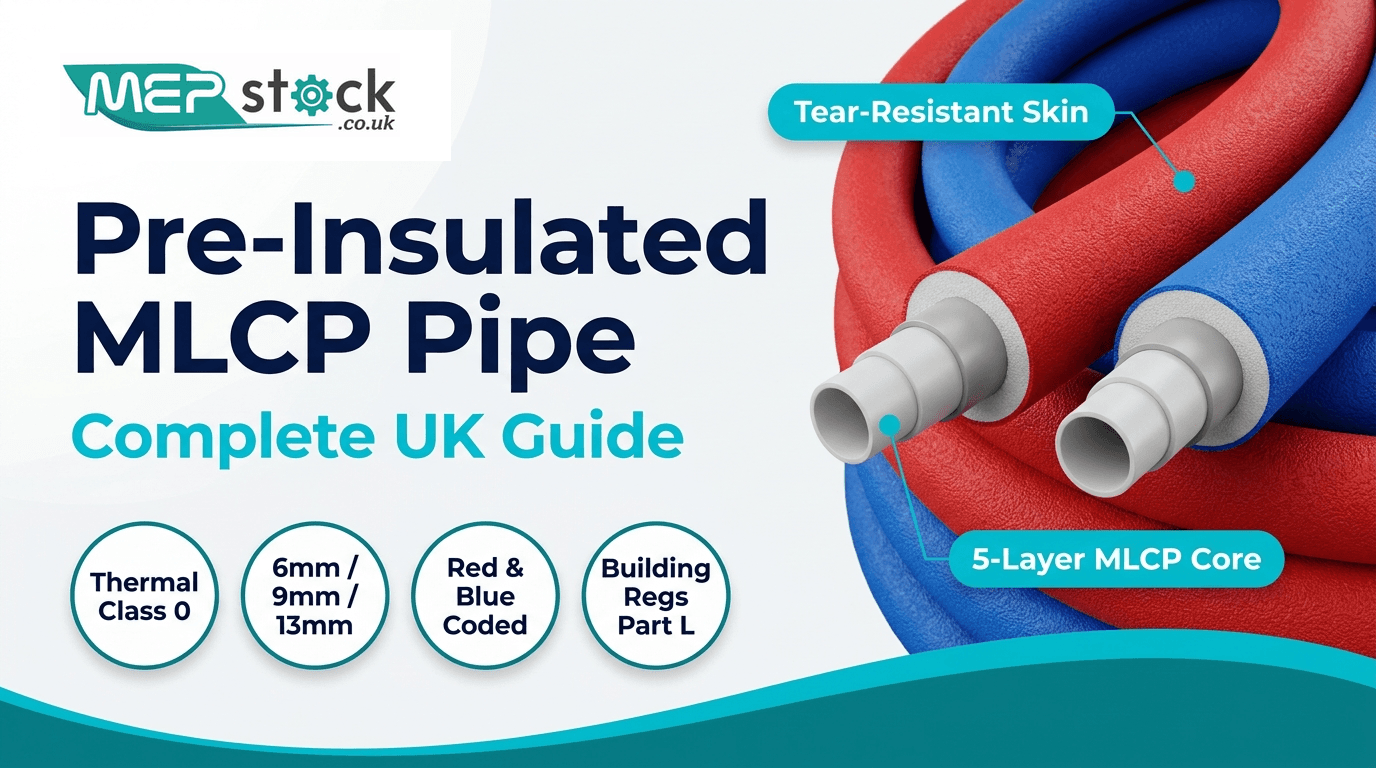
Quick Installer Summary: Why & Where to Use Pre-Insulated MLCP
Pre-insulated multi-layer composite pipe (MLCP) is factory-lagged with closed-cell expanded polyethylene foam, saving installers hours of manual lagging on site. Here is the essential specification guide:
- Red Protective Sheath: Used for central heating primary flow lines, secondary domestic hot water (DHW) circulation, and distribution feeds running from boiler/heat pump plant rooms to Underfloor Heating Manifolds.
- Blue Protective Sheath: Used for potable cold mains water, chilled distribution, and central heating return lines to prevent condensation ("sweating") and thermal gain.
- UK Building Regs Part L Compliance: Factory-extruded closed-cell foam insulation (thermal conductivity λ = 0.035–0.040 W/m·K) prevents parasitic heat loss through concrete subfloors, ceiling voids, and unheated riser ducts.
What Is Pre-Insulated MLCP Pipe?
Pre-insulated Multi-Layer Composite Pipe (MLCP) consists of a standard 5-layer composite pipe (polymer inner core, adhesive tie layer, butt-welded aluminium oxygen barrier, outer tie layer, and polymer skin) that is factory-encased in a high-density, closed-cell extruded polyethylene foam insulation sleeve.
The outer insulation jacket is protected by a tough, ribbed, or smooth LDPE (low-density polyethylene) outer skin coloured in standard signal red or signal blue. This outer skin serves as a vapour barrier, UV shield, and abrasion guard against rough site handling during screed pours and first-fix routing.
Red vs Blue Colour Coding: Industry Standards Explained
On modern UK building sites and plant room fit-outs, pipe identification must be clear, intuitive, and compliant with BS 1710 (Identification of Pipelines and Services). Pre-insulated coils eliminate confusion during multi-trade construction:
🔴 Red Insulated MLCP Applications
- Primary flow runs from heat source to manifold
- Domestic hot water (DHW) distribution lines
- Secondary hot water circulation loops
- Radiator branch feeds embedded in screed
- Prevents heat dissipation into unheated building zones
🔵 Blue Insulated MLCP Applications
- Cold potable mains water supply runs
- Central heating return circuits back to heat source
- Chilled water distribution lines for fan coils
- Prevents Legionella risk by stopping cold water warming
- 100% vapour barrier eliminates condensation dripping
Why Pre-Insulated Pipe Is Crucial for Building Regulations Part L
Under the updated Building Regulations Approved Document Part L (Conservation of Fuel and Power), uninsulated or poorly lagged primary pipework running through unheated floor spaces, ceiling cavities, and stud walls is no longer acceptable.
When hot distribution pipes pass through an unheated screed or structural subfloor before reaching the room they are intended to heat, uninsulated pipes act as uncontrolled radiators. This leads to:
- Parasitic Heat Loss: Up to 15%–20% of thermal energy generated by your boiler or heat pump is dissipated into hallways and subfloor concrete before reaching living spaces.
- Unbalanced Zone Temperatures: Hallways and corridors experience severe overheating because uninsulated manifold tails run beneath them.
- Condensation & Moisture Damage: Cold mains pipes passing through warm ceiling voids create heavy condensation droplets ("pipe sweat") that rot plasterboard and foster mould growth.
Installing Pre-Insulated MLCP Pipe Coils provides continuous, factory-bonded insulation with an optimal thermal conductivity of 0.035 W/m·K, ensuring full compliance with Part L energy efficiency benchmarks.
Technical Comparison: Pre-Insulated vs Standard MLCP vs Retrofit Lagging
| Feature | Pre-Insulated MLCP | Bare MLCP (Post-Lagged) | Traditional Copper (Lagged) |
|---|---|---|---|
| Site Labour & Install Time | Fastest (Single operation) | Double handling (Install + Lag) | Slowest (Solder/Press + Lag) |
| Vapour Barrier Integrity | Continuous, seamless outer LDPE film | Seams prone to gaps and moisture ingress | Prone to gaps at elbows and tees |
| Acoustic Dampening | High (Absorbs water hammer & flow noise) | Medium | Low (Metallic sound transmission) |
| Screed & Concrete Protection | 100% shielded against chemical screed attack | Requires conduit sleeve | Requires Denso tape or conduit |
| Thermal Expansion Absorption | Foam absorbs linear movement in screed | Direct screed friction | Rigid stress on fittings |
Installation Guide: How to Cut, Strip & Joint Pre-Insulated MLCP
1. Clean Cutting & Sleeve Pushback
To make a joint, use dedicated pipe shears to cut through the outer insulation and internal MLCP cleanly. Gently slit the outer coloured insulation jacket back by approximately 40mm to 50mm from the pipe end. Pull the foam sleeve backwards along the pipe—never rip or hack the insulation with a utility knife, as scoring the outer polymer of the MLCP weakens the burst pressure.
2. Calibrating & Reaming
Insert a calibrated deburring and chamfering reamer into the exposed pipe end and rotate 360 degrees. This creates a clean internal bevel and restores circularity, ensuring the fitting’s EPDM O-rings slide in without shearing.
3. Press Jointing & Seal Closure
Insert the approved MLCP press fitting or Euroconus adaptor. Crimp the stainless steel sleeve using a Manual M-Press Fitting Tool Kit or compatible press machine. Once pressed and visually inspected, slide the insulation foam sleeve back up against the fitting body and seal the joint tightly using colour-matched waterproof PVC tape.
Recommended Pre-Insulated Pipes, Manifolds & Tools
Pre-Insulated MLCP Coils (Red & Blue)
Factory-lagged 16mm, 20mm, and 25mm coils with thick closed-cell thermal foam. 100% oxygen barrier and Part L compliant.
Standard PERT-AL-PERT Coils
Bare 16mm 5-layer composite pipe for direct underfloor heating loop embedding into screeds and castellated panels.
Stainless Steel UFH Manifolds
2 to 12 port high-grade stainless manifolds with balancing flow meters, fill/drain valves, and manual air vents.
Manual M-Press Fitting Tool Kit
Heavy-duty mechanical crimper with extendable handles and interchangeable 15mm, 22mm, and 28mm press jaws.
Frequently Asked Questions
Can pre-insulated MLCP pipe be laid directly in concrete screed?
Yes. In fact, pre-insulated MLCP is the preferred product for running distribution pipes through concrete subfloors. The closed-cell foam provides dual protection: it thermally isolates the pipe from cold sub-base concrete and acts as an expansion cushion, allowing the pipe to expand and contract without cracking the surrounding screed.
What insulation thickness is required under UK Part L?
For standard internal domestic hot water and heating distribution runs embedded in screed or service voids, 6mm to 9mm of high-density closed-cell insulation with a thermal conductivity \(λ \le 0.035\text{ W/m·K}\) is standard. For external heat pump primary runs exposed to ambient outdoor air, minimum 13mm to 19mm insulation with high UV and moisture protection is recommended.
Can I use pre-insulated MLCP for heat pump primary connections?
Yes. Pre-insulated 20mm, 25mm, or 32mm MLCP is widely used for primary connections between the outdoor monobloc heat pump and the indoor cylinder/buffer tank, provided external runs are protected against weather and rodents.
Does pre-insulated MLCP require special fittings?
No. The core pipe inside the insulation is standard dimension MLCP (e.g. 16mm x 2.0mm, 20mm x 2.0mm). It uses all standard MLCP press fittings, compression fittings, and 3/4" Euroconus adaptors.
Order Pre-Insulated MLCP with Trade Next-Day Delivery
Save hours of site lagging labour. Buy Red & Blue Pre-Insulated MLCP coils in 50m and 100m lengths at competitive ex-VAT trade prices.
Shop Pre-Insulated MLCP Coils →