

Quick Trade Summary: UK Gas Press Fit Regulations & Standards
Installing copper press-fit systems for Natural Gas and LPG (Liquid Petroleum Gas) in the UK is governed by strict statutory safety regulations and British Standards:
- Legal Competence: All gas installation and alteration work must be carried out by a certified Gas Safe registered engineer holding the relevant domestic (CCN1) or commercial (COCN1) core competencies in compliance with the Gas Safety (Installation and Use) Regulations 1998 (GSIUR).
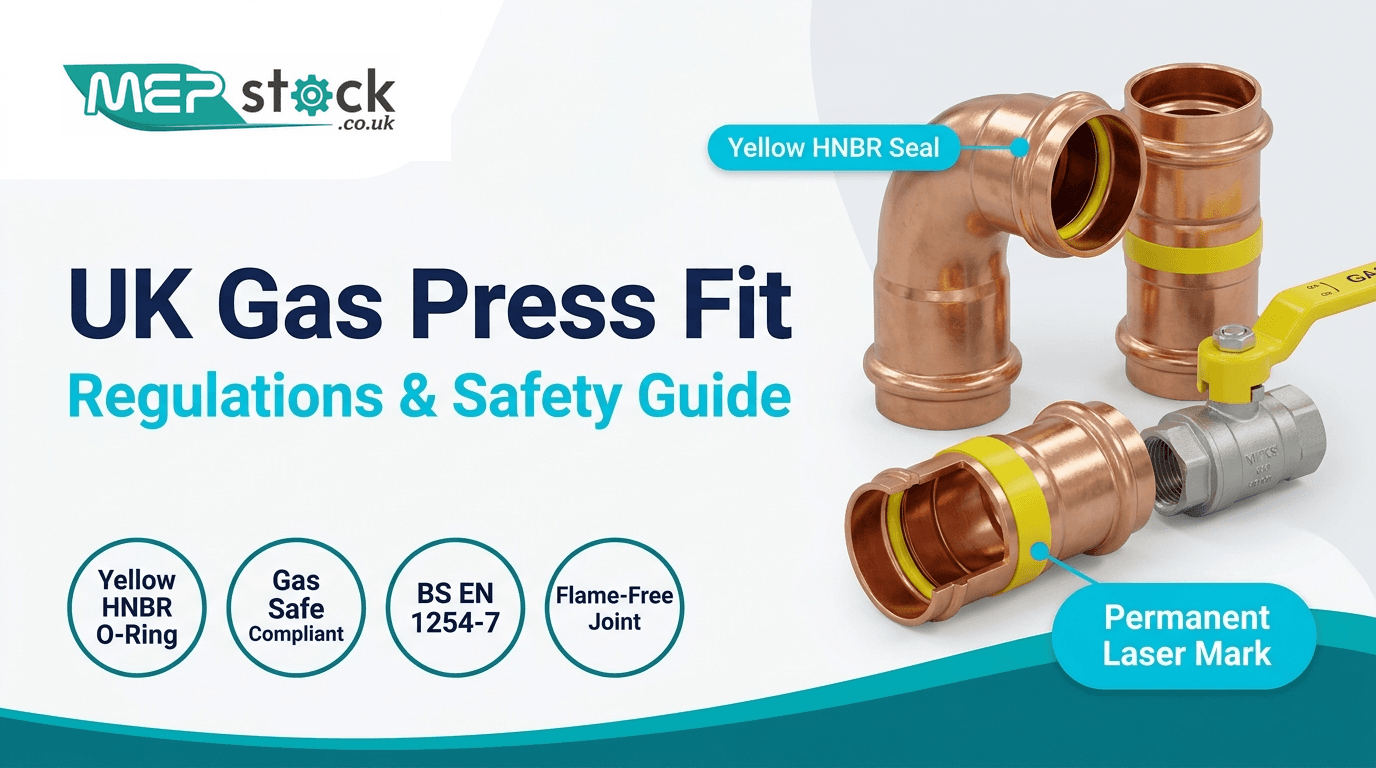
- Mandatory Yellow HNBR Seals: Only press fittings fitted with factory-installed Yellow HNBR (Hydrogenated Nitrile Butadiene Rubber) O-rings are permitted on gas. Black EPDM seals are strictly prohibited for gas services as aromatic hydrocarbons degrade EPDM, causing seal embrittlement and catastrophic leakage.
- Mandatory British Standards: Fittings must comply with BS EN 1254-7 (Press fittings for metallic pipes) and carry independent third-party certification (e.g. BSI Kitemark or DVGW Gas). Pipework design and installation must follow BS 6891:2015+A1:2019 (Installation of low-pressure gas pipework up to 35mm/28mm) and IGEM/UP/2 for larger installations.
- Permanent Visual Marking: Every gas press fitting features a permanent yellow external paint band or yellow dot and is stamped with "GAS" and the maximum operating pressure (typically PN5 / 5 bar or 1 bar for domestic installations).
The Polymer Chemistry: Why Yellow HNBR Is Mandatory for Gas
The most critical safety element in a gas press fitting is the internal elastomeric sealing element. While water and heating press fittings utilise standard Black EPDM (Ethylene Propylene Diene Monomer), gas press fittings exclusively utilise Yellow HNBR (Hydrogenated Nitrile Butadiene Rubber).
| Property / Attribute | Yellow HNBR (Gas Approved) | Black EPDM (Water / Heating Only) |
|---|---|---|
| Permitted Fluids | Natural Gas, LPG (Propane & Butane), Compressed Methane, Fuel Oils. | Potable Drinking Water, Wet Central Heating, Chilled Water, Glycol Solutions (up to 50%). |
| Resistance to Hydrocarbons | Impervious & Chemically Stable. Does not swell, harden, or leech. | Severe degradation. Hydrocarbons dissolve polymer bonds, leading to shrinkage and failure. |
| Operating Temperature Range | -20°C to +70°C (Specialised HTB rating up to 650°C for 30 mins under fire test). | -10°C to +110°C (Short peak to 120°C). |
| High Thermal Durability (HTB) | Complies with DIN 3376-2 / BS EN 1775 Class GT (650°C for 30 minutes at 1 bar). | Non-compliant with high-temperature fire tests for gas. |
UK Statutory Standards: BS 6891, BS EN 1254-7 & GSIUR 1998
Gas installations in Great Britain are subject to statutory law under the Health and Safety at Work etc. Act 1974 and the Gas Safety (Installation and Use) Regulations 1998. To ensure compliance, every installer must adhere to the following hierarchy of standards:
- BS EN 1254-7: Specifies constructional requirements, mechanical pull-out strength, and pressure limits for metallic press fittings used with copper tube.
- BS 6891:2015+A1:2019: Code of practice for the installation and maintenance of low-pressure gas installation pipework of up to 35mm ($R1 rac{1}{4}$) on premises. Allows press-fit copper joints in domestic and small commercial properties.
- IGEM/UP/2 (Edition 3): Guidance for gas installation pipework in commercial and industrial premises covering operating pressures up to 5 bar.
- BS EN 1057: Seamless, round copper tubes for water and gas in sanitary and heating applications. Half-hard (R250) or hard (R290) temper copper tube must be used; annealed soft coil (R220) requires internal brass calibration support sleeves before pressing.
Permitted vs Prohibited Installation Locations for Gas Press Fittings
Because copper press fittings form permanent, tamper-resistant mechanical joints, their installation permissions differ from threaded or compression fittings:
Permitted Locations
- Exposed surface-mounted pipework in habitable rooms, utility cupboards, and boiler rooms.
- Concealed within timber stud partitions and floor joist ceiling voids (provided adequate ventilation is maintained to BS 6891).
- Direct connection to boiler isolation valves and meter outlet emergency control valves (ECVs).
- Commercial kitchen gas drop pipes and high-level distribution manifolds.
Prohibited / Special Restriction Locations
- Directly buried in solid concrete floors: Must be continuously sleeved in factory-coated plastic or non-metallic ducting to prevent external galvanic corrosion. Joints in screed are discouraged.
- Unventilated cavity walls: Gas pipework must never be run within the cavity of an external wall.
- Lift shafts & fire-escape corridors: Prohibited unless enclosed within 2-hour fire-rated non-combustible ducts to Building Regulations Approved Document B.
Gas Tightness Testing Protocol (BS 6891 / IGEM/UP/1B)
Before commissioning any newly installed or modified gas press installation, the Gas Safe engineer must perform a formal tightness test using an electronic manometer:
- Let-By Test: Connect the digital manometer to the test point. Raise pressure to 7–10 mbar. Close the isolation valve and monitor for 1 minute to ensure no gas let-by through the ECV.
- Stabilisation Period: Increase system pressure to nominal operating test pressure (20–21 mbar for Natural Gas). Allow a minimum of 1 minute for temperature stabilisation.
- Tightness Test: Monitor the electronic gauge for a continuous 2-minute duration. For newly installed pipework (with no appliances connected), the test requires 0.00 mbar permissible pressure drop.
- Leak Detection Fluid (LDF): If pressure falls, apply BS EN 14291 compliant foaming leak detection fluid across all pressed fittings. Never use standard washing-up liquid, as chloride ions induce stress corrosion cracking in copper.
Certified Gas Press Fittings & Yellow Lever Ball Valves
BS EN 1254-7 & BS EN 331 compliant, factory fitted with yellow HNBR O-rings for UK Gas Safe installations.
Yellow Gas Lever Ball Valves
BS EN 331 approved full-bore female BSP valves with yellow safety handle and high-temperature HNBR sealing seats.
M-Profile Press Fittings
Complete range of M-profile copper press couplings, elbows, tees, and female BSP adaptors in 15mm to 35mm.
Press Tooling & Jaws
19kN and 32kN calibrated pressing tools and interchangeable M-profile steel jaws for perfect 3-point mechanical crimps.
Frequently Asked Questions (Trade FAQs)
Can a water press fitting be converted for gas use by swapping the O-ring?
No. Swapping O-rings is strictly prohibited. Gas press fittings are manufactured with distinct factory tolerances, quality audits, and permanent external yellow identification markings. Modifying a fitting on-site invalidates its BS EN 1254-7 certification and violates GSIUR Regulation 5, which prohibits fitting unapproved equipment to gas systems.
Is hot works insurance required when using press-fit for gas installations?
No. Because press-fit technology forms a mechanical cold joint without naked flames, blowtorches, or soldering flux, standard public liability insurance is sufficient. This completely eliminates hot work permits, fire watch standby periods, and thermal burn risks in commercial buildings, hospitals, and timber-frame properties.
Can press-fit fittings be used on LPG (Propane and Butane) vapor pipework?
Yes. Yellow HNBR gas press fittings are certified for both Natural Gas (methane) and LPG vapour systems operating at domestic (37 mbar / 28 mbar) or commercial distribution pressures up to 5 bar in accordance with UKLPG Code of Practice 22.