

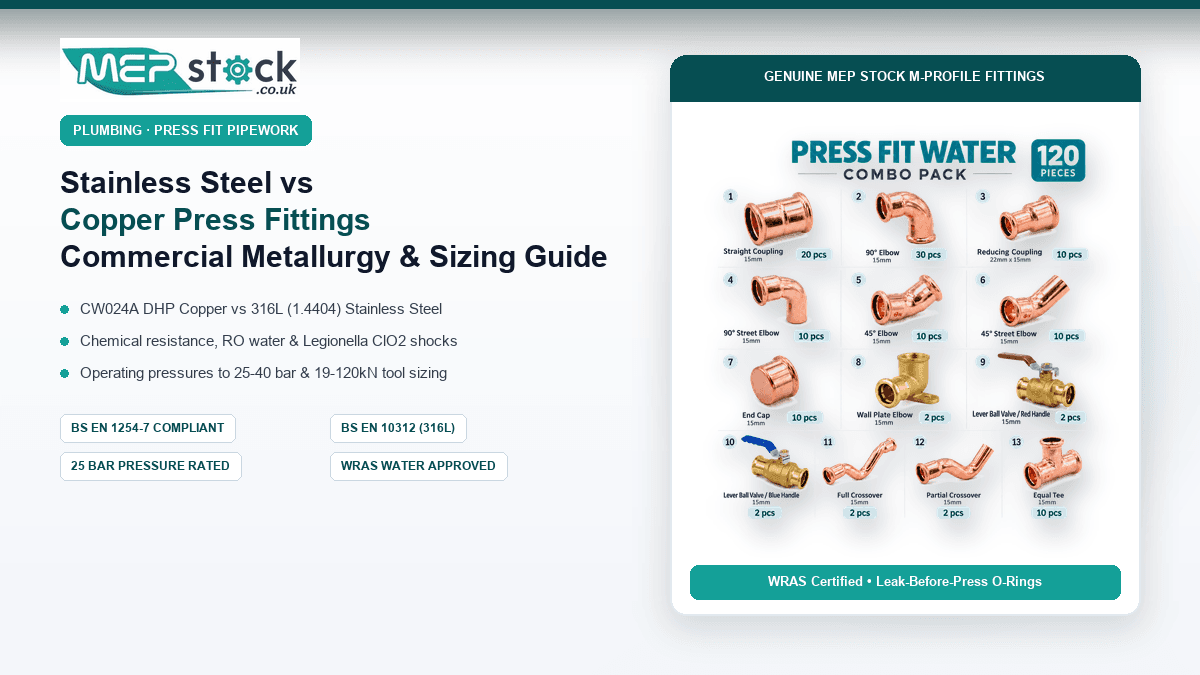
Quick Engineering Summary: Stainless Steel vs Copper Press Fittings
Selecting between stainless steel (AISI 316L / 1.4404) and copper (CW024A) press fittings depends on water chemistry, operating pressure, fluid aggression, and commercial project lifecycle specifications:
- Domestic & Light Commercial (Standard Potable Water & Heating): M-Profile Copper Press Fittings (BS EN 1254-7) remain the most cost-effective solution for standard domestic heating, chilled water, and general potable services up to 16 bar.
- Demineralised / RO Water & Aggressive Fluids: Install 316L Stainless Steel Press Fittings (BS EN 10312). Pure demineralised, deionised, or reverse osmosis water leaches copper ions from pure copper pipework, causing pinhole pitting corrosion within months. Stainless steel forms an impermeable chromium-oxide passive layer that remains completely inert.
- High Chlorine & Legionella Shock Dosing: In hospitals, care homes, and commercial hotels requiring periodic chlorine dioxide (>2.0 ppm) thermal or chemical flushing, 316L stainless steel provides superior resistance to stress-corrosion cracking and erosion compared to standard copper.
- Tooling & Press Jaw Compatibility: Both metals utilize standard M-profile jaws up to 35mm. However, commercial stainless installations from 42mm to 108mm require high-tonnage (32kN to 120kN) hydraulic tools such as the 18V Commercial Electric Hydraulic Press Tool Kit.
The Shift to Flameless Press Jointing in Commercial Pipework
Over the past fifteen years, flameless press-fit technology has largely replaced traditional brazing, silver soldering, and threaded pipe installations across UK commercial plantrooms, hospitals, schools, and high-rise developments. Eliminating hot works permits, fire-watch watches, and open acetylene bottles has delivered up to 70% labour time reductions while improving site safety.
However, as mechanical specifications expand into specialized commercial and industrial sectors—such as pharmaceutical laboratories, industrial manufacturing, data centre cooling, and district energy networks—specifiers and M&E contractors face a critical decision: When is copper press suitable, and when must 316L stainless steel press be specified?
Metallurgical Comparison: Copper (CW024A) vs 316L Stainless Steel (1.4404)
The mechanical and chemical performance of each press fitting system stems directly from its baseline metallurgy and crystal structure:
| Material Property | DHP Copper (CW024A / Cu-DHP) | 316L Stainless Steel (1.4404 / X2CrNiMo17-12-2) |
|---|---|---|
| Chemical Composition | ≥ 99.90% Cu, 0.015–0.040% Phosphorus | 16.5–18.5% Cr, 10.0–13.0% Ni, 2.0–2.5% Mo, ≤ 0.03% C |
| Relevant UK/EN Standard | BS EN 1254-7 / BS EN 1057 | BS EN 10312 / BS EN 10088 |
| Tensile Strength (Rm) | 220 – 290 N/mm² (Half-hard) | 500 – 700 N/mm² |
| Maximum Operating Pressure | 16 bar (PN16) | 25 to 40 bar (PN25 – PN40) |
| Thermal Expansion Coefficient | 0.0168 mm/m·K | 0.0165 mm/m·K |
| Corrosion Protection Mechanism | Natural copper-carbonate patina layer | Self-healing microscopic Chromium-Oxide film |
Chemical Resistance and Water Quality Compatibility
The internal water chemistry of a hydronic or potable system dictates whether copper or stainless steel must be specified. Operating outside material limits causes catastrophic premature failures:
Demineralised, Deionised, and Reverse Osmosis (RO) Water
In high-tech manufacturing, laboratories, battery gigafactories, and hospital autoclave feeds, water is stripped of all dissolved minerals and ions. This ultra-pure water is chemically aggressive and hungry for ions. When exposed to copper pipework, RO water aggressively leaches copper ions from the pipe walls, leading to rapid wall thinning and pinhole leaks within 6 to 18 months.
Specification Rule: Pure and demineralised water systems with conductivity < 20 μS/cm must always be plumbed with 316L stainless steel press systems fitted with EPDM or FKM elastomeric seals.
High Chlorination, Chlorine Dioxide, and Legionella Remediation
Under NHS HTM 04-01 guidelines and commercial building safety codes, potable water networks frequently undergo periodic chemical disinfection using chlorine or chlorine dioxide (ClO2). While standard copper handles normal municipal drinking water chlorination (≤ 0.5 mg/L), continuous chlorine dioxide dosing or shock chlorination exceeding 2.0 mg/L attacks the internal copper oxide protective film, creating accelerated pitting corrosion.
Grade 1.4404 (316L) stainless steel contains 2.0% to 2.5% Molybdenum, specifically alloyed to resist chloride pitting and crevice corrosion under high chemical sanitisation regimes.
Galvanic Corrosion and Mixed Metal Installation Rules
When combining copper press fittings and stainless steel components in the same hydraulic circuit, installers must adhere strictly to electrochemical series rules to prevent galvanic corrosion:
The Flow Direction Rule ("Nobility Principle"):
Stainless steel (+0.08V to +0.25V passive potential) is more noble than copper (+0.34V standard potential, but active under specific conditions). When mixed metals are connected in open or oxygenated water systems:
- Allowed: Flow from Stainless Steel → Copper. Stainless steel does not release ions that deposit onto copper.
- Caution: Flow from Copper → Galvanised Carbon Steel is strictly prohibited because copper ions deposit on steel, causing aggressive local pitting.
- Best Practice: When transitioning directly between stainless steel press pipe and copper press pipe, install a Dezincification Resistant (DZR) Brass Isolation Valve or dielectric union spacer to isolate the metals electrically.
Press Tooling and Jaw Profile Selection
Both copper and stainless steel press systems utilize radial mechanical deformation around an internal EPDM O-ring with a Leak-Before-Press safety geometry. However, tooling requirements differ by pipe diameter and wall thickness:
| Pipe Dimension | Jaw Profile Required | Minimum Press Force | Recommended Tooling |
|---|---|---|---|
| 15mm – 28mm | M-Profile (Copper & Stainless) | 19 kN | Manual M-Press Tool or Compact 19kN Cordless |
| 35mm – 54mm | M-Profile (Heavy-duty Jaws) | 32 kN | 18V Electric Hydraulic Press Tool (25-32kN) |
| 66.7mm – 108mm | M-Profile Press Collar + Adaptor Sling | 60 kN – 120 kN | Heavy Commercial Hydraulic Press Gun |
Source WRAS-Approved Press Fittings & Commercial Press Tools
Explore MEP Stock’s extensive inventory of BS EN 1254-7 copper press fittings, commercial ball valves, and professional cordless electro-hydraulic press tools backed by full manufacturer warranties.
Summary Decision Matrix: Copper vs Stainless Steel
| Application & Environment | Recommended Metal | Key Engineering Reason |
|---|---|---|
| Domestic Heating & Potable Water | Copper Press (CW024A) | Lowest material cost, rapid installation, WRAS approved for all municipal water supplies. |
| Demineralised / RO Water Feeds | 316L Stainless Steel | Copper ion leaching causes pinhole wall breaches; 316L chromium oxide layer is completely inert. |
| Hospital Thermal / ClO2 Disinfection | 316L Stainless Steel | Molybdenum content prevents chloride pitting corrosion under HTM 04-01 biocidal regimes. |
| High-Pressure Commercial Primaries (>16 bar) | 316L Stainless Steel | 500+ N/mm² tensile strength supports PN25 to PN40 pressure surges without mechanical expansion. |
Frequently Asked Questions
Can I use copper press jaws on stainless steel press fittings?
Yes, provided both the fitting and the jaw adhere to the standard M-Profile geometry (e.g. Geberit Mapress, Eurotubi, MEP Stock). However, the press tool itself must generate adequate hydraulic force (minimum 19kN for ≤28mm, and 32kN for 35mm–54mm) to deform the higher tensile strength stainless steel sleeve.
Why does reverse osmosis water destroy copper pipework?
Reverse osmosis (RO) water is stripped of all dissolved minerals and bicarbonate buffering ions, making it chemically acidic and aggressive. The pure water continuously dissolves copper ions from the inner pipe surface to reach chemical equilibrium, eroding the pipe wall until pinholes appear.
Are stainless steel press fittings WRAS approved for UK drinking water?
Yes. Grade 1.4404 (AISI 316L) stainless steel press fittings fitted with WRAS-approved black EPDM O-rings are fully certified for all UK potable domestic and commercial cold/hot water distribution under BS EN 10312.