

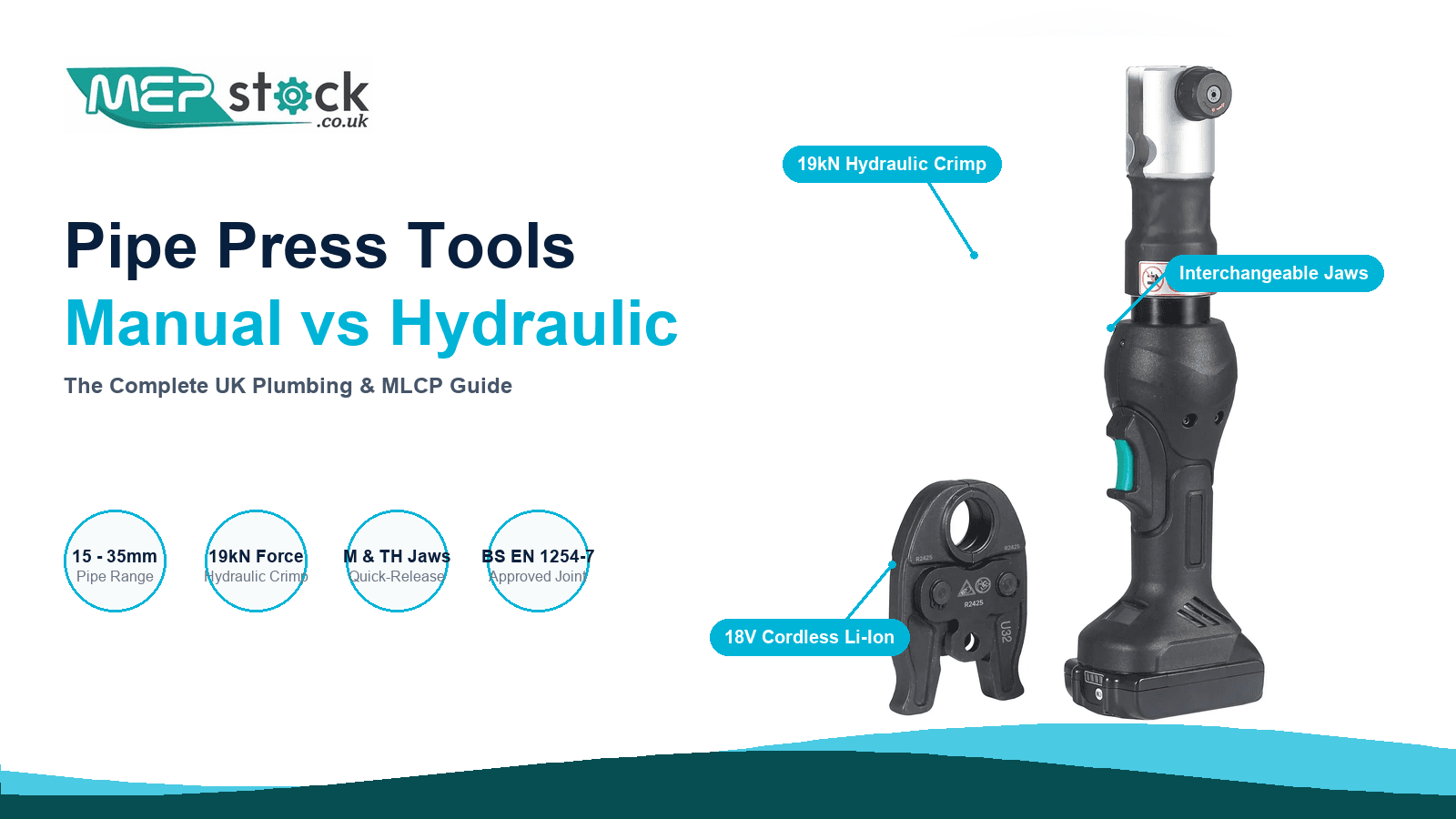
Quick Trade Summary: Best Pipe Pressing Tools for UK Installers
Pipe press tools replace traditional blowtorch soldering and manual compression jointing with calibrated, flame-free hydraulic crimping:
- Tool Categories: Compact Mini-Press Tools (19 kN Force) are engineered for domestic installers working on 12mm to 35mm metallic and up to 40mm MLCP pipework. Standard Commercial Press Tools (32 kN Force) handle heavy-duty 15mm to 108mm installations.
- Manual vs Battery-Hydraulic: Battery-powered hydraulic tools complete a certified joint in 3 to 5 seconds with automated force-limiting sensors, while manual mechanical press tongs require physical leverage and are restricted to 16mm–25mm MLCP or small copper repairs in tight niches.
- Mandatory Profile Compatibility: Always pair the press jaw profile identically with the fitting manufacturer: M-Profile for Geberit Mapress, Pegler XPress, and MEP Stock; V-Profile for Viega; TH-Profile for standard UK Multilayer (MLCP). Mixing profiles leads to unsealed joints and voided warranties.
- Annual Calibration: Electro-hydraulic tools must undergo certified service and calibration every 30,000 to 40,000 cycles (or 12 months) to guarantee joint integrity under BS EN 1254-7.
Jaw Profile Master Guide: M-Profile vs V-Profile vs TH-Profile
The most critical rule of press-fit installation is that jaw contours are not interchangeable. Pressing a fitting with an incompatible jaw profile results in uneven crimping, pinched O-rings, and delayed hydraulic blow-outs:
| Jaw Profile | Primary Pipe Material | Crimp Contour Geometry | Compatible Fitting Systems |
|---|---|---|---|
| M Profile | Copper, Carbon Steel, 316 Stainless Steel | Single circumferential ridge pressing simultaneously behind and across the O-ring bead. | MEP Stock Press, Geberit Mapress, Pegler Yorkshire XPress, Sanha, Eurotubi. |
| V Profile | Copper & Bronze | Double indent crimp formed symmetrically on either side of the raised O-ring bead. | Viega Profipress, Conex Bänninger >B< Press, IBP. |
| TH Profile | Multilayer Composite Pipe (MLCP / PERT-AL-PERT / PEX-AL-PEX) | Dual-groove circumferential ribbing compressing the stainless steel sleeve into pipe barbs. | MEP Stock MLCP, Emmeti, Giacomini, Maincor, Pipetec. |
| U Profile | Multilayer Composite Pipe (MLCP) | U-shaped compression collar clamping. | Uponor S-Press PLUS, Wavin Tigris. |
Manual Mechanical vs Battery-Hydraulic Press Tools
| Feature / Capability | 18V Battery-Hydraulic Mini Press (e.g. Novopress / Rothenberger) | Manual Mechanical Press Tongs |
|---|---|---|
| Cycle Time per Joint | 3 to 5 seconds (One-touch trigger). | 30 to 60 seconds (Manual multi-stroke ratchet). |
| Crimp Force Uniformity | Microprocessor-controlled 19 kN / 32 kN force monitoring. | Dependent on installer arm strength and mechanical ratchet. |
| Working Range | 12mm to 35mm (Mini) / Up to 108mm (Standard). | Restricted to 16mm–25mm MLCP / 15mm–22mm Copper. |
| Access in Tight Spaces | Compact inline chassis with 180°–360° rotating head. | Requires wide handle swing clearance (difficult in joists). |
Professional Press Tooling & M-Profile Fittings
High-precision M-profile and TH-profile jaws, calibrated press tools, and certified copper fittings in stock.
M-Profile Press Fittings
15mm to 35mm WRAS approved copper press couplings, elbows, tees, and female adaptors for water and gas.
MLCP TH-Profile Fittings
Precision brass press fittings with stainless steel sleeves for 16mm, 20mm, 26mm, and 32mm MLCP pipe.
Full-Bore Lever Ball Valves
Heavy-duty forged brass isolation valves with red and blue handles for plantroom and manifold headers.
Standard 5-Step Pressing Protocol for Certified Joint Integrity
- Square Cut: Cut copper or MLCP tube strictly square at 90° using a rotary pipe cutter. Never use a hacksaw, as angled cuts create uneven insertion depths.
- Internal & External Deburr: Thoroughly deburr both inside and outside of the pipe using a conical reamer. Sharp raw edges will slice through the rubber O-ring during insertion.
- Insertion Depth Marking: Mark the exact socket insertion depth on the tube with a permanent marker (e.g. 20mm for 15mm copper, 24mm for 22mm copper).
- Insert & Verify: Push the fitting onto the tube until it hits the internal stop. Verify the marker line aligns with the fitting socket edge.
- Perpendicular Crimp: Position the tool jaws perpendicular (90°) over the fitting bead. Depress the trigger until the hydraulic cycle completes and releases automatically.
Frequently Asked Questions (Trade FAQs)
Can an M-profile jaw be used on a V-profile fitting in an emergency?
No. Never mix M and V profiles. M-profile jaws crimp the fitting directly on and behind the bead, whereas V-profile jaws create indentations on both sides of the bead. Mismatching jaws results in insufficient mechanical crimp force and will cause the joint to blow off under hydraulic pressure testing.
How do I know when a battery press tool requires calibration?
Modern press tools feature an onboard cycle counter and LED status indicator. The service light will flash or glow red once 30,000 to 40,000 cycles are reached. In the UK, commercial contractors require calibration certificates renewed every 12 months to maintain site insurance and compliance.