

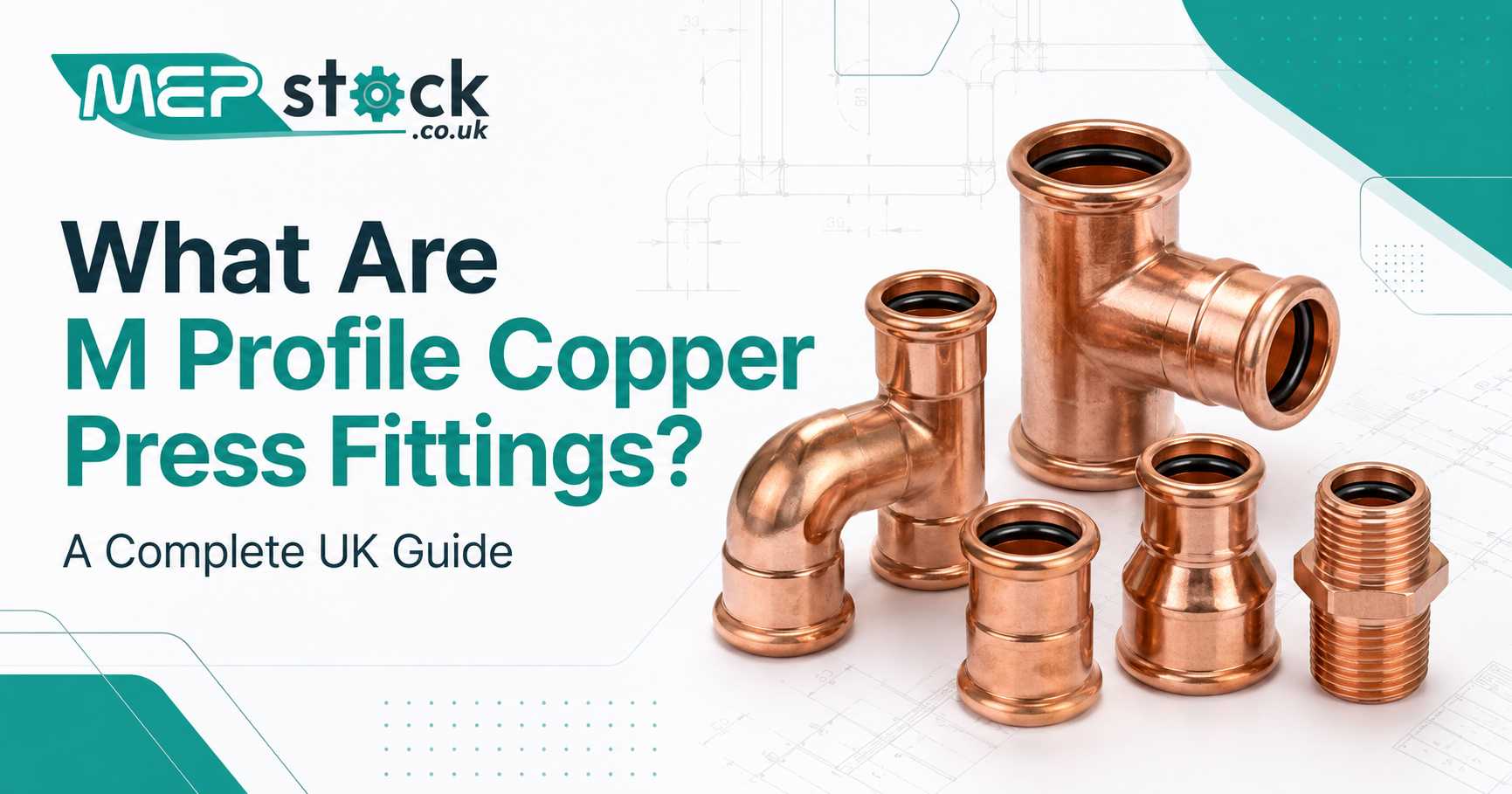
M Profile copper press fittings are metal pipe connectors used to join compatible copper tube without soldering. A correctly matched M Profile jaw or press ring compresses the fitting around the pipe and its sealing element, creating a permanent joint that must be installed and tested according to the fitting manufacturer’s instructions.
Press fittings are used in domestic, commercial and industrial pipework because they provide a flame-free method of joining pipe. Instead of heating the fitting and applying solder, the installer prepares the tube, inserts it into the fitting and completes the joint using a compatible pressing tool.
This guide focuses on M Profile copper press fittings for water and compatible heating applications. Gas press fittings are separate products and must not be substituted with water fittings.
What Does M Profile Mean?
M Profile describes the pressing contour that must be formed around a compatible press fitting. It identifies the shape and position in which an M Profile jaw or ring applies force to the fitting during the pressing cycle.
The profile is not the pipe size, fitting material or application approval. A 22mm M Profile jaw, for example, describes both the required pressing contour and nominal fitting size.
M Profile pressing jaws and rings are commonly designed for metallic systems such as copper, carbon steel and stainless steel. However, matching the letter M is only the first compatibility check. The installer must also confirm the pipe material, fitting system, jaw size, press-machine interface and manufacturer’s compatibility requirements.
The four compatibility checks
Before pressing a joint, confirm:
Profile: The fitting requires an M Profile press.
Size: The jaw or ring matches the fitting and tube size.
System: The pipe, fitting, seal and tool combination is approved by the relevant manufacturer.
Application: The complete system is suitable for the intended water, heating or other approved medium.
A tool that can physically close around a fitting is not automatically approved for that fitting system.
How Do Copper Press Fittings Work?
A copper press fitting works by combining a mechanical connection with a pre-installed sealing element. The copper tube is inserted to the specified depth, and a powered press tool permanently forms the fitting around the tube.
A typical press connection contains four functional parts:
During installation, the correctly sized jaw or ring closes around the fitting’s designated pressing area. The pressing cycle permanently changes the shape of the fitting and compresses the sealing element in the intended position.
The exact joint geometry varies between press-fitting systems. This is why installers must use the specified profile rather than choosing a jaw based only on appearance.
Are Press Fit and Push Fit the Same?
No. Press fit and push fit are different connection methods.
A push-fit connection is generally made by inserting a prepared pipe into a fitting containing an internal gripping and sealing mechanism. A press-fit connection requires a compatible powered tool and jaw or ring to mechanically form the fitting around the pipe.
The two terms should not be used interchangeably in product titles, descriptions or installation guidance.
For MEP Stock, all M Profile products in this range should consistently use:
Press Fit
Copper Press Fitting
M Profile Press Fitting
They should not be described as “push fit” unless the product genuinely uses a push-fit connection.
Why Are Copper Press Fittings Used for Water Pipework?
Flame-free jointing
A press connection is completed without applying an open flame to the joint. This can be particularly useful in refurbishment work, occupied buildings, plant rooms and locations where combustible materials are nearby.
Removing the flame from the jointing process does not remove every site risk, but it avoids the ignition source associated with soldering or brazing. HSE guidance identifies heat, sparks and flames from hot work as construction-site fire risks that must be controlled. (HSE)
Consistent installation process
Pressing follows a repeatable sequence:
Prepare the pipe.
Check the fitting.
Mark the insertion depth.
Insert the pipe fully.
Position the correct jaw.
Complete the press cycle.
Inspect and test the system.
The joint still depends on correct preparation and compatible equipment. Press fitting is not a substitute for competent installation.
No cooling period after pressing
A completed press connection does not need to cool in the way that a recently soldered joint does. The installer can continue with inspection and the required system-testing procedure once the joint and surrounding pipework are ready.
Wide choice of fitting configurations
M Profile copper press-fitting ranges can include couplings, elbows, tees, reducers, threaded adaptors, end caps, crossovers and valves. The current MEP Stock Press Fit Water category already groups several of these product families and their size variations. (Mepstock)
What Types of M Profile Copper Press Fittings Are Available?
The correct fitting depends on what the pipework needs to do.
Straight coupling or slip coupling?
A standard straight coupling is normally used to connect two prepared pipe ends in a new installation.
A slip coupling is useful where the installer needs more longitudinal movement, such as some pipe repairs. The exact internal design can differ, so the installer should confirm whether the selected coupling has an internal stop and follow its product instructions.
Standard elbow or street elbow?
A standard elbow normally has press sockets at both ends.
A street elbow normally has a press socket at one end and a plain male insertion end at the other. This can reduce the number of fittings needed in certain layouts because the plain end can connect directly into a compatible press socket.
Equal tee or reducing tee?
An equal tee uses the same nominal size for its three connections.
A reducing tee uses different sizes on the run, branch or both. The order in which the sizes are written must match the manufacturer’s dimensional diagram. Installers should not assume that every supplier records the branch measurement in the same position.
How Do You Choose the Correct M Profile Press Fitting?
Select the fitting by checking the complete system rather than choosing only by pipe diameter.
1. Confirm the intended application
Determine what the pipework will carry and how the system will operate.
Possible application questions include:
Is it a potable water installation?
Is it a sealed heating circuit?
Will the system contain treatment chemicals or antifreeze?
What are the maximum working pressure and temperature?
Is the installation domestic, commercial or industrial?
A fitting should only be used for applications listed in its verified technical documentation.
2. Confirm the pipe material and specification
Check that the fitting is approved for the exact copper tube being installed.
The tube must have the correct:
Outside diameter
Wall thickness or tube specification
Material condition
Surface quality
System approval
Do not install a press fitting onto damaged, badly scored, distorted or contaminated pipe.
3. Select the fitting function
Choose the geometry that performs the required task:
Coupling for joining
Reducer for changing size
Elbow for changing direction
Tee for creating a branch
Adaptor for changing connection type
Valve for isolation
End cap for termination
4. Select the exact size
The fitting size must match the outside diameter of the compatible tube.
For reducing products, check every connection. A reducing tee described with three dimensions cannot safely be selected by looking only at its largest size.
5. Check the press profile
Confirm that the fitting requires an M Profile jaw or ring.
Never press an M Profile fitting with a V, TH, U or other jaw unless the manufacturer explicitly approves that exact combination.
6. Check the sealing element
The suitability of a sealing element depends on the medium, temperature and system design.
Do not assume that all black, yellow or coloured seals have the same material or approval. Colour conventions and product markings vary between manufacturers.
7. Verify pressure, temperature and approvals
Review the exact product data for:
Maximum operating pressure
Minimum and maximum operating temperature
Potable water approval
Applicable certification
Permitted system additives
Installation restrictions
Manufacturer’s guarantee conditions
These details should be checked for the actual MEP Stock product range before they are repeated across category pages, product pages or articles.
How Are M Profile Copper Press Fittings Installed?
The following is a general overview, not a replacement for the fitting, pipe or tool manufacturer’s installation manual.
Step 1: Confirm compatibility
Verify the fitting, copper tube, press tool, jaw profile, jaw size and intended application before beginning the joint.
Step 2: Cut the copper tube
Cut the pipe square using a suitable pipe-cutting tool. An angled or distorted cut can affect insertion and sealing.
Step 3: Deburr the pipe
Remove internal and external burrs without damaging or excessively chamfering the tube.
Deburring is essential because a sharp pipe edge can damage or displace the fitting’s sealing element during insertion.
Step 4: Clean and inspect the tube
The insertion area should be clean, round and free from deep scratches, paint, adhesive, metal fragments and other contamination.
Step 5: Inspect the fitting
Check that:
The fitting is the correct size and type.
The sealing element is present.
The seal is correctly seated.
The socket is clean.
The fitting is not damaged or distorted.
Step 6: Mark the insertion depth
Measure or identify the required insertion depth and mark it on the pipe.
The mark gives the installer a visible reference showing whether the pipe remains fully inserted before and after pressing.
Step 7: Insert the tube
Push the tube into the fitting until it reaches the required insertion depth. Avoid forcing the pipe into the socket at a damaging angle.
Step 8: Position the correct jaw or ring
Place the correct M Profile jaw squarely around the designated pressing area.
Do not press over the wrong part of the fitting.
Step 9: Complete the pressing cycle
Activate the press tool and allow it to finish its full cycle. Do not interrupt the machine unless the tool manufacturer’s safety procedure requires it.
Step 10: Inspect and test
Check:
The insertion mark
The joint alignment
The completed press
The surrounding pipework
Any system-specific pressing indicator
The completed installation must then be tested using the procedure, pressure and duration specified for that system and application.
Official manufacturer instructions describe the same essential sequence: cut the tube, deburr and clean it, mark the insertion depth, insert it fully, position the pressing equipment and complete the press.
What Is the Difference Between M Profile and V Profile?
M Profile and V Profile are different pressing contours. They require jaws or rings shaped for their respective fitting designs.
Neither profile should automatically be described as better for every installation. The correct choice is the profile specified and approved for the selected pipe-and-fitting system.
A press machine may be capable of accepting different jaw types, but this does not make the jaws interchangeable. Manufacturers distinguish between M and V jaws, and fitting manufacturers warn that using an incorrect or supposedly universal contour can result in an improperly formed connection. (Eurotubi Pressfitting System)
Internal link: Add a link to the future “M Profile vs V Profile Press Fittings” guide when published.
Can Water Press Fittings Be Used for Gas?
No. A press fitting sold for water should not be installed on gas pipework unless it is specifically designed, tested, marked and approved for that gas application.
Gas press systems can use different sealing elements, identification markings, pressure limits and certifications. For example, manufacturer gas ranges commonly distinguish gas components using application-specific HNBR seals and clear gas identification.
In the UK, businesses legally carrying out gas work within the scope of the Gas Safety Regulations must be registered with the Gas Safe Register, and the engineer must be competent for that category of work.
MEP Stock should therefore maintain a clear separation between:
Press Fit Water
Press Fit Gas
Product images, seals, titles and descriptions must not create confusion between the two ranges.
Can M Profile Press Fittings Be Used for Hot and Cold Water?
They can be used for hot and cold water only when the exact fitting system is approved for those applications and operating conditions.
Many copper press systems are designed for drinking water and heating installations, but permissible temperatures, pressures, seals and tube specifications vary between systems. The product’s verified technical data takes priority over a general statement about press fittings. (Viega)
Before installation, verify:
Water suitability
Potable water approval where required
Maximum continuous temperature
Temporary peak temperature
Maximum operating pressure
Approved water-treatment chemicals
Pipe compatibility
Do not apply one product’s temperature or pressure rating to every fitting in the category without supporting documentation.
Are M Profile Copper Press Fittings Reusable?
A fitting that has been fully pressed should be treated as a permanent connection.
The pressing cycle mechanically changes the fitting’s shape, and manufacturers describe completed press connections as unable to be undone. A pressed fitting should not be removed and then installed again as a new fitting.
Where a pressed joint must be altered, the normal approach is to isolate the system, cut out the affected section and install new compatible components according to the system instructions.
An unpressed fitting should also be inspected carefully before reuse. If the fitting, socket or sealing element has been damaged, contaminated or displaced, it should not be installed.
What Are the Most Common Press-Fitting Installation Mistakes?
M Profile Copper Press-Fitting Buying Checklist
Before ordering, confirm all of the following:
The product is approved for the intended water or heating application.
The fitting material is compatible with the selected tube.
The fitting requires an M Profile press.
The fitting size matches the tube outside diameter.
Every connection size is correct on reducing fittings.
The seal is suitable for the system medium.
The pressure and temperature limits meet the design conditions.
The required approvals are supported by current documentation.
A compatible press tool and correct-size jaw or ring are available.
Enough installation space is available to position the pressing equipment.
The selected parent product has the correct size and pack variation.
The installation and testing instructions are available before work begins.
Explore M Profile Copper Press Fittings for Water
M Profile copper press fittings provide a practical, flame-free method of connecting compatible copper tube when the correct pipe, fitting, seal, jaw and press tool are used together.
The most important selection rule is simple: choose the fitting as part of a complete approved system, not as an isolated component.
Explore the MEP Stock Press Fit Water range to find:
Straight and slip couplings
Reducing couplings and fitting reducers
45-degree and 90-degree elbows
Street elbows
Equal and reducing tees
Male and female threaded adaptors
Crossovers
End caps
Press-fit valves
Frequently Asked Questions
What is an M Profile copper press fitting?
An M Profile copper press fitting is a connector designed to be mechanically formed around compatible copper tube using an M Profile pressing jaw or ring. The fitting normally contains a sealing element and creates a permanent connection without requiring the joint to be soldered.
Do I need an M Profile jaw for an M Profile fitting?
Yes. An M Profile fitting must be pressed using the correctly sized and approved M Profile jaw or ring. Using another contour can form the fitting incorrectly, even when the alternative jaw appears to fit around it.
Can any M Profile jaw be used with any M Profile fitting?
Not automatically. Matching the M contour and size is essential, but the installer must also confirm the press machine, jaw, fitting and pipe combination against the fitting or tooling manufacturer’s compatibility information.
Is press fit the same as push fit?
No. A press-fit joint requires a powered pressing tool to permanently form the fitting around the pipe. A push-fit connection is made through the fitting’s internal grip and sealing components when the pipe is inserted. The terms describe different jointing systems.
Can M Profile copper press fittings be used for drinking water?
Only when the selected fitting system is approved for potable water and installed with compatible tube, tools and seals. Check the exact product approval rather than assuming that every copper press fitting is suitable for drinking water.
Can a water press fitting be used for gas?
No. Use only a gas-specific fitting that carries the appropriate approval, marking and sealing element. Water and gas press fittings must remain clearly separated. Gas work in the UK must be carried out by an appropriately competent Gas Safe registered engineer where the regulations apply. (HSE)
Can a pressed fitting be removed and reused?
No. Pressing permanently changes the fitting. A completed press connection should be cut out and replaced with new compatible components when an alteration is required.
What is the difference between a press-fit elbow and a street elbow?
A standard press-fit elbow normally has press sockets at both ends. A street elbow normally combines one press socket with one plain insertion end, allowing the plain end to connect directly into another compatible press fitting.
Why must copper tube be deburred before pressing?
Deburring removes sharp internal and external edges created during cutting. A sharp edge can interfere with insertion or damage the fitting’s sealing element as the pipe enters the socket.