

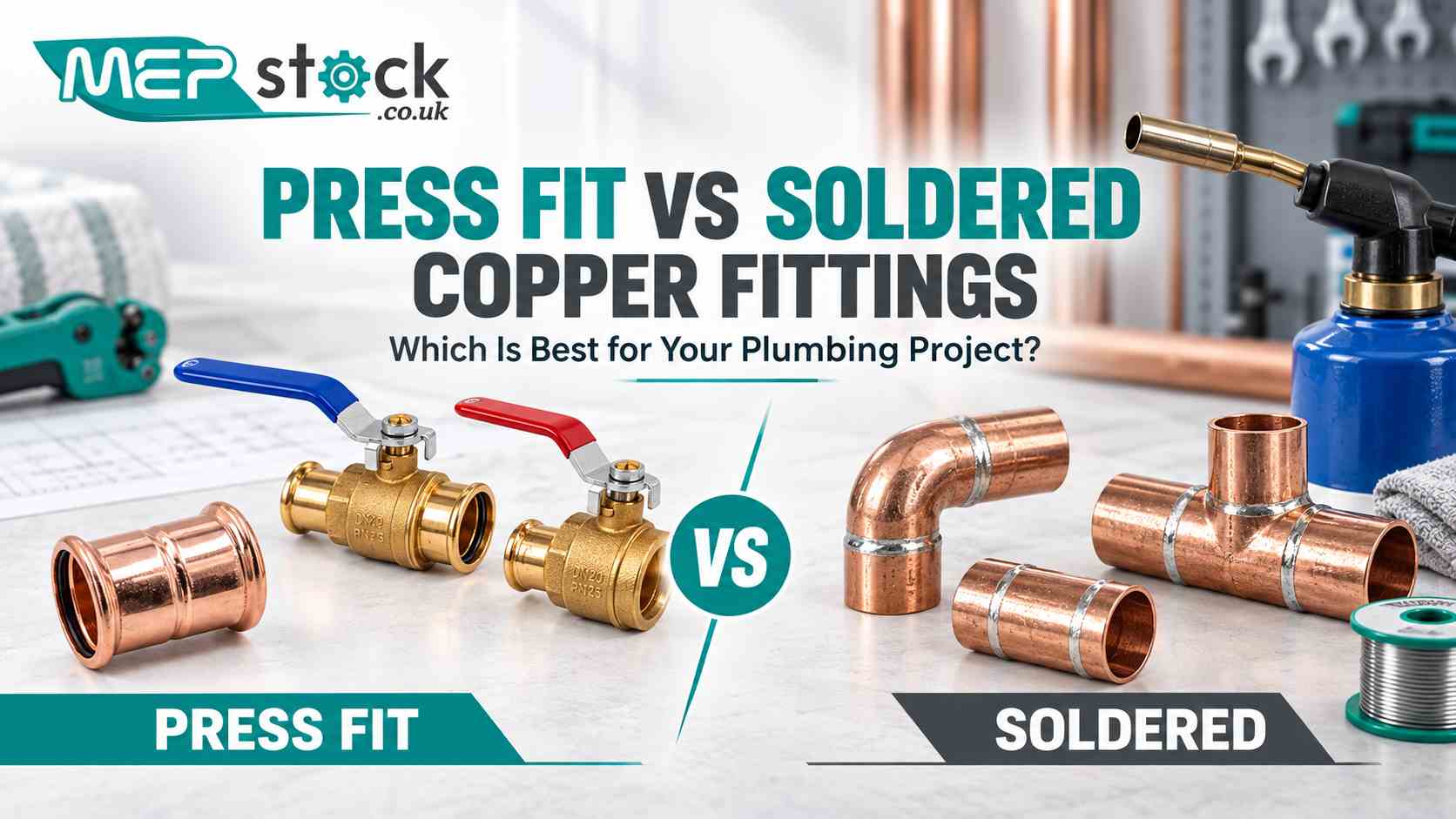
When joining copper tube, installers commonly choose between press fit and traditional soldered fittings. Both methods can produce reliable pipework when the correct components are selected and the installation is completed properly. However, the tools, preparation, working conditions and installation process are very different.
For plumbers, heating engineers, contractors and facilities teams, the best choice depends on the application—not simply which fitting costs less. Labour time, access, fire-safety requirements and system compatibility can all affect the final decision.
This guide compares press fit vs soldered copper fittings to help you choose the most suitable connection method for your next installation or maintenance job.
What Are Copper Press Fit Fittings?
Copper press fit fittings create a mechanical joint using a compatible pressing tool and correctly profiled jaw. The fitting is placed over a properly prepared copper tube, and the tool compresses the joint to the required form. A factory-fitted sealing element inside the fitting helps create the seal.
Unlike soldering, the press fit process does not require a flame. That makes it particularly useful on projects where hot works are restricted, difficult to manage or likely to interrupt other work.
MEP Stock supplies a broad selection of Copper M Profile Press Fit Water Fittings including straight couplings, elbows, tees, reducers, adaptors, end caps and valves.
Important: A press fitting must be compatible with the tube, jaw profile, pressing tool, seal and intended application. Always follow the fitting and tool manufacturers’ instructions.
What Are Soldered Copper Fittings?
Soldered copper fittings are joined by heating the fitting and tube so solder can flow into the prepared joint by capillary action. Depending on the fitting type, the installer may apply separate solder or use a solder-ring fitting with solder already incorporated into the fitting.
This traditional method is familiar to many experienced plumbers and can provide neat, durable copper pipework. It requires careful cleaning, flux application where applicable, controlled heating and a suitable cooling period. Because a blowtorch is normally involved, appropriate hot-work precautions must also be followed.
Press Fit vs Soldered Copper Fittings: Quick Comparison
| Factor | Press fit copper fittings | Soldered copper fittings |
|---|---|---|
| Installation method | Mechanical pressing | Heat and solder |
| Open flame required | No | Normally yes |
| Installation speed | Usually faster, especially across multiple joints | Usually slower because preparation, heating and cooling are required |
| Main equipment | Compatible press tool and correct jaw | Blowtorch, heat protection and soldering materials |
| Wet or difficult conditions | Can be more practical, subject to system instructions | Pipework generally needs to be sufficiently dry for successful soldering |
| Confined spaces | Useful where the tool and jaw can be positioned safely | Heat and flame can make access more challenging |
| Visual quality check | Jaw position, press completion and joint inspection | Solder flow and joint finish must be inspected |
| Installer skill | Correct preparation and pressing procedure are essential | Heat control and soldering technique are essential |
1. Installation Speed
Speed is one of the main reasons contractors choose copper press fit fittings. Once the tube has been measured, cut, deburred, marked and inserted correctly, the joint can be pressed in seconds.
Soldered joints require additional stages. The tube and fitting must be cleaned, flux may need to be applied, the assembly must be heated evenly, solder must flow correctly, and the joint needs time to cool before it is handled or tested.
On a small repair, the time difference may be modest. Across an installation containing dozens or hundreds of joints, however, press fitting can significantly reduce installation time and help keep work moving.
2. Flame-Free Installation and Site Safety
Press fit systems do not use an open flame during jointing. This can make planning easier in occupied buildings, refurbishment projects, roof spaces, plant rooms and areas close to combustible materials.
Traditional soldering involves hot work. The installer must assess the surrounding area, protect nearby surfaces and comply with the site’s fire-safety procedures. Some commercial sites may also require a hot-work permit and continued monitoring after the work has finished.
Press fitting does not remove the need for safe working practices, but it eliminates the flame used to form the joint. For many projects, that is a major practical advantage.
3. Tools and Initial Cost
A professional press tool represents a larger initial investment than a basic soldering kit. Installers also need the correct jaw profile and size for the selected fitting system. Tool calibration, maintenance and inspection must form part of the working process.
Soldering equipment generally costs less to purchase initially. However, the price of the fitting or tool should not be considered in isolation. Labour time, permits, fire protection, access restrictions and project delays can make the faster method more economical overall.
For regular installation work, it is better to compare the total installed cost per joint rather than only the individual fitting price.
4. Working in Tight or Difficult Areas
Both methods need adequate access. A press tool and jaw must fit around the joint and sit squarely in the correct position. Before starting, check that there is enough clearance to operate the tool safely.
Soldering may use smaller hand tools, but the flame and heat must be kept away from timber, insulation, cables, finished surfaces and other sensitive materials. In awkward spaces, the surrounding fire risk can be more important than the size of the tool.
Where a right-angle change of direction is required, a fitting such as a Copper M Profile Press Fit Water Male BSP Elbow can provide a practical transition when its size, connection and system compatibility suit the installation.
5. Reliability and Joint Quality
Neither method is automatically reliable if it is installed incorrectly. A strong joint begins with selecting compatible products and following the required preparation process.
Common press fit installation errors include:
Using the wrong jaw profile or jaw size
Failing to deburr the tube
Damaging or contaminating the sealing element
Not inserting the tube to the required depth
Positioning the jaw incorrectly
Forgetting to press a joint
Common soldering errors include:
Inadequate cleaning
Too much or too little heat
Poor solder penetration
Excessive or incorrect flux use
Moving the joint before it has set
Trying to solder pipework that is not sufficiently dry
Good preparation, clean components, correct tools and a consistent inspection routine matter more than rushing either method.
6. Repairs, Maintenance and Existing Systems
Press fittings can be highly useful during maintenance because the installation is quick and flame-free. They may also help where residual water makes a soldered repair difficult, provided the pipe and fitting system instructions permit the working conditions.
Soldered fittings remain a practical choice when extending or repairing existing soldered copper pipework, particularly where the installer has suitable access and hot work is permitted.
For a straight, same-size connection, consider a Copper M Profile Press Fit Water Straight Coupling. Where a threaded appliance or connection is involved, the Copper M Profile Press Fit Water Tap Connector is available in several size options.
Always identify the pipe size, fitting type, intended use and existing system before ordering replacement parts.
When Should You Choose Press Fit Copper Fittings?
Press fit can be the better option when:
Fast installation is a priority
Open flames are prohibited or undesirable
The project includes a large number of joints
Work is taking place in an occupied or sensitive building
A consistent, repeatable installation process is required
The contractor already has the compatible pressing equipment
Reducing downtime is important
Explore the complete Press Fit Water Fittings range to compare available couplings, elbows, tees, reducers, adaptors, caps and valves.
When Might Soldered Copper Fittings Be More Suitable?
Soldering may be suitable when:
The installer already has the necessary skills and equipment
Hot work is permitted and can be managed safely
Only a small number of joints are required
There is not enough clearance for the required pressing jaw
The existing installation or project specification calls for soldered joints
Lower initial tool cost is more important than installation speed
The project specification and the instructions supplied with the selected pipework system should always guide the final decision.
How to Install a Press Fit Joint Correctly
Exact instructions vary by system, but a typical professional process includes:
Confirm that the tube, fitting, seal, tool and jaw profile are compatible.
Cut the tube squarely using an appropriate tube cutter.
Deburr the inside and outside edges carefully.
Check that the tube end is clean, round and free from damage.
Inspect the fitting and sealing element before assembly.
Mark the required insertion depth on the tube.
Insert the tube fully without damaging or displacing the seal.
Position the correct jaw squarely on the fitting’s press contour.
Complete the full pressing cycle according to the tool instructions.
Inspect the joint and test the completed system as required.
Never mix components simply because they appear to fit. Compatibility must be confirmed before installation.
Frequently Asked Questions
Are press fit fittings better than soldered fittings?
Neither method is best for every project. Press fit is often preferred for speed and flame-free installation, while soldering remains useful where hot work is permitted and the installer has the required skills. The correct choice depends on access, project specification, system compatibility and total installation cost.
Do press fit copper fittings need solder?
No. A compatible pressing tool and jaw mechanically form the joint. The fitting’s sealing element helps create the seal, so soldering and an open flame are not required.
Can press fit fittings be used on heating systems?
Only use a fitting where its manufacturer confirms suitability for the intended medium, pressure and temperature. Check the individual product specification and the requirements of the complete system before installation.
What does M Profile mean on press fittings?
M Profile refers to the pressing contour used by the fitting system. The pressing jaw must match the required profile and fitting size. A jaw that is the wrong profile or size must not be used.
Can press fit and soldered fittings be used in the same system?
They may be used within the same wider copper installation when every component is suitable for the intended application and installed according to its instructions. Each individual joint must be completed using the correct method and compatible components.
How do I choose the correct press fitting size?
Check the outside diameter of the compatible copper tube and the configuration needed, such as straight coupling, elbow, tee, reducer or threaded adaptor. Never estimate the size from appearance alone.
Final Verdict: Press Fit or Solder?
For contractors who value speed, repeatability and flame-free installation, copper press fit fittings are an excellent modern option. They can reduce time on site and simplify work in locations where soldering would create additional safety controls.
Soldered copper fittings remain a proven solution when installed by a skilled professional under suitable conditions. They may be economical for smaller jobs or installations where the required soldering tools and procedures are already in place.
The best method is the one that meets the project specification, suits the site conditions and can be installed correctly with compatible materials and tools.
Browse MEP Stock’s Copper M Profile Press Fit Water Fittings to find professional couplings, elbows, tees, reducers, adaptors, end caps and valves for your next installation.